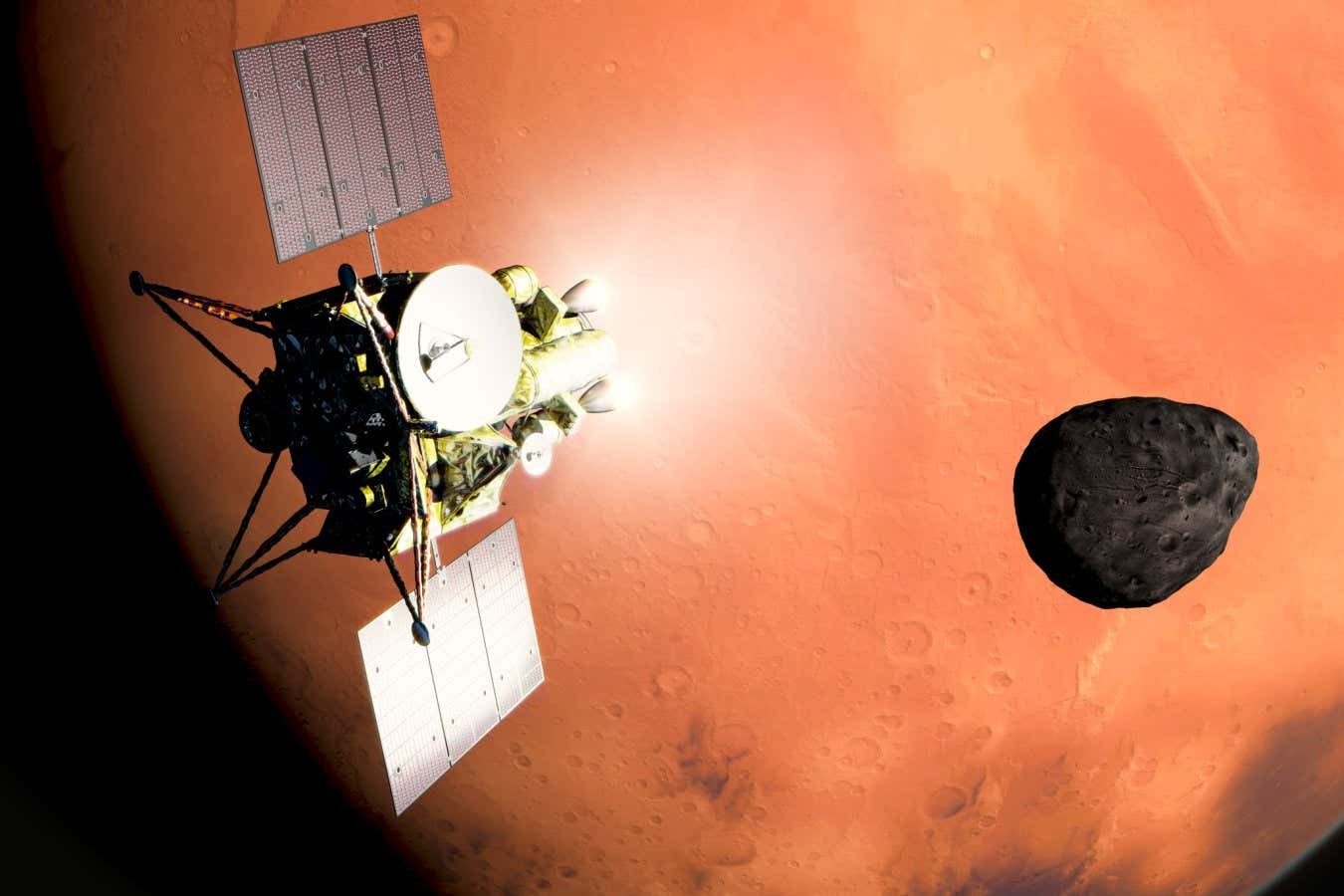
A spacecraft launching in 2026 will attempt to solve a long-standing mystery: how Mars acquired its two small moons, Phobos and Deimos. The mission, led by the Japan Aerospace Exploration Agency (MMX), will collect a sample from Phobos and return it to Earth, providing scientists with the first opportunity to analyze the moon’s composition directly.
The Two Leading Theories
Currently, there are two primary hypotheses about the origins of Phobos and Deimos. The first suggests that Mars captured them as asteroids, either as a pre-existing pair or from a single asteroid that split apart. The second posits that they formed from debris ejected after a massive impact on Mars, similar to how Earth’s moon is believed to have originated.
The key difference lies in the moons’ composition. Captured asteroids would likely have a carbon-rich, dry composition, while material from a Martian impact would show signs of past melting and could even contain remnants of ancient Martian rock.
How the Mission Will Work
The MMX spacecraft will reach the Martian moons in 2027. It will orbit both Phobos and Deimos, gathering data with cameras and spectrometers to assess their surface composition. Crucially, the mission includes a rover designed to land on Phobos and collect samples from both its surface and several centimeters below.
These samples are scheduled to return to Earth in 2031. Once in terrestrial labs, scientists will analyze them for traces of past melting, which would indicate an impact origin. If carbon-rich materials and evidence of water are found, the asteroid capture theory gains traction.
Why This Matters
Understanding the origins of Phobos and Deimos isn’t just about lunar history. Phobos orbits so close to Mars that it may contain fragments of the planet from a time when liquid water still flowed on its surface. This means the mission could offer a unique window into Mars’ past climate and geological evolution.
“There’s a potential there that Phobos could have pieces of ancient Mars from back when it had liquid water, so we’d be learning a lot about the history of Mars as well.” — Emelia Branagan-Harris, Natural History Museum in London.
The MMX mission represents a critical step in unraveling the mysteries of the Martian system and could reshape our understanding of planetary formation and evolution.
The mission is expected to provide definitive answers regarding the moons’ origins, helping scientists better reconstruct the history of Mars and its place in the solar system.