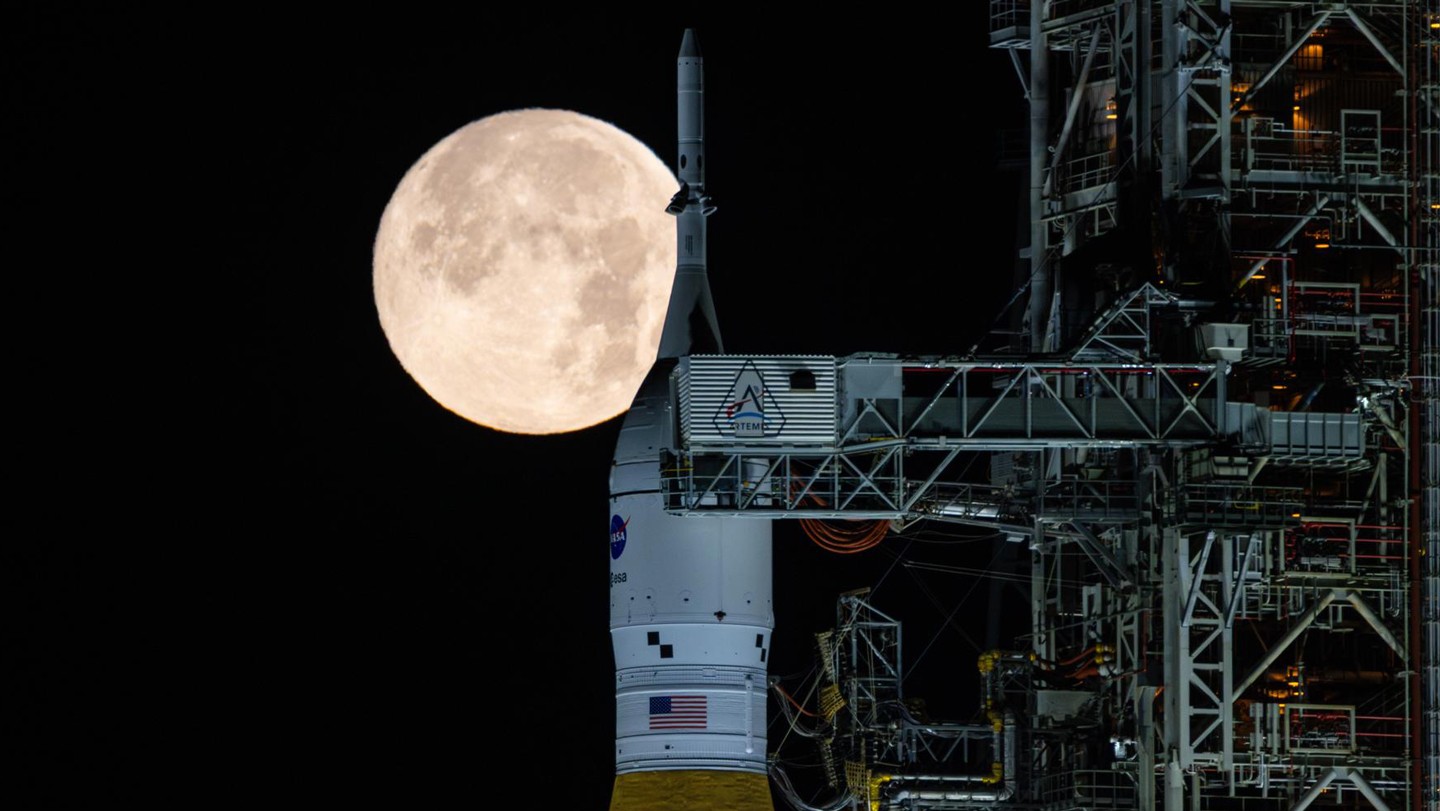
For the first time in over half a century, humans are preparing to venture near the Moon. The Artemis II mission, currently scheduled for launch no earlier than March 6, will send four astronauts on a circumlunar trajectory – a loop around our natural satellite – bringing them closer to the Moon than anyone has been since the Apollo 17 mission in 1972. This isn’t just a symbolic return; it marks a significant shift in how we approach space exploration, with science integrated from the ground up.
The Mission’s Evolution and Delay
Originally slated for a February launch, Artemis II faced a delay due to a propellant leak discovered during a critical “wet” dress rehearsal. This setback, while frustrating, underscores the meticulous engineering required for deep-space human missions. NASA opted to postpone the launch to allow for further testing and refinements, highlighting the program’s commitment to safety and reliability.
The Artemis II mission won’t involve a lunar landing; that milestone is reserved for future Artemis missions currently under development. Instead, this flight mirrors the Apollo 8 mission of 1968: a crucial technological demonstration designed to validate the life-support systems and overall performance needed for sustained human presence in deep space.
A New Approach to Space Science
While Apollo 8 prioritized reaching the Moon first amid Cold War competition, Artemis II is fundamentally different. As planetary scientist Marie Henderson emphasizes, “science and exploration go hand-in-hand; we can’t do one without the other.” The Artemis program isn’t just about getting back to the Moon; it’s about how we do it, with a core emphasis on scientific discovery.
This mission will be the first manned flight in NASA’s Orion spacecraft, which completed an uncrewed test flight around the Moon in 2022. The crew – Reid Wiseman, Victor Glover, Christina Koch, and Canadian astronaut Jeremy Hansen – will embark on a ten-day journey, traveling up to 400,000 kilometers from Earth, farther than any human has ventured before. The mission will test the systems needed for long-term lunar habitation, paving the way for eventual human missions to Mars.
The Astronauts as Scientific Instruments
Artemis II takes an innovative approach by utilizing the astronauts themselves as subjects of scientific study. They will wear devices to track movement, sleep patterns, and stress levels, while carrying radiation sensors to measure exposure to harmful particles outside Earth’s protective magnetic field.
Further, the crew will provide saliva samples to monitor immune system changes throughout the flight. Perhaps most strikingly, they will carry “organ-on-a-chip” devices containing their own cells, allowing researchers to study how spaceflight affects human biology at a molecular level.
Unprecedented Lunar Observation
The Artemis II mission also offers a unique opportunity for human observation of the lunar farside, an area less explored than the nearside. While robotic missions have provided images and samples, the human eye possesses an advantage in identifying subtle changes, such as meteorite impacts, and perceiving nuances in color and texture that cameras may miss.
Apollo astronauts briefly glimpsed the lunar farside during their approach to landing sites. However, Artemis II will provide prolonged views in full sunlight, offering scientists an unprecedented visual assessment of the Moon’s hidden hemisphere.
A More Prepared Crew
Unlike the Apollo 8 crew, largely composed of test pilots with limited scientific training, the Artemis II astronauts have undergone extensive preparation in geology, physics, and lunar observation techniques. Field expeditions to Earth-based lunar analogs, like Iceland and Arizona, along with simulations using virtual lunar maps, have equipped them to make scientifically valuable observations. This dedication to training underscores the program’s commitment to maximizing the scientific return of the mission.
The Artemis II mission is more than just a return to the Moon; it’s a blueprint for a new era of human space exploration, where science is not an afterthought but an integral component of every mission.
The Artemis program represents a fundamental shift in how we approach space exploration, prioritizing scientific discovery alongside engineering milestones. This mission, while a stepping stone to lunar colonization and Mars exploration, will reshape our understanding of the Moon and prepare us for the challenges of deep-space travel.