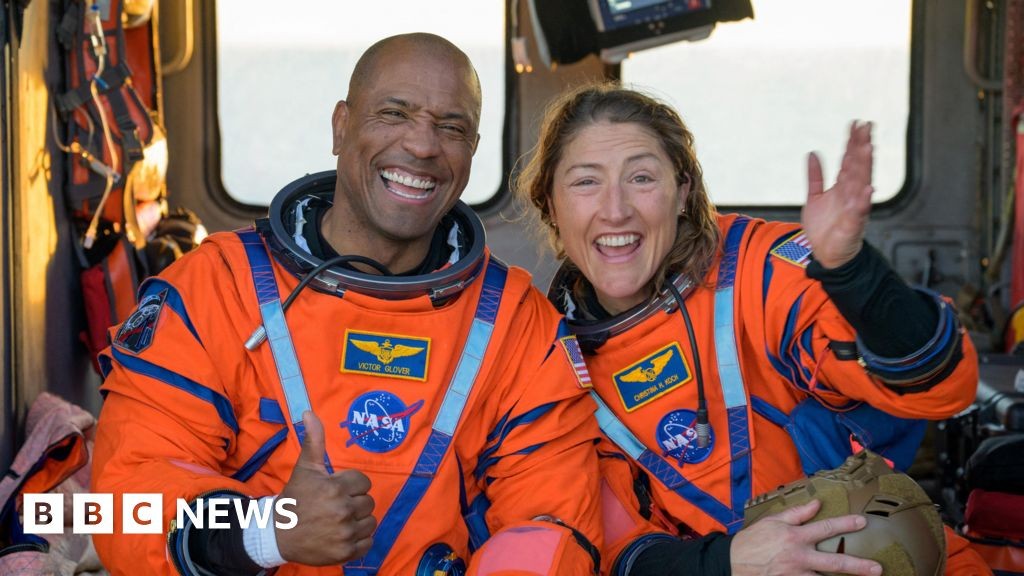
The crew of NASA’s Artemis II mission has successfully splashed down in the Pacific Ocean, marking the conclusion of a historic nine-day journey that took four humans further from Earth than any before them.
The mission, which saw the crew orbit the Moon, serves as a critical validation of the hardware and procedures required for future lunar landings.
A High-Stakes Re-entry
The most perilous phase of the mission occurred when the Orion spacecraft—christened Integrity by the crew—hit the Earth’s upper atmosphere at speeds exceeding 24,000 mph (38,600 km/h).
The descent presented two major technical challenges:
* Extreme Thermal Stress: The heatshield endured temperatures reaching nearly half as hot as the surface of the sun.
* Communication Blackout: Due to the intense heat generated during re-entry, mission control in Houston lost contact with the capsule for six minutes.
The tension broke when Commander Reid Wiseman successfully re-established contact, announcing: “Houston, Integrity here. We hear you loud and clear.” Following the blackout, the spacecraft’s parachutes deployed successfully, leading to what NASA commentators described as a “perfect bull’s eye splashdown” southeast of Hawaii.
Overcoming Technical Hurdles
This mission was a vital test for the Orion capsule’s heatshield. During the uncrewed Artemis I mission in 2022, engineers observed unexpected damage to the shield, raising concerns about its durability for crewed flights.
To mitigate this risk, NASA engineers developed a new re-entry trajectory designed to reduce the thermal load on the shield. Artemis II was the first live test of this revised approach. While full data analysis is still pending, the safe return of the crew suggests that the new flight path successfully managed the extreme temperatures.
“The team hit it; that is not luck, it is 1,000 people doing their jobs,” said NASA Associate Administrator Anit Kshatriya, emphasizing the precision required to hit a narrow atmospheric target after a 250,000-mile journey.
The Crew and the Path Ahead
The four astronauts—Reid Wiseman, Victor Glover, Christina Koch, and Jeremy Hansen —were recovered by helicopter and transported to the USS John P. Murtha. They are currently undergoing medical evaluations and are expected to be reunited with their families in Houston this Saturday.
The successful completion of Artemis II is a foundational milestone for NASA’s broader goals. While this mission did not involve a lunar landing, it has proven several essential components of the Artemis program:
1. Hardware Reliability: The Orion capsule and its service module functioned as intended.
2. Human Endurance: The crew demonstrated they can operate in deep space environments.
3. Navigation Precision: The complex trajectories for both lunar orbit and Earth re-entry were successfully executed.
Conclusion
The successful return of the Artemis II crew validates the essential systems needed for deep space exploration. By proving that the Orion spacecraft can safely navigate the heat of re-entry, NASA has cleared a major technical hurdle on its path toward landing humans on the lunar surface and establishing a permanent base on the Moon.