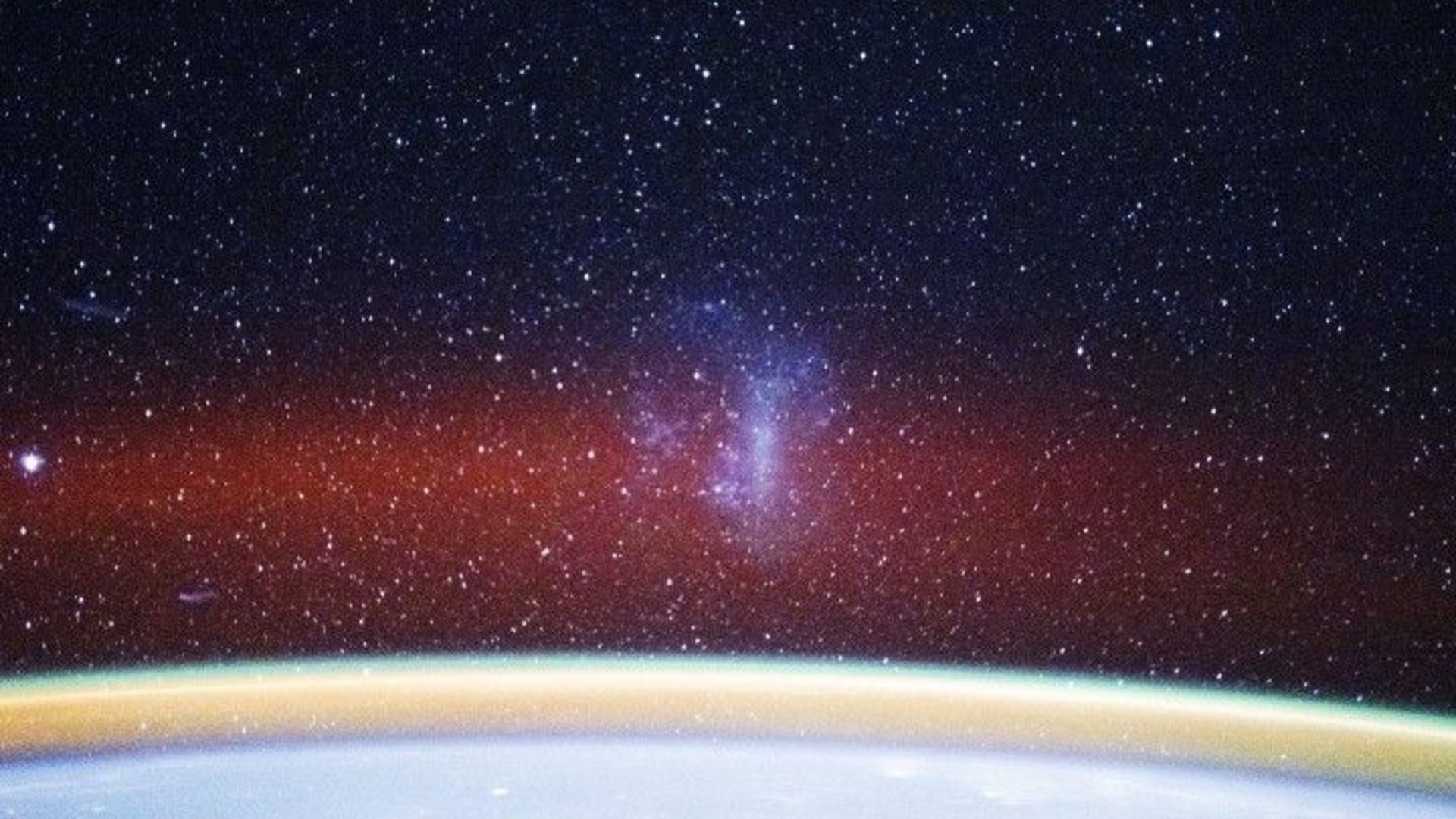
Astronauts aboard the International Space Station (ISS) recently documented a breathtaking cosmic scene: Earth’s atmospheric glow juxtaposed with the Large Magellanic Cloud, a nearby dwarf galaxy. The image, captured on November 28, 2025, using a Nikon Z9 camera, highlights the stark difference between viewing the night sky from Earth and from space.
Earth’s Airglow: A Veil Removed
From the ground, the atmosphere scatters and dims starlight, creating the familiar night sky. But from orbit, this veil disappears. The ISS crew observed a vibrant airglow along the Earth’s horizon – luminous layers of blue, yellow, green, and red. This natural phenomenon occurs when atoms and molecules in the upper atmosphere release energy after being excited by sunlight and chemical reactions. The effect is a subtle shimmer visible to astronauts, but not easily seen from below.
The Large Magellanic Cloud: A Galactic Neighbor
Dominating the center of the image is the Large Magellanic Cloud (LMC), a dwarf galaxy roughly 160,000 light-years away. For observers in the Southern Hemisphere, the LMC appears as a faint smudge. From space, it presents as a densely packed haze of stars, gas, and nebulae – so tightly clustered that individual lights blur into a bright cloud.
Why This Matters: A Cosmic Laboratory
The LMC isn’t just visually striking; it’s scientifically valuable. Its proximity and relatively clear visibility make it a prime location for studying star formation and galactic evolution. Astronomers use the LMC to test whether the processes observed in our Milky Way also occur under slightly different conditions in other galaxies.
“The LMC offers a natural laboratory for understanding how stars and interstellar dust evolve over time.”
The galaxy is famous for hosting Supernova 1987A, the closest observed supernova in centuries. This event provided scientists with an unprecedented opportunity to study the aftermath of a stellar explosion over decades, observing how the blast interacted with surrounding gas and dust, including a bright ring that continued to glow long after the initial flash. The supernova’s remnants also revealed the formation of new dust – crucial material for future stars and planets.
This image is a reminder that space-based observations offer unique insights into the universe, unfiltered by atmospheric distortions. The combination of Earth’s airglow and a distant galaxy in a single frame underscores the beauty and complexity of our cosmic environment.