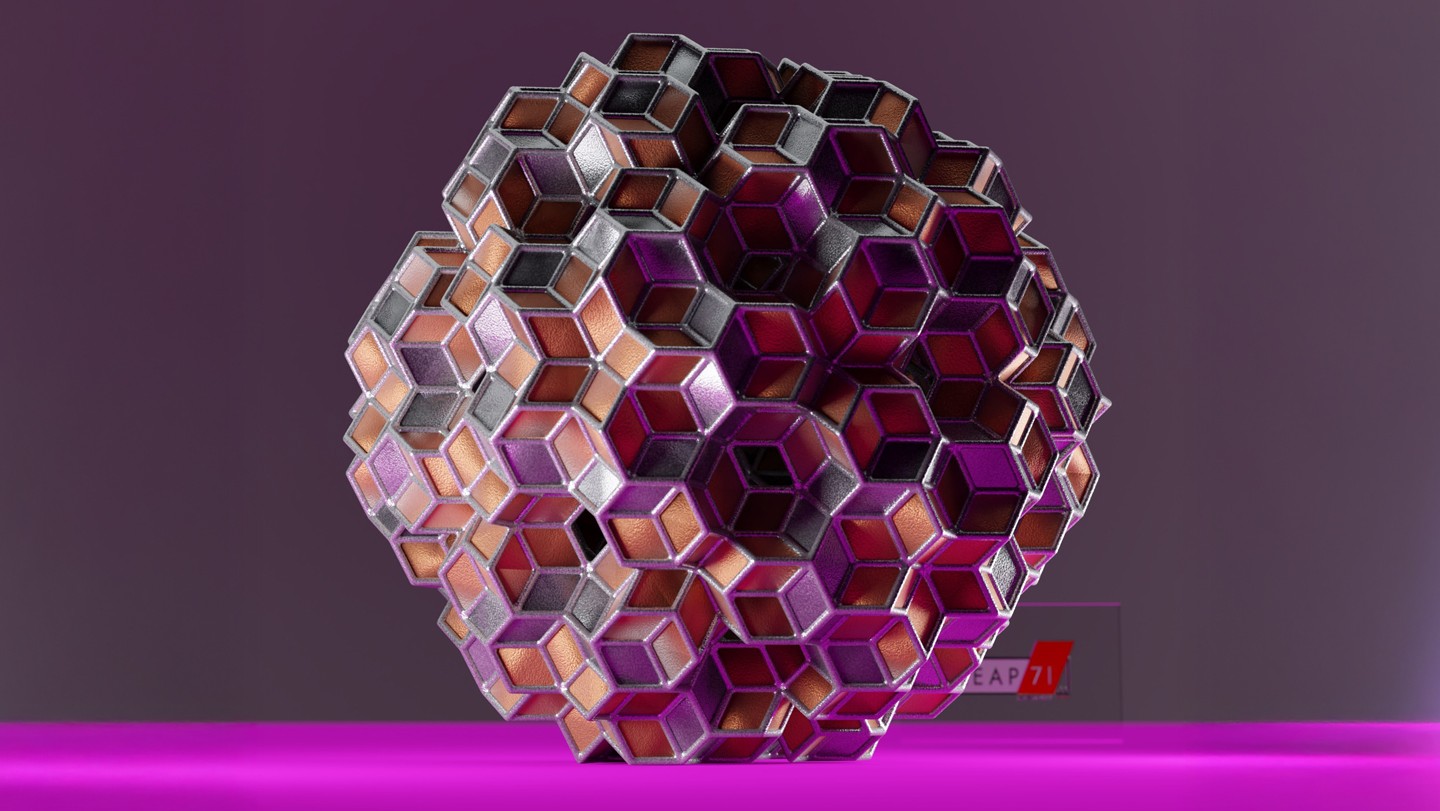
Researchers have theorized the existence of “spacetime quasicrystals”—structures blending space and time in a non-repeating, yet orderly pattern—suggesting these formations could underpin the very fabric of the universe. While previously observed in materials like meteorites and atomic test debris, this concept extends beyond three dimensions into the four-dimensional realm of spacetime as described by Einstein’s theory of relativity.
The Nature of Quasicrystals
Traditional crystals exhibit perfect repetition: a pattern that, when shifted, aligns seamlessly. Quasicrystals, however, possess order without this regular recurrence, a characteristic first discovered in natural materials and later synthesized in labs. The novel element here is extending this concept into spacetime itself.
Why this matters: The standard models of physics assume that spacetime follows certain symmetries, like Lorentz symmetry, which means that laws of physics shouldn’t change for observers at different speeds. Regular crystals and quasicrystals break this symmetry when viewed from different frames of reference, but spacetime quasicrystals could offer a structure that remains consistent regardless of motion.
Theoretical Foundation and Lorentz Symmetry
The researchers’ models satisfy Lorentz symmetry by constructing these structures from higher-dimensional grids. These grids are sliced at an irrational slope—a mathematical constant like pi that cannot be expressed as a simple fraction—ensuring the slice never directly intersects the grid points. This non-intersection creates the repeating non-pattern that defines a quasicrystal.
In essence: The geometry of these spacetime quasicrystals would appear identical to observers at rest or traveling near light speed. This is critical because many fundamental laws of physics rely on the consistency of observations across different reference frames.
Implications for Quantum Gravity and String Theory
The implications of these theoretical structures extend into other areas of theoretical physics. Researchers suggest spacetime quasicrystals could provide a framework for quantum gravity theories, which attempt to reconcile quantum mechanics with general relativity. On the smallest scales, spacetime may not be smooth but rather broken up into discrete points. Quasicrystals could explain how this fragmentation respects Lorentz symmetry.
Furthermore, the models intersect with string theory, which posits that the universe has ten dimensions, but only four are directly observable. The other six dimensions are thought to be curled up at scales too small to detect. These spacetime quasicrystals suggest an alternative: that the universe’s observed dimensions are constructed from a higher-dimensional structure sliced at an irrational angle, creating the illusion of infinite space and time.
Status and Future Research
The researchers themselves acknowledge the work as “half-baked,” indicating this is a preliminary exploration. However, the mathematical elegance of the concept has garnered interest from the physics community.
“It’s beautiful mathematics,” says Gregory Moore of Rutgers University. “The physics is very highly speculative.”
Further research will be needed to determine if these theoretical structures have real-world counterparts or measurable effects. Nevertheless, the proposition of spacetime quasicrystals offers a novel way to consider the fundamental nature of reality.