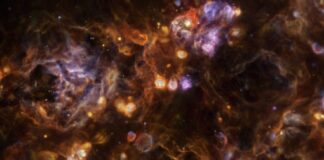
An astrophotographer has produced a breathtaking image of the Antennae Galaxies, two spiral galaxies locked in a slow-motion, multi-million-year collision. The photograph, taken by Greg Meyer, showcases the dramatic gravitational interplay between NGC 4038 and NGC 4039, which are being ripped apart and reshaped into a single, massive elliptical galaxy.
The Violent Dance of Galactic Mergers
The image reveals the core regions glowing with intense star formation, fueled by the collision. Sweeping tidal tails—elongated structures resembling antennae—stretch across vast distances, giving the galaxies their namesake. These arms are not just visually striking; they are the result of immense gravitational forces at play. The merger triggers bursts of star birth, forming super star clusters within the tidal tails. NASA estimates that most of these clusters will eventually dissipate, but some will survive as dense globular clusters.
Capturing the Light from Across the Universe
Meyer used a Sky-Watcher Esprit 120 telescope with an 840mm focal length to capture the image. The process involved nearly 21 hours of observation time at the Starfront Observatory in Texas, utilizing specialized astronomy filters. The resulting light data was then processed using Adobe Photoshop, Lightroom, and PixInsight astrophotography software.
Why this matters: Galactic mergers are fundamental to how galaxies evolve. These collisions don’t just destroy spiral structures; they reshape galactic populations, triggering new star formation and ultimately creating larger, more massive galaxies. The Antennae Galaxies are an excellent example of this process, offering astronomers a window into the future of our own Milky Way, which is destined to collide with the Andromeda Galaxy billions of years from now.
The resulting image stands as a testament to the power of both cosmic forces and modern astrophotography, showcasing the universe’s most spectacular phenomena in unprecedented detail.