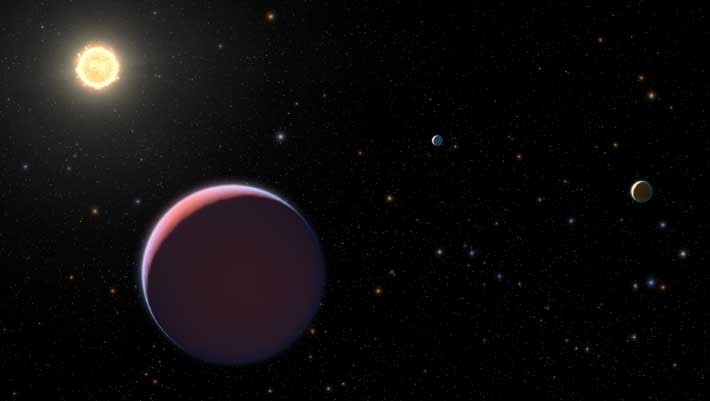
Astronomers are baffled by Kepler-51d, a gas giant orbiting a distant star that appears to have almost no core and an incredibly fluffy, hazy atmosphere. This exoplanet, located 2,615 light-years away in the Cygnus constellation, challenges existing models of how planets form.
The Puzzle of Super-Puff Planets
Kepler-51d is one of three ‘super-puff’ planets in its system, meaning it’s roughly the size of Saturn but with a density so low that scientists compare it to cotton candy. Unlike typical gas giants, which have dense cores that attract and hold onto atmospheric gases, Kepler-51d seems to lack a substantial core. This raises fundamental questions about its origins.
Why this matters: Gas giants usually form far from their stars, where cold temperatures allow for the accumulation of gas around a dense core. Kepler-51d orbits relatively close to its star, similar to Venus’s orbit around the Sun, where stellar winds should strip away its atmosphere. Yet, it remains remarkably inflated.
Thick Haze Obscures Answers
The James Webb Space Telescope (JWST) was used to analyze the planet’s atmosphere, but researchers found no clear chemical fingerprints. The atmosphere appears so thick with haze—possibly hydrocarbon-rich like Saturn’s moon Titan—that it absorbs most light, making it impossible to discern the underlying composition.
“We think the planet has such a thick haze layer that is absorbing the wavelengths of light we looked at, so we can’t actually see the features underneath,” explains Penn State Professor Suvrath Mahadevan.
The mystery deepens: The haze layer surrounding Kepler-51d is estimated to be almost as large as Earth itself, making it one of the most extensive hazes observed on any planet to date.
Possible Explanations and Future Research
Several theories attempt to explain this anomaly. One possibility is that Kepler-51d formed further out in the system and migrated inward. Another is that the star’s activity somehow stabilized the planet’s atmosphere despite the strong stellar winds.
Researchers hope to refine atmospheric models and search for alternative wavelengths of light that might penetrate the haze. The unique conditions of this system—three ultra-low-density planets orbiting a relatively active star—suggest that planet formation can be far more diverse than previously understood.
“What is it about this system that created these three really oddball planets, a combination of extremes that we haven’t seen anywhere else?” asks Dr. Jessica Libby-Roberts, an astronomer at the University of Tampa.
The data supporting these findings were published in the Astronomical Journal this week. Further study of Kepler-51d may offer crucial insights into the limits of planet formation and the prevalence of exotic worlds in the universe.