
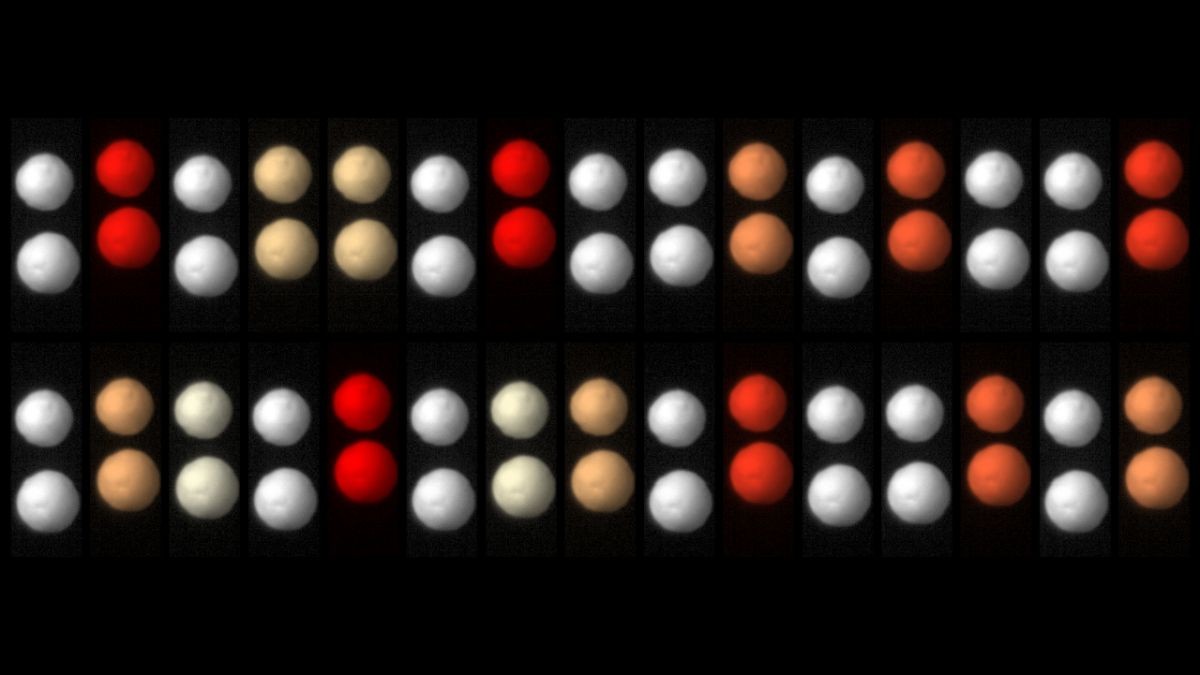
Scientists at New York University (NYU) have demonstrated a classical time crystal using surprisingly simple materials: speakers and polystyrene beads. This breakthrough challenges the notion that time crystals are exclusively quantum phenomena and offers a new, accessible platform for studying complex physical interactions.
What are Time Crystals?
Time crystals aren’t objects, but rather a peculiar state of matter where patterns repeat not just in space (like ordinary crystals), but also in time. Traditional crystals arrange atoms in repeating spatial patterns, but a time crystal oscillates with a consistent temporal pattern that emerges from the system itself, without needing an external force to drive it. This breaks time symmetry, meaning the system doesn’t rely on a ticking clock to maintain its rhythm.
This behavior was first theorized in 2012, and most experimental examples rely on entangled quantum states. The NYU team’s discovery is significant because it’s a classical version – meaning it doesn’t depend on quantum mechanics.
How the Experiment Worked
Researchers Mia Morrell, Leela Elliott, and David Grier stumbled upon this effect while studying non-reciprocal interactions. They used tiny polystyrene beads (millimeters in size) suspended by standing sound waves. These beads are ideal because they’re light enough to levitate with sound, yet rigid enough to hold their shape under acoustic forces.
The key is that the beads aren’t perfectly uniform. A slightly larger bead exerts a stronger force on a smaller one than vice versa. This non-reciprocal interaction – where forces aren’t balanced – is normally difficult to isolate, but the setup made it clear.
When the speaker array created a balanced standing wave and the beads were introduced, they began to oscillate in a repeating pattern. Critically, this oscillation happened without any external shaking or driving force. The system settled into a stable, hours-long oscillation.
Why This Matters
The simplicity of the experiment is remarkable. It proves that time crystal behavior isn’t restricted to high-tech quantum setups. This opens doors for studying non-reciprocal interactions on a macroscopic scale, which are often overlooked in complex systems.
The discovery raises interesting questions about whether similar principles might exist in other areas, such as biological systems. For example, some biochemical interactions in the body are non-reciprocal, prompting speculation about whether time crystal-like dynamics could play a role in biological rhythms.
“Our system is remarkable because it’s incredibly simple.” – David Grier, NYU physicist
For now, practical applications remain unclear, but the experiment shows that exploring exotic physics doesn’t always require cutting-edge technology. Sometimes, all it takes is styrofoam and a subwoofer.