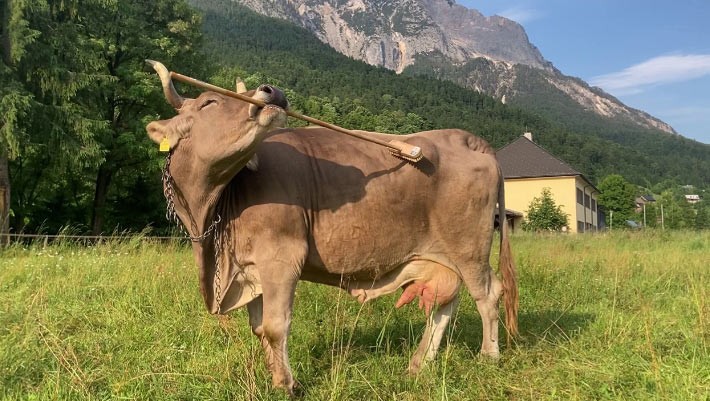
Researchers have, for the first time, documented a cow exhibiting flexible, multi-purpose tool use—behavior previously considered rare even among primates. The findings, published in Current Biology, reveal that a Swiss Brown cow named Veronika can intentionally manipulate an object (a deck brush) to scratch different parts of her body with varying techniques, selecting appropriate tool features for each task.
The Experiment and Findings
The study, conducted by Dr. Alice Auersperg and Dr. Antonio Osuna-Mascaró at the University of Veterinary Medicine, Vienna, involved controlled trials where Veronika was presented with a deck brush. Researchers observed her consistently choosing different ends of the brush—bristles for broad areas like her back, and the smooth handle for more sensitive lower body regions.
The key observation was not just that she used the tool, but how she used it. Veronika adjusted her movements: forceful, wide sweeps for her back versus slower, controlled motions for her underbelly. This suggests an understanding of the tool’s capabilities and the physical requirements of different scratching tasks.
Why This Matters
This discovery challenges long-held assumptions about livestock intelligence. For decades, cattle, like many farm animals, have been underestimated in cognitive ability. The study suggests that these underestimations may stem from a lack of rigorous observation rather than genuine limitations.
“The findings highlight how assumptions about livestock intelligence may reflect gaps in observation rather than genuine cognitive limits,” says Dr. Auersperg.
The researchers emphasize that while the tool use is egocentric (directed at her own body), it demonstrates a level of flexibility rarely seen outside of humans and chimpanzees. The fact that Veronika must manipulate the tool with her mouth—a physical constraint—and still adapts her grip and movements accordingly further underscores the complexity of her behavior.
The Subject: A Unique Cow
Veronika is not a typical farm animal; she lives as a companion to organic farmer Witgar Wiegele, who noticed her self-scratching behavior over a decade ago. This long-term observation was crucial in prompting the scientific investigation.
The implications are broad. If a single cow can display this level of tool manipulation, it raises questions about the cognitive potential of other livestock and the ethics of treating them as purely utilitarian resources.
In conclusion, this study provides compelling evidence that cattle are capable of more complex thought and behavior than previously recognized. The findings open new avenues for research into animal intelligence and challenge us to reconsider our relationship with the animals that sustain us.