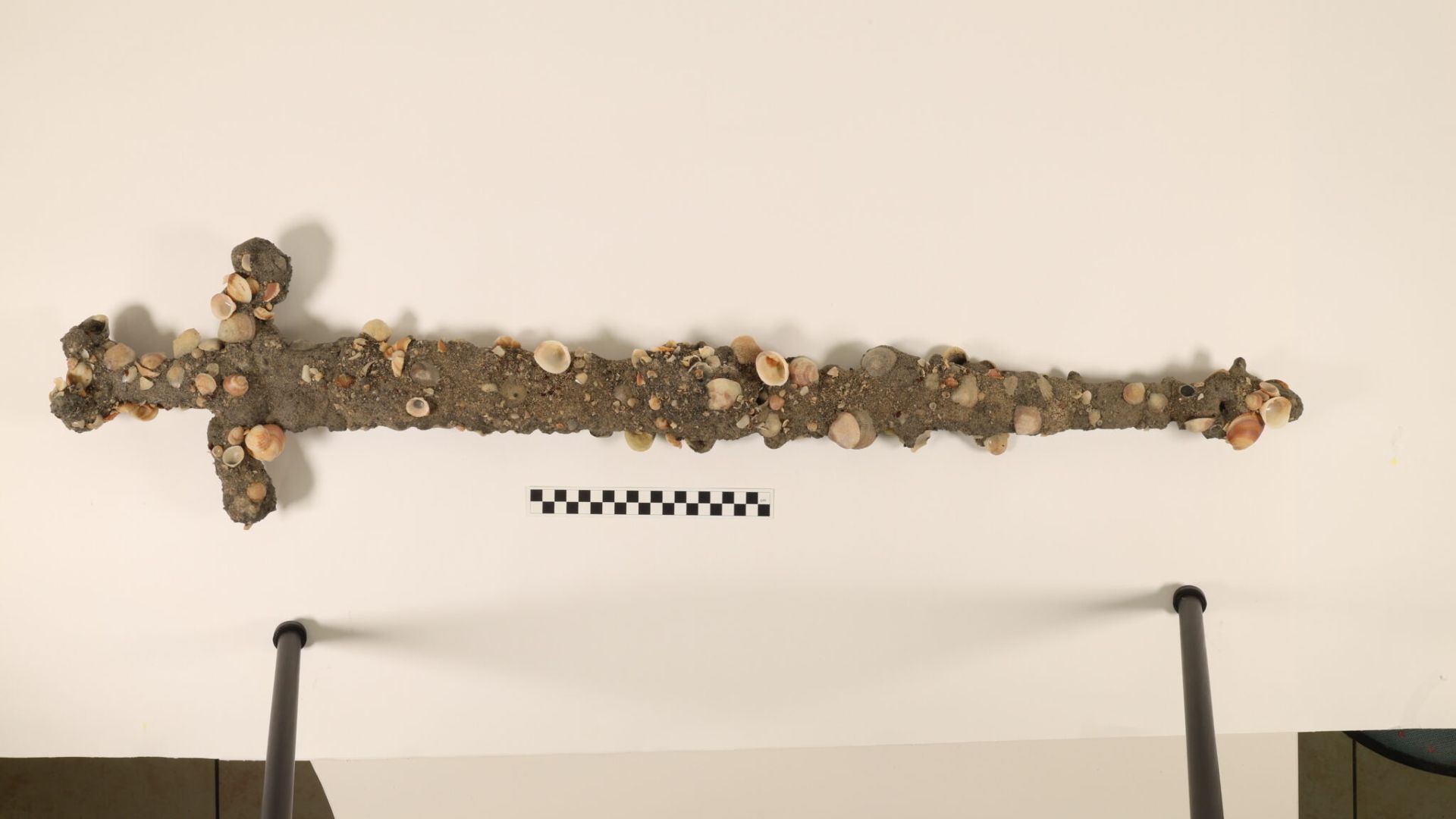
A remarkably well-preserved Crusader-era sword has been discovered off the coast of Israel by a University of Haifa graduate student, marking a rare find that offers fresh insights into medieval warfare and maritime history. The 3-foot-long weapon, estimated to date back to the 12th century, was spotted partially buried in the seabed by Shlomi Katzin, who recognized its significance after previously finding a similar artifact in 2021.
Accidental Discovery and Preservation Efforts
Katzin initially observed a group using metal detectors, suspecting potential looting of antiquities. After deterring them, he noticed the sword’s hilt protruding from the sand. Recognizing its historical value, he alerted nautical archaeologist Deborah Cvikel, who promptly contacted the Israel Antiquities Authority. The authorities authorized a careful excavation to study the artifact further.
“This is an extremely rare find that sheds light on the Crusader presence on the coasts of the country,” Cvikel stated. Only a handful of similar Crusader swords have been found in Israel to date, making this discovery particularly significant for understanding medieval military activity in the region.
The Crusades: A Brutal Era Revealed
The sword dates back to the period of the Crusades (1095–1291), a series of religious wars initiated by Western European Christians to seize control of the Holy Land from Muslim rule. These conflicts, sanctioned by the Catholic Pope, were marked by intense violence and brutality. Artifacts like this sword offer tangible evidence of the harsh realities faced by warriors during that era.
Analyzing the Weapon’s Condition and Origins
Researchers used a hospital CT scan to examine the sword’s interior without disturbing the marine encrustation. The scan revealed significant corrosion, with only a fraction of the original iron blade remaining intact. Despite the damage, analysis suggests the sword was designed for one-handed combat, likely wielded by a Crusader soldier—possibly of Frankish origin.
“In the Middle Ages, the sword became a symbol of The knights and knighthoods, as well as a symbol of the Christian faith,” noted Sára Lantos, a researcher at the University of Haifa. Studying this personal and symbolic object enriches our understanding of the material culture of the Crusader period.
The discovery provides a unique opportunity to learn about the lives of Frankish knights in the Holy Land. The sword’s presence in the Mediterranean highlights the extent of Crusader naval movements and maritime anchorages during the conflict.
The sword’s survival for centuries under the sea underscores how little we know about the long-term impact of medieval warfare. The artifact will contribute greatly to our understanding of the lives of warriors during this period.