Observations from NASA’s SPHEREx mission confirm that the interstellar object 3I/ATLAS has undergone a dramatic transformation, evolving into a fully active comet after passing close to the Sun in late 2025. This marks the first time scientists have observed an interstellar object “waking up” in such a pronounced way as it approaches our solar system’s warmer regions.
Comet’s Dramatic Shift
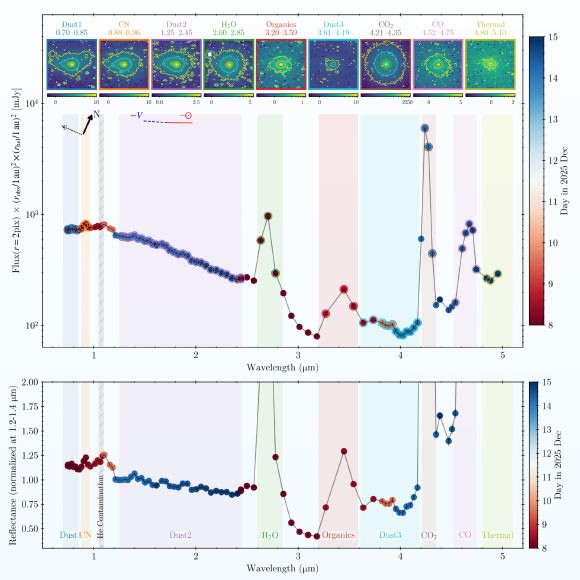
Prior to its closest approach to the Sun (perihelion), 3I/ATLAS displayed minimal cometary activity. However, SPHEREx re-observed the object between December 8 and 15, 2025, revealing a significant surge in activity. The object now exhibits a well-defined coma – a cloud of gas and dust surrounding the nucleus – driven by the sublimation of its ices.
“The December 2025 observations are consistent with a comet that is now fully active, sublimating even water ice,” explained Dr. Carey Lisse and colleagues from the Johns Hopkins University Applied Physics Laboratory. The team found substantial emissions of key volatile compounds including cyanide (CN), water (H2O), organic molecules (C-H), carbon dioxide (CO2), and carbon monoxide (CO).
Key Findings in Gas and Dust Composition
Water activity has increased by a factor of 20, while carbon monoxide emissions have risen 20-fold, indicating a shift in the object’s composition. The presence of cyanide and organic molecules suggests these materials were locked within the water ice and are now being released as the comet warms.
The coma itself has expanded significantly, measuring between 1′ and 3′ in radius. Interestingly, the gas coma appears more symmetrical, centered on the nucleus, while the dust coma takes on a pear-shaped form with the narrow end pointing towards the Sun. This suggests that different materials originate from different regions of the comet.
Implications for Interstellar Object Behavior
The behavior of 3I/ATLAS sheds light on how interstellar objects interact with our solar system. After spending 3.5 months inside the solar system’s “ice line” – the region where water ice can readily sublimate – the comet began releasing all its volatile components. The final composition now closely resembles typical comets found within our own solar system, with comparable ratios of ice abundance.
“By December, 3I/ATLAS had spent 3.5 months inside the Solar System’s ice line, and all of the cometary constituents, not just the highly volatile CO2 and CO ice portions, was active,” the authors said.
SPHEREx will continue monitoring 3I/ATLAS during a follow-up survey in April 2026, which will provide more detailed data on this remarkable interstellar visitor. The findings highlight how even objects from beyond our solar system can exhibit behavior familiar to scientists studying comets within our own cosmic neighborhood.