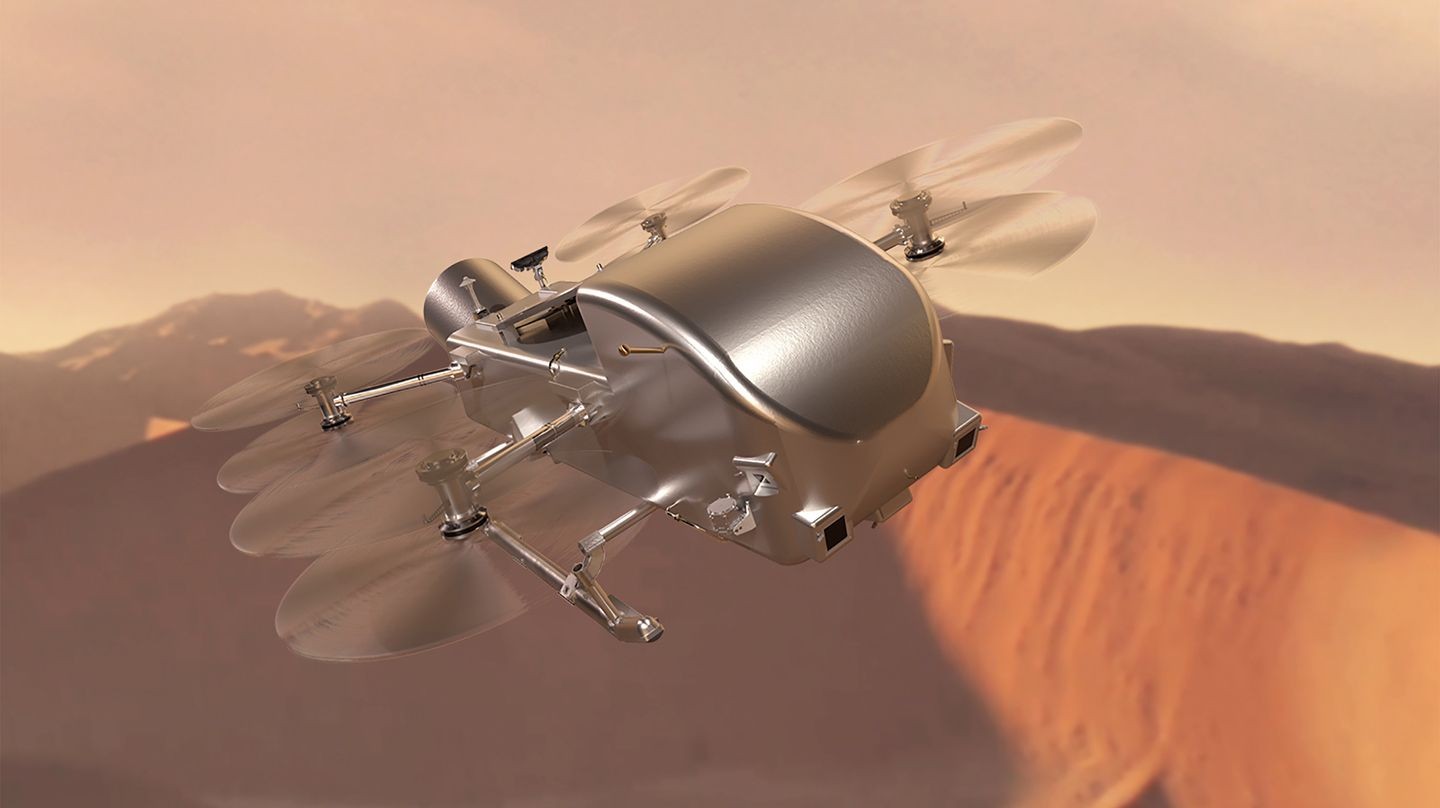
NASA is moving forward with the Dragonfly mission, a groundbreaking rotorcraft designed to explore Saturn’s moon Titan. Technicians at the Johns Hopkins Applied Physics Laboratory (APL) have begun assembling and rigorously testing the nuclear-powered drone, targeting a 2028 launch. This marks a significant leap in space exploration, as Dragonfly represents the first dedicated mission to fly across an ocean world in our solar system.
Pioneering Nuclear Propulsion
Unlike its predecessor, the solar-powered Ingenuity helicopter on Mars, Dragonfly will rely on nuclear energy for sustained operation in Titan’s distant, sun-starved environment. This is crucial because Titan receives minimal sunlight, making traditional solar power impractical for long-duration flight. The mission’s $3.35 billion budget reflects its complexity and scope—a substantial increase from Ingenuity’s $85 million technology demonstration.
Titan: A Unique Scientific Target
Titan is considered a prime candidate in the search for prebiotic chemistry, the building blocks of life. While the European Huygens lander briefly touched down on Titan in 2005, Dragonfly will conduct an extended exploration of diverse sites to study the moon’s chemistry, geology, and atmosphere. The mission aims to understand how organic molecules form and potentially evolve in an environment vastly different from Earth, offering insights into life’s origins.
Testing and Integration Phase
The current phase at APL focuses on Dragonfly’s integrated electronics, including guidance, navigation, and data handling systems. Over the next year, rigorous testing will assess the spacecraft’s ability to withstand the harsh conditions of space and Titan’s frigid atmosphere. The protective shell, already tested in wind tunnels, is undergoing final integration at Lockheed Martin Space in Colorado.
Key Milestones and Timeline
- Early 2027: Continued testing and integration at APL.
- Mid-2027: Shipment to Lockheed Martin for full systems testing.
- Spring 2028: Final preparations and transport to NASA’s Kennedy Space Center for launch aboard a SpaceX Falcon Heavy rocket.
Dragonfly’s development builds directly on lessons learned from Ingenuity, which exceeded expectations in its nearly three-year mission on Mars. The larger, nuclear-powered drone represents a bold step forward in planetary exploration, pushing the boundaries of what’s achievable in our solar system.
“This milestone essentially marks the birth of our flight system,” says Elizabeth Turtle, Dragonfly principal investigator. “Building a first-of-its kind vehicle…pushes us to the edge of what’s possible.”
The mission is poised to unlock critical insights into the potential for life beyond Earth, making Titan a focal point for astrobiological research in the coming decade.