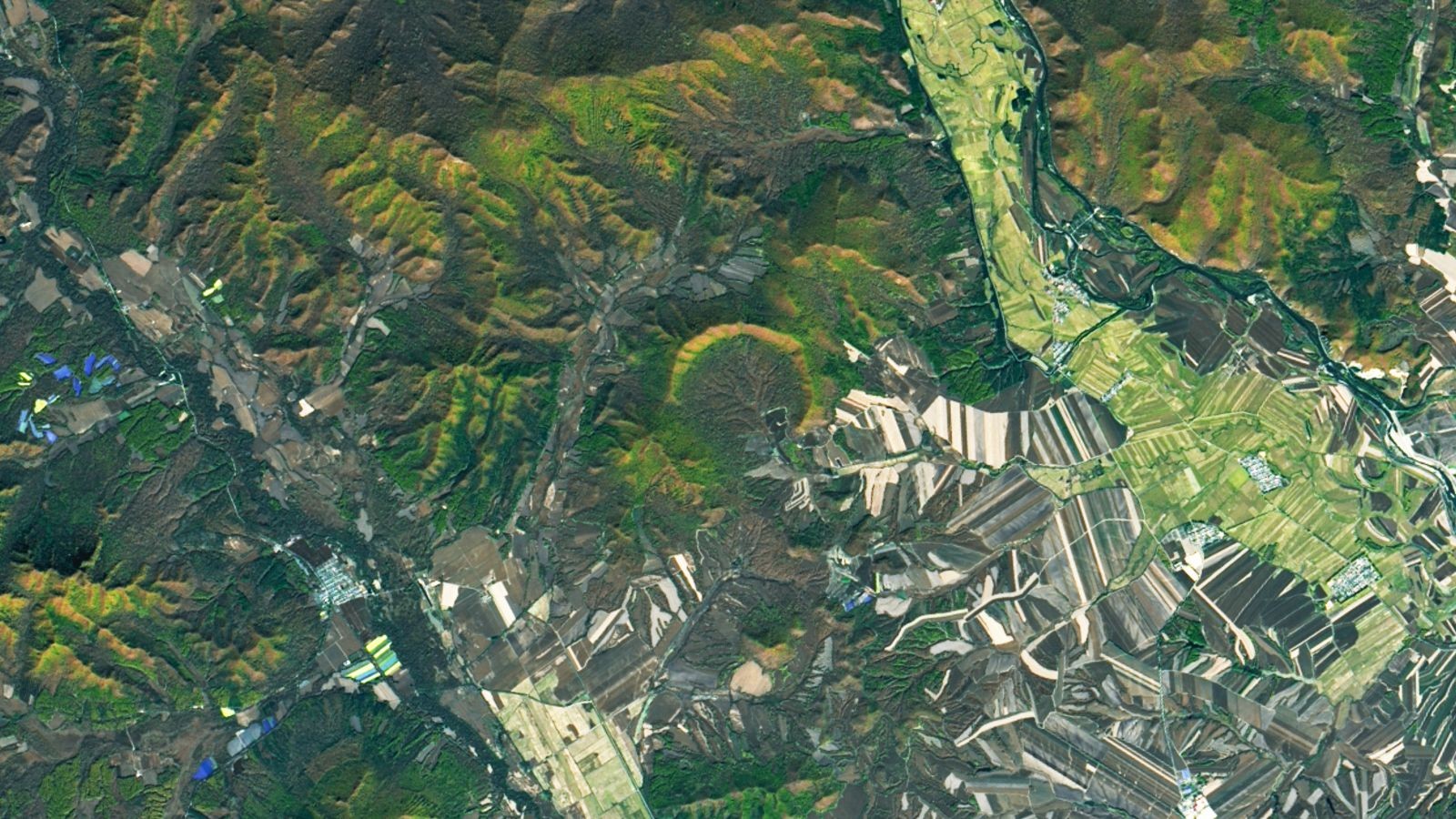
A recently identified impact crater in northeastern China could be the youngest major impact site on Earth, offering new insights into the planet’s ongoing vulnerability to space rocks. The Yilan crater, located in Heilongjiang province, stands out as the largest impact structure known to have formed within the last 100,000 years.
A Hidden Impact
The nearly circular depression, approximately 1.15 miles (1.85 km) wide, remained largely unnoticed due to dense forest cover. Locals referred to it as “Quanshan,” meaning “circular mountain ridge,” unaware of its extraterrestrial origins. Researchers confirmed its impact nature in mid-2021 after discovering key indicators: shocked quartz, melted granite, and distinctive glass fragments formed during high-velocity collisions.
Dating the Impact
Carbon dating places the Yilan crater’s formation between 46,000 and 53,000 years ago. This suggests it may be younger than the Barringer Crater in Arizona, long considered the most recent major impact, which formed around 50,000 years ago. While age uncertainty remains, Yilan is definitively the largest crater under 100,000 years old, surpassing Barringer’s size.
A Partially Lost Structure
The Yilan crater is incomplete, missing its southern rim. Evidence suggests that a lake once filled the depression, implying the structure was initially fully intact before erosion or other geological processes removed a portion of it. The exact cause of this damage remains unknown, though ongoing study may reveal more.
China’s Emerging Impact Record
Before Yilan, only one other confirmed impact crater existed in China: the Xiuyan crater, identified in 2009 and dating back 330,000 to 1.1 million years. The discovery of Yilan has prompted renewed interest in identifying other hidden impact structures within China’s vast territory. In 2023, a third crater was uncovered near the North Korean border, dating back 150 million years, and in 2025, scientists confirmed the Jinlin crater, potentially as recent as the Holocene epoch (within the last 11,700 years), although this age is unconfirmed.
The increasing number of impact discoveries in China underscores the planet’s ongoing exposure to extraterrestrial threats. These events, though rare, shape Earth’s geological history and continue to influence our understanding of planetary dynamics.
The Yilan crater offers a unique opportunity to study a relatively recent impact event in detail, providing insights into the forces that have shaped our world.