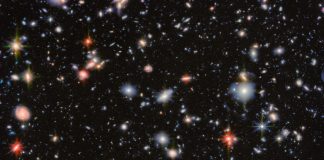
For decades, the accelerating expansion of the Universe has been attributed to a mysterious force called dark energy. However, a new theoretical framework proposed by physicists at the University of Bremen and the Transylvanian University of Brașov suggests that this acceleration could be an inherent property of spacetime itself, potentially reducing or even eliminating the need for dark energy as we currently understand it.
The Puzzle of Cosmic Acceleration
Since the late 1990s, observations of distant Type Ia supernovae have revealed that the Universe isn’t just expanding—it’s expanding faster over time. This contradicts the intuitive expectation that gravity should be slowing expansion down. The leading explanation for this acceleration has been the existence of dark energy, an unknown form of energy that makes up roughly 68% of the Universe.
Despite its prominence in the Standard Model of cosmology, the physical nature of dark energy remains one of the biggest mysteries in physics. No direct evidence of it has ever been observed, leaving many scientists seeking alternative explanations.
A Geometric Solution
The new approach, led by Dr. Christian Pfeifer, builds upon Finsler gravity, an extension of Einstein’s general relativity. General relativity describes how matter and energy warp spacetime, but Finsler gravity introduces a more flexible and generalized geometry. This allows for a more precise description of gravity’s effects on matter, particularly gases.
Using this framework, the team re-calculated the Friedmann equations—the core equations governing the Universe’s expansion. The results show that within Finsler gravity, an accelerated expansion emerges naturally without requiring any additional dark energy component. In essence, the acceleration isn’t caused by a mysterious force, but by the geometry of spacetime itself.
“This is an exciting indication that we may be able to explain the accelerated expansion of the Universe, at least in parts, without dark energy, on the basis of a generalized spacetime geometry,” Dr. Pfeifer stated.
Implications and Next Steps
This doesn’t necessarily mean dark energy is entirely wrong. The research suggests that at least some of the effects currently attributed to dark energy might stem from a more nuanced understanding of gravity. The new framework offers a potential refinement to our existing cosmological model, rather than a complete overthrow.
The study, published in the Journal of Cosmology and Astroparticle Physics, opens new avenues for exploring the fundamental laws governing the cosmos. Further research will be crucial to determine whether this geometric approach can fully account for the observed acceleration and, if so, what implications it holds for our broader understanding of the Universe.
This discovery underscores that our cosmological models are always evolving. The Universe may not need dark energy after all—it may just require a better way to describe its geometry.