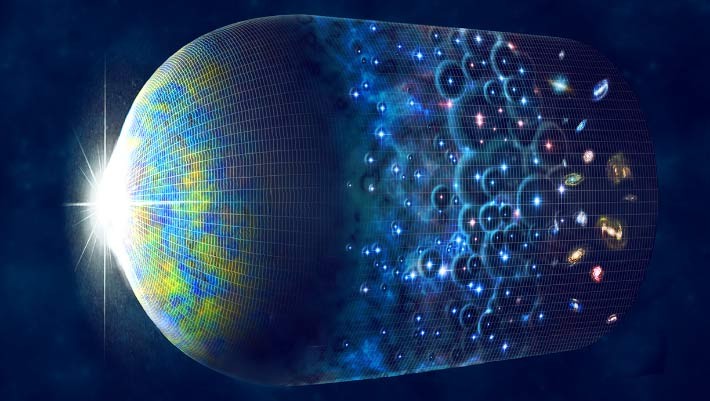
For decades, physicists have struggled to explain why the Universe is expanding faster instead of slowing down. The standard explanation, “dark energy,” remains mysterious, prompting scientists to explore alternative theories. Now, researchers at the University of Bremen and the Transylvanian University of Brașov propose a radical shift: the acceleration isn’t caused by an unseen force, but by the very fabric of spacetime itself.
The Dark Energy Problem
Since the late 1990s, observations of distant supernovae have revealed that the Universe’s expansion is accelerating. This led to the hypothesis of dark energy, a hypothetical form of energy that makes up about 68% of the Universe and counteracts gravity’s pull. Despite its prevalence in cosmological models, dark energy’s true nature is unknown, raising fundamental questions about our understanding of the cosmos.
Finsler Gravity: A New Geometric Approach
The new framework, detailed in a paper published in the Journal of Cosmology and Astroparticle Physics, hinges on an extension of Einstein’s general relativity called Finsler gravity.
Unlike general relativity, which assumes a rigid geometric structure for spacetime, Finsler gravity allows for a more flexible and dynamic geometry. This means that how matter, especially gases, interacts with gravity can be described in greater detail. The team recalculated the Friedmann equations (which describe the Universe’s expansion) using this more generalized framework.
Acceleration Without Dark Energy
The results were striking: the modified Friedmann equations naturally predict an accelerated expansion of the Universe even in the absence of dark energy. The acceleration arises not from an exotic force, but from the underlying geometry of spacetime itself.
“This is an exciting indication that we may be able to explain the accelerated expansion of the Universe, at least in parts, without dark energy, on the basis of a generalized spacetime geometry,” said Dr. Christian Pfeifer.
What This Means
This doesn’t eliminate dark energy entirely, nor does it overthrow the Standard Model overnight. Rather, it suggests that some effects currently attributed to dark energy might actually stem from a more nuanced description of gravity. The work opens up new avenues for understanding the Universe’s expansion and the fundamental laws governing it.
The implications are significant: if validated, this could reshape our understanding of cosmology and the nature of gravity itself. The team’s research provides a compelling alternative to the dark energy paradigm, offering a potential solution to one of the biggest mysteries in modern physics.