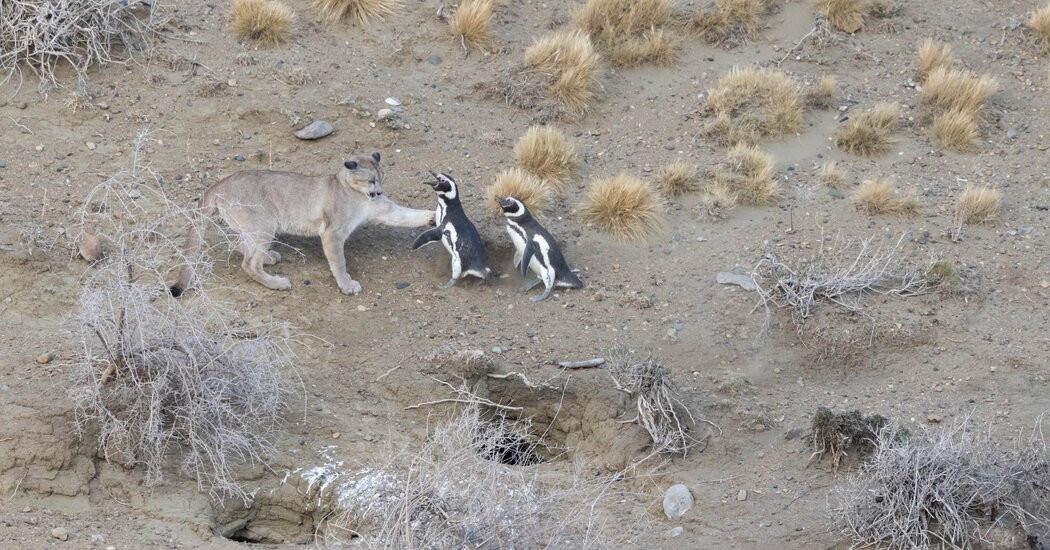
Magellanic penguins in Patagonia, Argentina, are increasingly falling prey to pumas —a surprising development driven by changing predator-prey dynamics. Historically, penguins faced threats from marine predators like seals and orcas, but land-based predation was minimal. However, a new study published in the journal Proceedings of the Royal Society B reveals that pumas, once driven out by human activity, are now actively hunting penguins.
The Return of the Puma and Penguin Expansion
For much of the 20th century, extensive sheep ranching in Patagonia eliminated pumas from the region. This absence allowed Magellanic penguins, previously confined to offshore islands, to colonize the Argentinian coast in large numbers. As conservation efforts successfully reintroduced pumas, they encountered this concentrated penguin population, leading to novel predatory behavior.
Why This Matters: Predator Flexibility
Wildlife ecologist Jake Goheen, not involved in the study, describes this as “an extraordinary example of how flexible large carnivores can be.” Pumas typically target larger grazing mammals, but their adaptability has allowed them to incorporate penguins into their diet. This highlights how ecosystems respond to shifts in predator presence —sometimes in unexpected ways.
The fact that large predators are now feeding on smaller prey shows that animals will adapt to survive. This also suggests that as humans continue to reshape landscapes, we may see other surprising food chain adjustments.
The Future of Predator-Prey Relationships
The increase in puma predation on penguins is a direct consequence of human intervention and ecological restoration. This demonstrates how even successful conservation efforts can introduce unforeseen challenges. Understanding these dynamics is crucial for managing both predator and prey populations in a rapidly changing world.
This situation underscores the complex interplay between human actions, species recovery, and the unexpected consequences that can arise when ecosystems are disrupted and then reassembled.