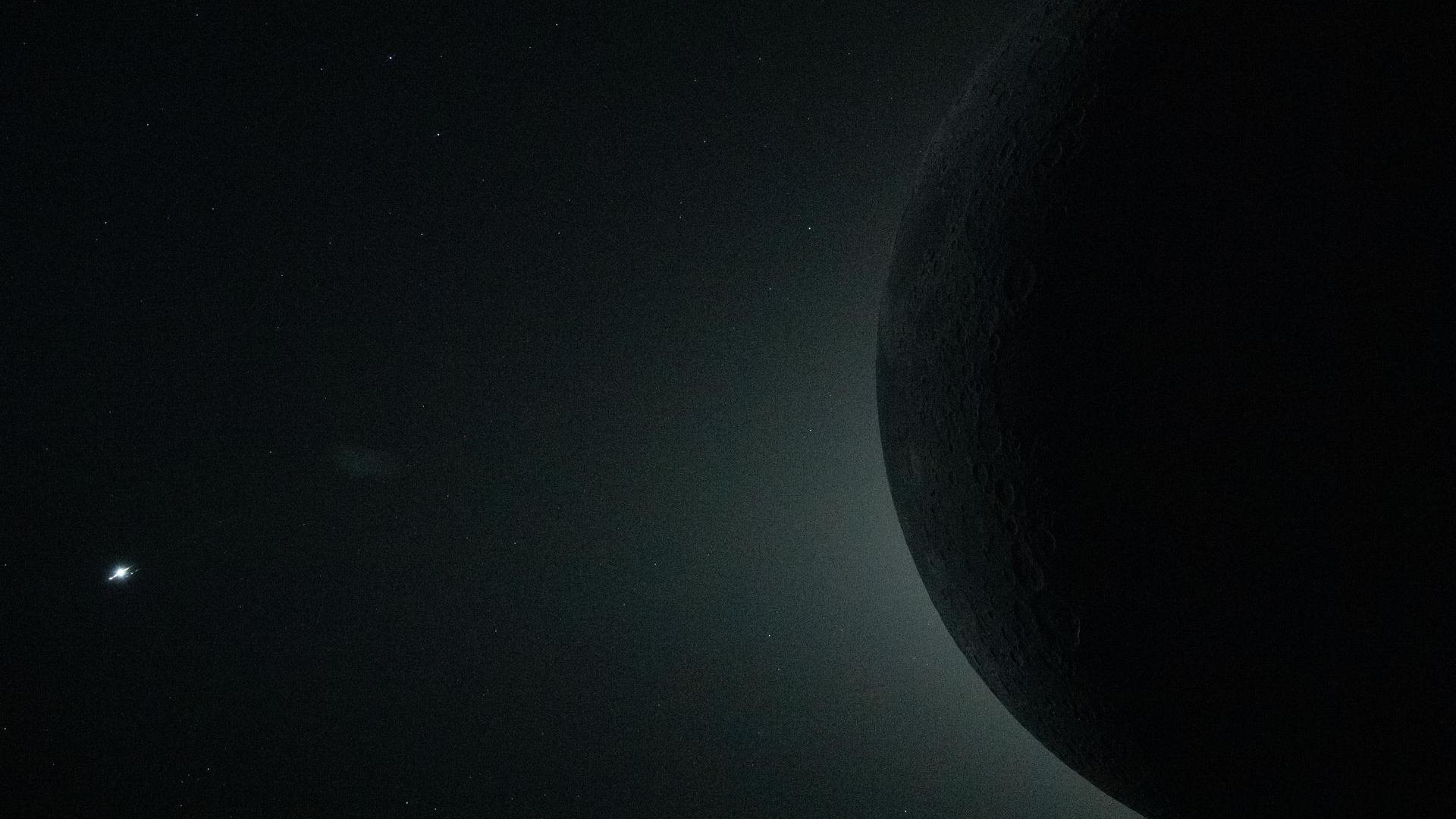
NASA has released a striking new timelapse video capturing a rare celestial event: a solar eclipse observed from deep space. Captured during the Artemis 2 mission, the footage shows the crew of the Orion spacecraft witnessing the moon fully obscure the sun as they performed a flyby of the lunar far side.
A Rare Perspective on Totality
The timelapse compresses nearly an hour of totality into a brief, visually stunning sequence. As the Orion spacecraft moved behind the moon on April 6, the lunar disk gradually slid in front of the sun. This alignment transformed the sun into a glowing halo, revealing the solar corona —the sun’s outer atmosphere—in high definition.
This observation offers a significant scientific advantage over Earth-based viewing. Because the event took place beyond Earth’s atmosphere, the crew was not hindered by atmospheric scattering or distortion. This resulted in:
– Higher contrast: The transition from bright sunlight to total darkness was sharper.
– Enhanced detail: Faint coronal structures became much easier to observe.
– Celestial clarity: As the sun’s photosphere was blocked, background stars and planets became visible, along with “earthshine”—the faint light reflected from Earth onto the lunar surface.
Why the Duration Matters
One of the most remarkable aspects of this eclipse was its length. While a solar eclipse viewed from Earth typically lasts only a few minutes, the specific trajectory of the Artemis 2 mission allowed for a period of totality lasting approximately 53 minutes.
This extended window was made possible by the spacecraft’s unique path around the moon. This duration provided both the astronauts and the onboard scientific instruments with a sustained period of observation, allowing for a much deeper study of the corona than is possible during shorter eclipses.
Scientific Mysteries and Historical Context
The visual phenomenon of the “glowing halo” seen in the footage has sparked new questions for NASA’s science teams. Researchers are currently investigating whether the observed light effect is caused by:
1. The solar corona itself;
2. Zodiacal light (sunlight scattered by interplanetary dust);
3. Or a combination of both.
While astronauts during the Apollo era also witnessed solar eclipses near the moon, the Artemis 2 mission represents a leap in observational capability. Because the Orion spacecraft follows a different trajectory than the older Apollo modules, the crew enjoyed a significantly longer observing window, turning a fleeting moment into a prolonged scientific opportunity.
The eclipse occurred during a period when Orion was behind the moon, resulting in a temporary communications blackout with Earth—a moment that provided the perfect, uninterrupted conditions for deep-space observation.
Conclusion
The Artemis 2 eclipse timelapse provides a unique glimpse into the mechanics of our solar system from a vantage point few humans have ever occupied. By observing the sun’s corona from deep space for nearly an hour, NASA is gaining unprecedented data that could refine our understanding of solar behavior and interplanetary light.