While both Jupiter and Saturn are massive gas giants, their “families” of moons look remarkably different. Jupiter boasts a diverse collection of major satellites, including the solar system’s largest moon, Ganymede. Saturn, by contrast, is dominated by a single massive moon, Titan, with its other satellites being significantly smaller.
For years, astronomers have struggled to explain why two similar planets ended up with such different satellite architectures. New research suggests the answer lies not in the amount of material available, but in the strength of the planets’ magnetic fields during their formative years.
The Mystery of the Missing Moons
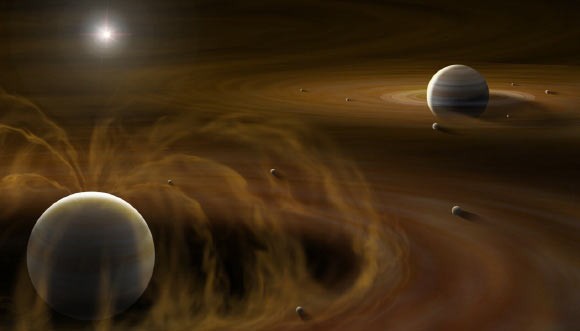
To understand this discrepancy, scientists look at the circumplanetary disk —the swirling ring of gas and dust that orbits a young planet and serves as the “nursery” for new moons.
As moons form within these disks, they tend to migrate, moving closer to or further from the planet due to gravitational interactions. The central question for researchers has been: Why did Jupiter manage to retain several large moons, while Saturn’s system seems to have lost its potential for multiple giants?
The Role of the Magnetospheric Cavity
A study led by Dr. Yuri Fujii of Kyoto and Nagoya Universities, published in Nature Astronomy, utilizes advanced numerical simulations to bridge this gap. By modeling the interior structures and magnetic evolution of young gas giants, the team discovered a critical mechanism: magnetospheric cavity formation.
The researchers found that:
- Jupiter’s Strong Field: Jupiter’s intense magnetic field was powerful enough to carve out a “cavity” or a cleared gap within its circumplanetary disk. This magnetic shield acted as a protective zone, capturing and preserving major moons like Io, Europa, and Ganymede as they migrated through the system.
- Saturn’s Weaker Field: Saturn’s magnetic field lacked the strength to create such a cavity. Without this magnetic barrier, migrating moons were unable to find stable orbits within the disk, leading to a system dominated by a single large body rather than a diverse group of giants.
Why This Matters for Space Exploration
This discovery does more than just explain the history of our own solar system; it provides a roadmap for finding life and studying planetary evolution elsewhere in the universe.
Because we can only use our solar system as a primary reference, testing theories of planet formation is notoriously difficult. However, this model provides a predictable pattern that astronomers can look for when observing exoplanets (planets outside our solar system).
“Our findings predict that compact exomoon systems, in cases of massive gas giants, and a couple of distant moons, in cases of Saturn-sized gas giants, will be found in future surveys.”
By applying this “magnetic rule,” future space surveys can better predict whether a distant gas giant is likely to host a complex, multi-moon system—which could potentially include moons with the right conditions to support life.
Conclusion: The structural difference between Jupiter and Saturn’s moons is likely the result of magnetic forces shaping their early environments. This insight provides a new lens through which we can interpret the satellite systems of distant worlds across the galaxy.