


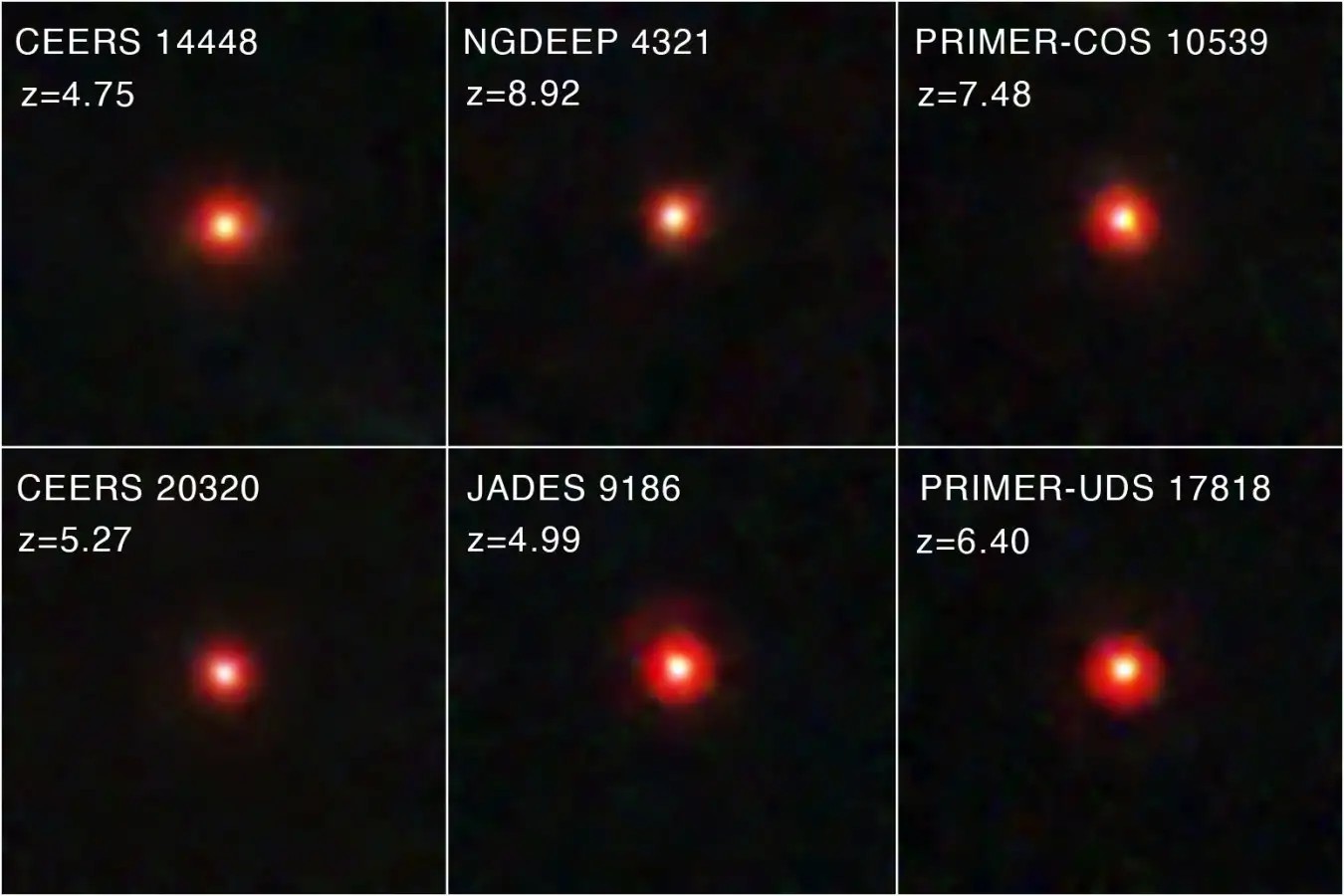
Recent observations from the James Webb Space Telescope (JWST) suggest that unusually bright, distant galaxies – dubbed “little red dots” (LRDs) – may not be as extraordinary as first believed. Initial data indicated these galaxies could contain either an unprecedented density of stars or black holes exceeding expected sizes for their age, which would require major revisions to cosmological models. However, new findings suggest these galaxies likely contain smaller, “baby” black holes instead.
The Mystery of the Little Red Dots
In its early observations of the early universe, JWST detected hundreds of highly luminous, red-shifted galaxies. Their extreme brightness posed a challenge to existing theories: either they held an impossibly high concentration of stars, or their central black holes were far more massive than expected. Both scenarios would have strained current understanding of galaxy and black hole formation.
Dust or Something Else?
Early interpretations assumed the red color of LRDs was due to abundant dust, similar to red galaxies closer to home. However, recent analysis has cast doubt on this assumption. Researchers found little evidence of substantial dust within these galaxies, prompting a reevaluation of their nature.
Revised Brightness Estimates
The original brightness measurements relied on extrapolating from specific hydrogen light frequencies, assuming standard dust-related light absorption. A new study, led by Jenny Greene at Princeton University, directly measured light across multiple frequencies (including X-rays and infrared). The results revealed that LRDs are at least ten times dimmer than initially estimated in most wavelengths except visible light.
Implications for Black Hole Mass
This dimmer reality has significant consequences for the black holes at the center of LRDs. According to Greene, “If there’s actually not as much light there as we thought, the black hole masses are probably much more modest.” This alleviates the earlier tension, suggesting these black holes aren’t as over-massive as previously feared.
“Baby” Black Holes and Black Hole Stars
Rohan Naidu of MIT suggests these black holes can be considered “baby” black holes, potentially embedded within a special class of black hole stars—a black hole surrounded by dense gas. Naidu notes that, unlike typical black holes where much energy is hidden, LRDs seem to emit most of their energy at wavelengths visible to telescopes.
Lingering Uncertainty
Not all researchers agree. Roberto Maiolino of the University of Cambridge cautions that emitted light indicates growth rate, not total mass, leaving some uncertainty about the black holes’ true size. Greene maintains that reduced photon emissions imply a smaller overall mass scale, suggesting that the black holes are less massive than previously thought.
In conclusion, new data suggests early galaxies may not harbor the monstrous black holes initially feared. Instead, they appear to contain smaller, more typical black holes, easing tensions with current cosmological models.


