


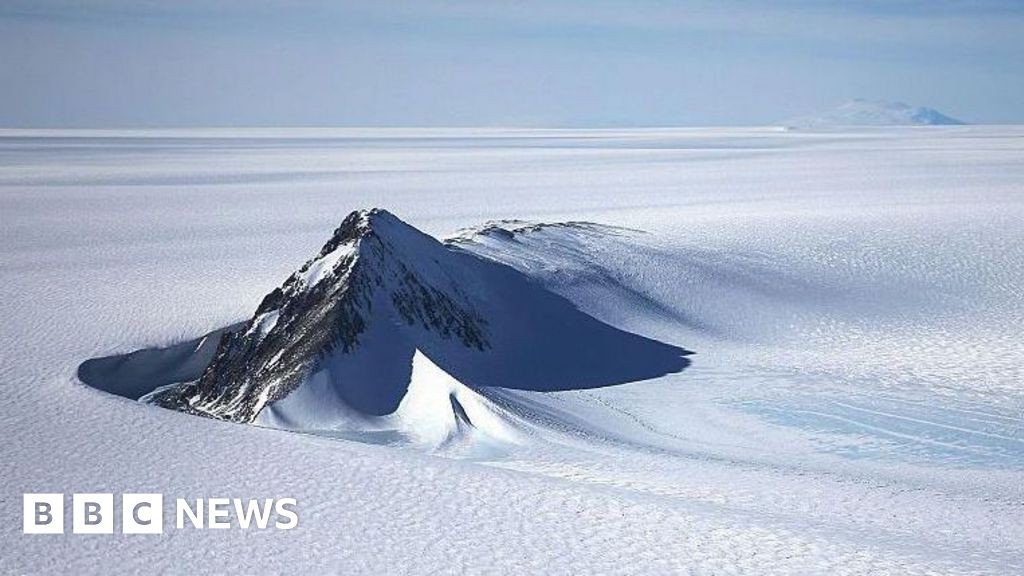
For decades, the topography beneath Antarctica’s vast ice sheet remained one of Earth’s last great unknowns. Now, a groundbreaking new map is changing that, revealing thousands of previously undiscovered hills, ridges, and valleys hidden under miles of ice. This isn’t just about filling in blank spaces on a map; it’s about fundamentally improving our understanding of how Antarctica will respond to climate change, and what that means for global sea levels.
The Ice-Covered Continent: A Mystery Until Now
Antarctica is unique in how little is known about its bedrock. In fact, scientists have better maps of some planetary surfaces in our solar system than they do of the landmass buried under the Antarctic ice. Traditional methods – radar surveys from aircraft or ground teams – provided only fragmented glimpses, leaving massive gaps in our knowledge. Imagine trying to map the Scottish Highlands or the Alps while only flying over them every few kilometers; you’d miss countless details.
A New Approach: Combining Satellites and Physics
The researchers behind this new map took a different tack. Instead of relying solely on sparse radar data, they combined high-resolution satellite measurements of the ice surface with physics-based models of how ice flows over underlying terrain. Ice doesn’t move randomly; its patterns reveal clues about the hills, ridges, and valleys it’s flowing over.
“It’s a little bit like kayaking in a river,” explains Dr. Helen Ockenden, lead author of the study. “When ice flows over a ridge, that manifests in the surface, but also in its velocity.”
By analyzing these subtle shifts in ice flow, scientists could infer the shape of the land beneath with far greater accuracy than ever before. The result? A map that’s clearer, more complete, and more useful for predicting the future of Antarctica.
Key Discoveries: Deep Channels and Hidden Mountains
The map reveals tens of thousands of previously unknown landforms, including a particularly striking feature in the Maud Subglacial Basin: a deep channel nearly 400 kilometers long, averaging 50 meters deep and 6 kilometers wide. This discovery is just one example of the wealth of new details now available to researchers. The map isn’t perfect; it relies on assumptions about ice flow, and further refinement is inevitable. But, combined with ground-based and airborne surveys, it represents a significant leap forward.
Why This Matters: Predicting Sea-Level Rise
Understanding Antarctica’s hidden landscape is critical for improving climate models. The shape of the bedrock directly influences how glaciers move, and how quickly they melt in a warming climate. This research offers the most detailed picture yet of what’s going on beneath the ice, allowing scientists to better project the rate of future melting and its impact on global sea levels. The study’s authors and other researchers agree: a clearer map of Antarctica’s underbelly is an essential step in predicting our planet’s future.
This new map is not the final word, but it is a vital step towards understanding one of Earth’s most critical and least-understood regions.


