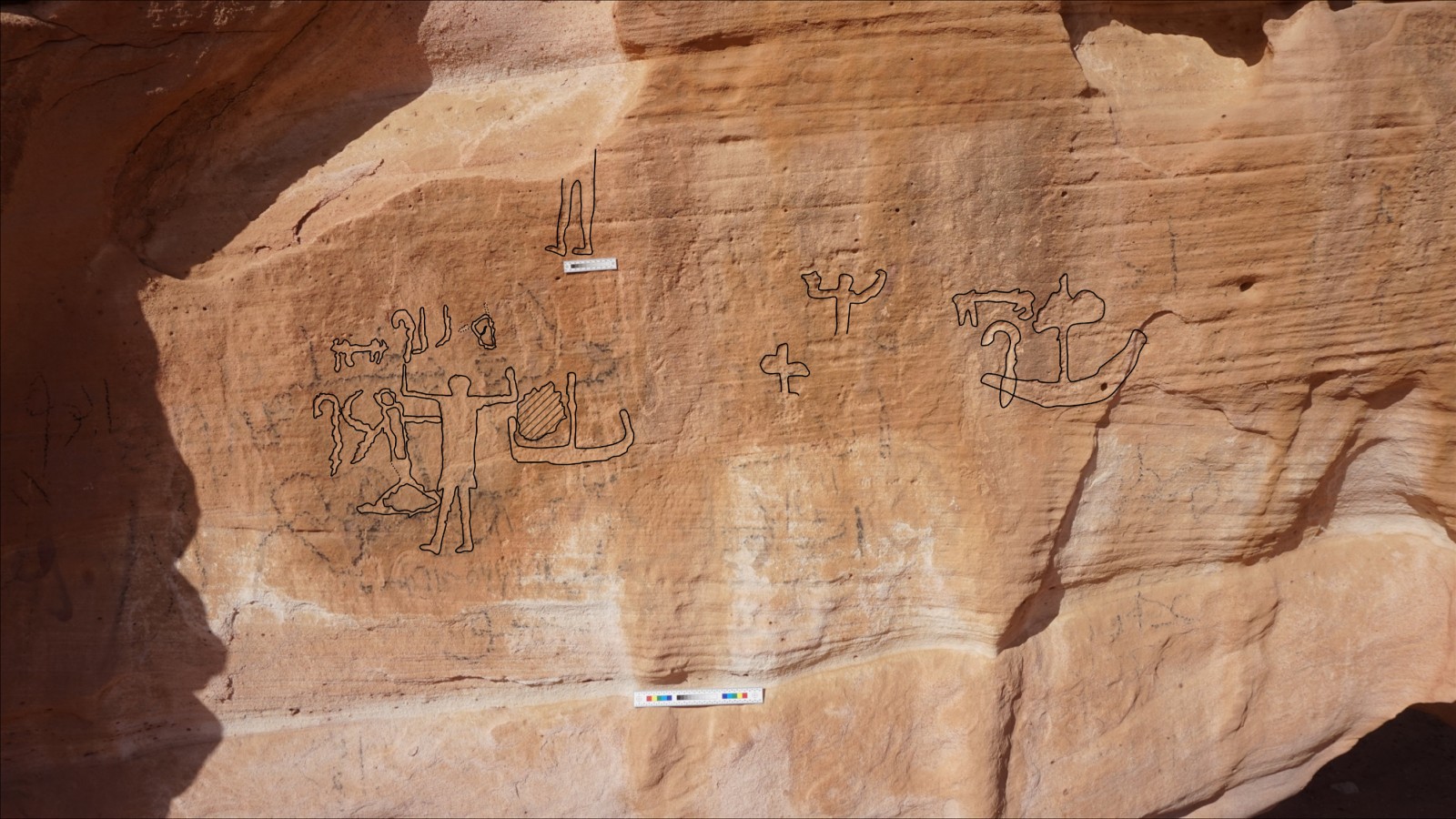
Archaeologists have unearthed 5,000-year-old rock carvings in the Sinai Desert that vividly depict ancient Egypt’s violent takeover of the region. The artwork provides a rare, chilling glimpse into how early Egyptian power was asserted through military dominance and resource control.
Evidence of Early Imperialism
The discovery, published in the 2025 edition of Blätter Abrahams, showcases a scene of stark conquest. One figure is shown raising his arms in victory, while another lies defeated with an arrow in his chest and bound hands. Nearby, a boat – symbolic of the pharaoh’s authority – accompanies an inscription declaring Min, the Egyptian god of fertility, as “ruler of the copper area.”
This isn’t the first evidence of Egyptian expansion into the Sinai around 5,000 years ago. Previous rock art findings also suggest a period of forceful colonization. However, this new panel is particularly striking in its direct portrayal of subjugation.
Resource-Driven Conflict
The expedition into the Sinai wasn’t simply about territorial expansion; it was fundamentally driven by the desire for mineral wealth. Egypt sought copper and turquoise, which were abundant in the region. At the time, the Sinai was inhabited by nomadic groups, making it an easy target for a centralized, militarized state like ancient Egypt.
According to Ludwig Morenz, an Egyptology professor at the University of Bonn, this rock panel may be one of the earliest visual records of territorial dominance in history. The scene’s brutality underscores the ruthlessness with which early empires secured their economic interests.
Deliberate Erasure of a Pharaoh’s Name
Notably, an inscription near the boat image – likely naming the Egyptian ruler at the time – was deliberately erased. The reasons behind this act remain unknown, but historical precedent suggests it could be tied to damnatio memoriae, where a successor pharaoh sought to obliterate the legacy of a predecessor. The timing and perpetrator of the erasure are still unclear, adding another layer of mystery to the discovery.
Ongoing Research
The artwork was discovered by archaeologist Mustafa Nour El-Din during a 2025 survey. The research team believes this is just the beginning, and larger-scale excavations are planned to uncover more hidden panels. The Sinai Desert likely holds numerous other records of this early imperial era.
The rock art offers a stark reminder that even in antiquity, power was often seized through violence and sustained by the exploitation of resources.
The ongoing research promises to shed more light on the dynamics of ancient Egyptian expansion and its impact on the indigenous populations of the Sinai Peninsula.