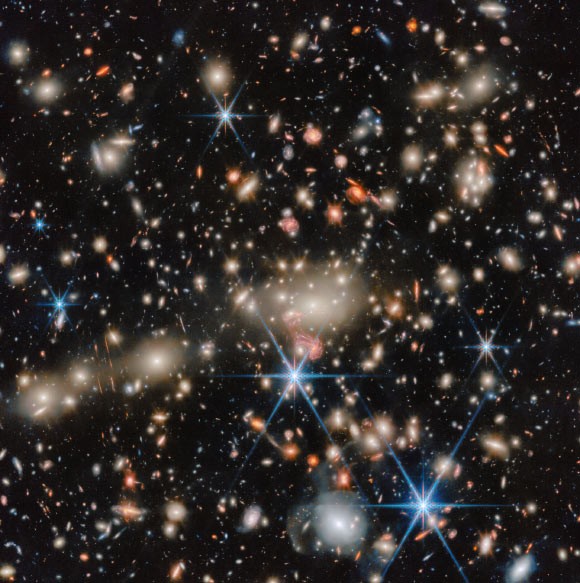
The James Webb Space Telescope has captured a stunning image of MACS J1149.5+2223 (MACS J1149), a galaxy cluster 5 billion light-years away in the constellation Leo. This new data doesn’t just show galaxies; it demonstrates how their immense gravity bends and distorts light from objects behind them, a phenomenon called gravitational lensing.
What is Gravitational Lensing?
Massive objects, like galaxy clusters, warp spacetime. Light from distant galaxies traveling through this warped space curves around the cluster instead of moving in a straight line. This bending magnifies and distorts the background galaxies, creating stretched arcs and bizarre shapes.
The effect is similar to looking through a warped glass lens — objects appear elongated, duplicated, or otherwise altered. This is not an optical illusion, but a fundamental consequence of Einstein’s theory of general relativity.
Key Observations in the MACS J1149 Image
Webb’s image reveals several striking examples of gravitational lensing:
- Distorted Spirals: One galaxy near the cluster’s core appears stretched into a pink, jellyfish-like shape.
- Multiple Images: The same distant object can appear in multiple places due to light bending around different parts of the cluster. This has even been observed with a single supernova, appearing four times in the same field of view.
- Magnified Backgrounds: The lensing effect effectively creates a natural telescope, allowing astronomers to study galaxies that would otherwise be too faint to observe.
Why This Matters: Studying the Early Universe
These observations were made as part of the CAnadian NIRISS Unbiased Cluster Survey (CANUCS), a program using Webb to study the evolution of galaxies in the early Universe.
The data will help scientists:
- Understand how stars form in dense cluster environments.
- Map the distribution of mass within galaxy clusters.
- Study the epoch of reionization — a period when the first stars and galaxies lit up the Universe after the Big Bang.
“The crushing gravity of this cluster does more than just hold all the galaxies together; it bends spacetime itself, giving us a unique window into the distant past.”
By analyzing how light is distorted, astronomers can infer the mass distribution within the cluster and even probe conditions in the early Universe. This makes gravitational lensing not just a beautiful phenomenon, but a powerful tool for cosmological research.
The Webb telescope’s ability to detect these subtle distortions opens new avenues for understanding the evolution of galaxies and the large-scale structure of the cosmos.