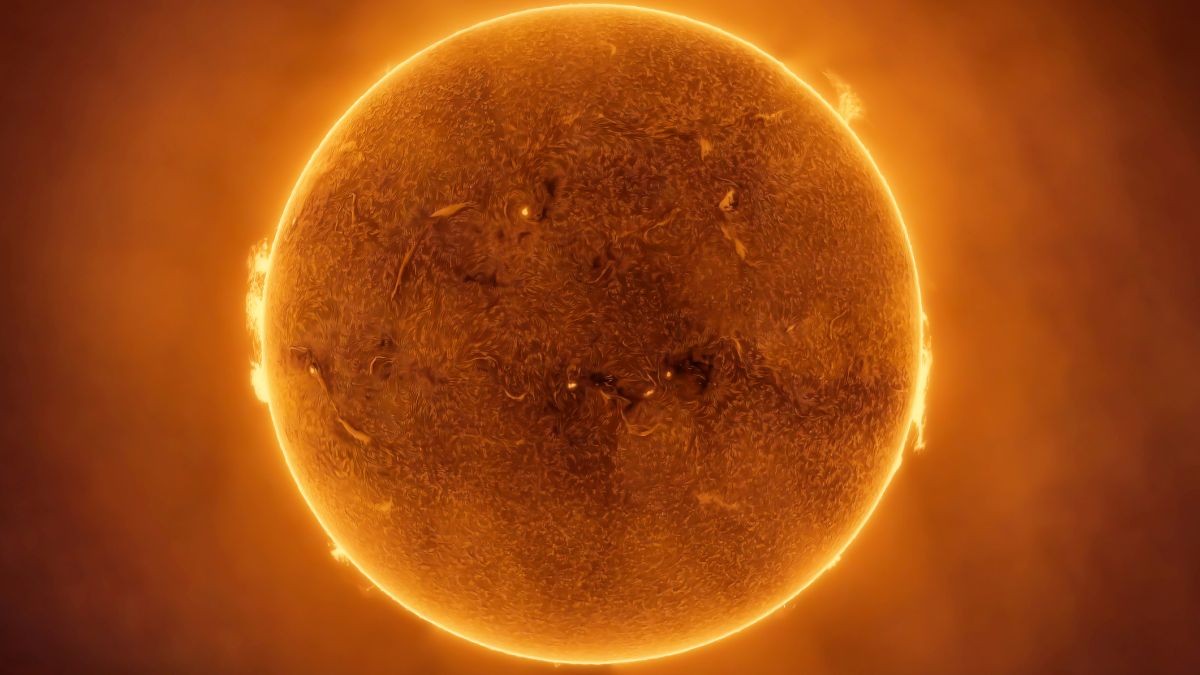
The Sun’s periods of intense activity—solar flares and coronal mass ejections—capture the most attention, but its quieter phases are equally important. New research reveals that even during lulls in its 11-year activity cycle, the Sun undergoes measurable internal changes. This means that solar minima, once thought nearly identical, actually leave a distinct “fingerprint” within the star itself.
Unveiling the Sun’s Hidden Dynamics
For decades, scientists have tracked the Sun’s cycles of activity, noting the magnetic reversals that occur every 11 years. Solar maxima bring heightened flares and sunspots, while minima represent periods of relative calm. However, a recent analysis using decades of data demonstrates that these quiet phases aren’t interchangeable. The deepest solar minimum in recent history—between 2008 and 2009—caused measurable shifts in the Sun’s internal structure.
Why this matters: Solar activity directly influences space weather, which can disrupt satellites, communication systems, and even power grids on Earth. Understanding how internal dynamics drive these cycles is crucial for accurate forecasting.
How Scientists Looked Inside the Sun
Researchers led by astrophysicist Sarbani Basu of Yale University used a technique called helioseismology to examine the Sun’s interior. This method analyzes acoustic oscillations—sound waves that travel through the solar plasma—similar to how seismic waves reveal Earth’s internal structure.
The team used the Birmingham Solar-Oscillations Network (BiSON), a global network of telescopes, to monitor these vibrations across four successive solar minima: 1985, 1996, 2008-2009, and 2018-2019. They focused on two key indicators:
- The helium glitch: Changes in the ionization of helium near the Sun’s surface, detectable through shifts in oscillation patterns.
- The speed of sound: Variations in sound velocity within the Sun, which reflect changes in temperature, pressure, and magnetic fields.
The 2008-2009 Minimum: A Clear Signal
The 2008-2009 minimum stood out as the longest and quietest in modern records. This period showed the most significant internal shifts: a stronger helium glitch signal and faster sound speeds in the outer layers. This suggests higher gas pressure, slightly increased temperatures, and weaker magnetic fields in certain regions of the Sun during that time.
“Revealing how the Sun behaves beneath its surface during these quiet periods is significant because this behavior has a strong bearing on how the activity levels build up in the cycles that follow,” notes Basu.
Notably, the subsequent solar cycle (Cycle 24) was exceptionally weak—one of the quietest maxima ever recorded. This correlation underscores how internal conditions influence future activity levels.
Implications for Solar Forecasting and Beyond
Forecasting solar behavior remains challenging due to the hidden engine driving it. Even small internal shifts can trigger substantial changes in surface activity. This research shows that seemingly similar solar minima can arise from subtly different internal conditions.
Future missions, such as the European Space Agency’s PLATO, will expand this type of analysis. These observations can also be applied to other Sun-like stars, helping us understand how their activity changes and affects their surrounding environments—including any planets they may host.
The Sun’s internal dynamics are more variable than previously thought. This variability must be accounted for in solar models to improve forecasting and better understand the long-term behavior of our star.