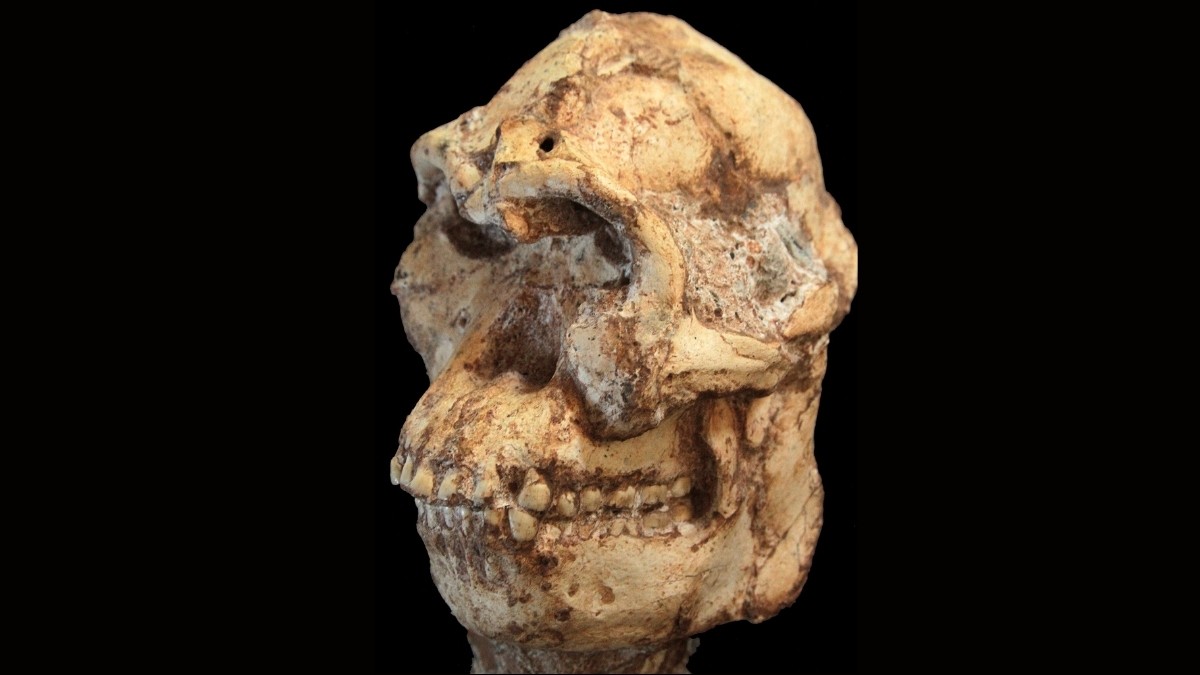
A remarkably complete fossil, nicknamed ‘Little Foot,’ has yielded the first digital reconstruction of a 3.67-million-year-old hominin face. The breakthrough, led by paleoanthropologist Amélie Beaudet at the Université de Poitiers, offers fresh insight into the evolution of the human face by digitally piecing together a skull crushed and deformed over millennia.
Unearthing Little Foot: A Decades-Long Effort
Discovered in 1980 in South Africa’s Sterkfontein Cave, ‘Little Foot’ initially presented only fragments – four small ankle bones. It wasn’t until the 1990s that the nearly complete skeleton was found embedded in concrete-like rock, requiring another 15 years of meticulous extraction. This painstaking recovery underscores how rare and valuable such specimens are for understanding human origins.
Reconstructing a Distorted Skull
The biggest challenge was the skull itself, severely distorted by geological pressure over millions of years. To overcome this, researchers used high-resolution X-ray micro-CT scans to create a digital 3D model at 21-micrometer precision. The skull was virtually disassembled into five blocks, then carefully reassembled like a jigsaw puzzle, restoring its original shape as closely as possible.
Unexpected Connections to Eastern Africa
Surprisingly, the reconstructed skull shares more similarities with Australopithecus specimens found in eastern Africa than with others from the same region. This suggests a more complex evolutionary history than previously thought, with potential migrations or shared ancestry between populations. The team also noted unique orbital (eye socket) shapes, hinting at specific adaptations linked to visual capabilities in a changing environment.
“Evolutionary pressure might have acted specifically on the orbital region in southern African Pliocene hominins, perhaps in conjunction with environmental instability leading to food resources becoming scarce…”
Uncertainty and Future Research
Despite this progress, definitive species identification remains elusive. It’s possible Little Foot represents a previously unknown species, or that variations within Australopithecus make accurate classification difficult. The reconstruction itself is considered preliminary, with some distortions likely uncorrectable. Future refinement with more advanced methods will be crucial for clearer results.
This research highlights the challenges of piecing together the human evolutionary tree. The fossil record is incomplete, and even well-preserved specimens like Little Foot require innovative techniques to reveal their secrets. Ongoing work promises to bring our ancient relatives into sharper focus, but uncertainty remains a fundamental part of the process.