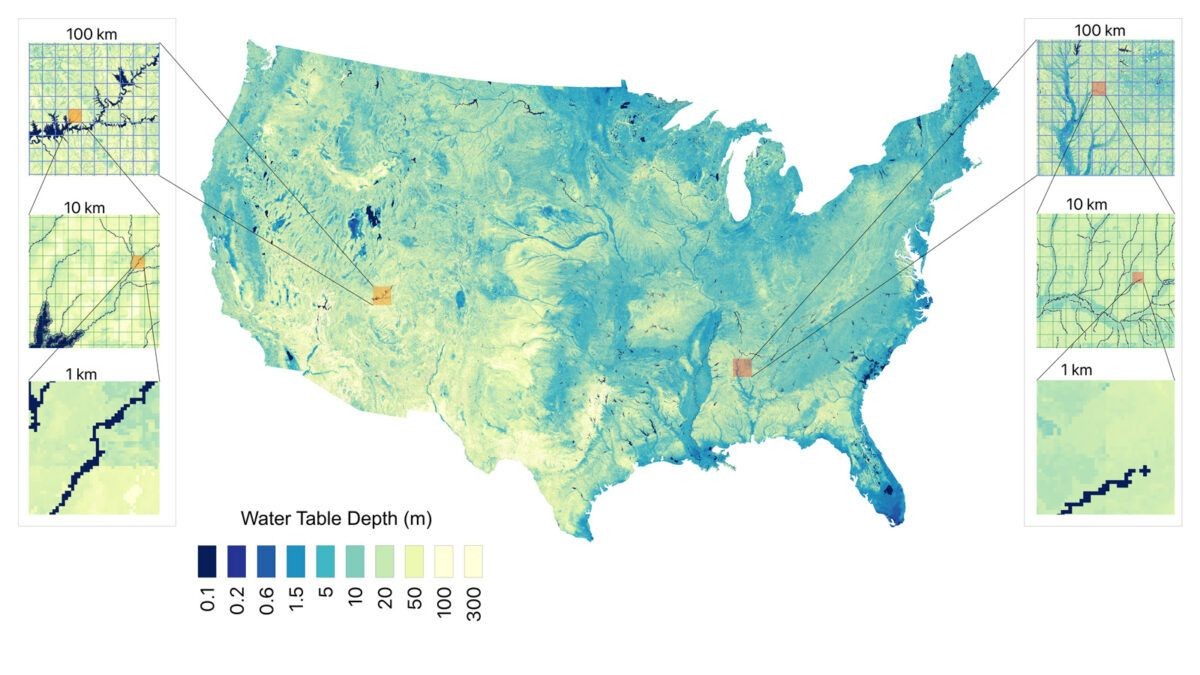
A newly released, high-resolution map reveals that the contiguous United States holds an astonishing 306,500 cubic kilometers of groundwater – equivalent to 13 times the combined volume of all the Great Lakes. This finding, published by researchers at Princeton University, provides the most accurate estimate to date of the nation’s hidden freshwater reserves, a resource far more substantial than previously understood.
The Scale of Hidden Water
For decades, understanding groundwater reserves has been hampered by the difficulty of direct measurement. While surface water is readily visible, underground aquifers remain largely unseen. The new map leverages over a million measurements taken from 1895 to 2023, alongside satellite data and machine learning, to create a detailed picture down to a depth of 392 meters (approximately 1,286 feet).
Previous estimates varied widely, ranging from 159,000 to 570,000 cubic kilometers. The latest assessment narrows this range significantly and offers a resolution up to 10,000 times higher than earlier methods. The difference is not merely academic; reducing the resolution of the map artificially lowered the estimate by 18%, demonstrating the importance of precise data.
Why This Matters: Groundwater as a Strategic Reserve
This discovery highlights the critical role groundwater plays in water management. Hydrologists often compare surface water to a checking account – used for immediate needs – while groundwater functions as a savings account, accumulating over time. However, until now, we lacked an accurate understanding of just how much was in that account.
The implications are far-reaching. Groundwater sustains agriculture, industry, and municipal water supplies, particularly in arid and semi-arid regions. Knowing the true extent of these reserves allows for better planning, especially as climate change intensifies droughts and increases demand.
How The Map Was Made: A Machine Learning Approach
The map was created by combining well observations, satellite data (including NASA’s GRACE mission), and environmental factors like precipitation and soil type. The research team then trained a machine learning model to fill in the gaps and extrapolate from existing data.
Interestingly, the model’s inherent “bias” – often seen as a negative in machine learning – proved beneficial. The algorithm implicitly accounted for human water extraction, recognizing the signal of groundwater pumping and depletion in the historical data. This means the map not only shows how much water exists but also reflects how it is being used.
Groundwater’s Hidden Connections
The map reveals that roughly 40% of the contiguous US has a water table less than 10 meters below the surface. This shallow depth facilitates interaction between groundwater, vegetation, and the land, underlining the interconnectedness of these systems. The high-resolution data also highlights regional variations in groundwater availability, informing more targeted management strategies.
“Groundwater is literally everywhere all the time,” says Laura Condon, a hydrologist at the University of Arizona. “Some places it’s 300 meters deep, some places it’s 1 meter deep. But wherever you’re standing, dig down, and there’s water down there somewhere.”
The new groundwater map isn’t just a scientific achievement; it’s a practical tool for decision-makers, farmers, and anyone concerned about sustainable water use. The research underscores a fundamental truth: groundwater is an essential but often overlooked resource, and its management requires accurate data and informed strategies.