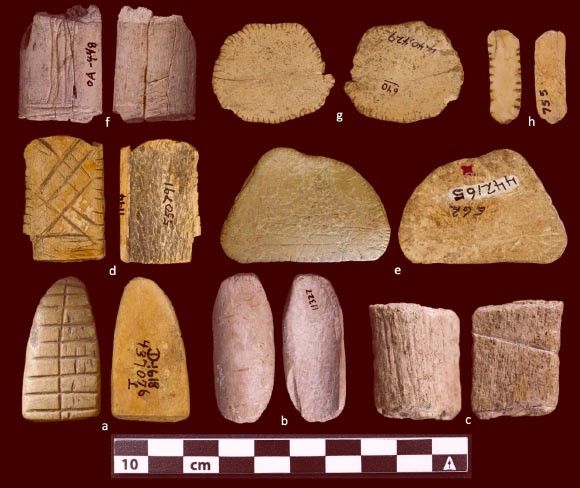
For decades, the history of gambling and probability has been told as a story of the “Old World.” Historians largely assumed that the invention of dice and structured games of chance was a development unique to ancient civilizations in Eurasia and Africa. However, new archaeological research is overturning this narrative, revealing that Native Americans were crafting dice and engaging in games of chance as far back as 12,000 years ago.
Redefining Ancient Gaming
A recent study led by Robert Madden, a Ph.D. student at Colorado State University, demonstrates that Ice Age hunter-gatherers were not just surviving; they were intentionally creating tools to manipulate randomness.
The research identifies the earliest evidence of these games within the Folsom sites, dating back approximately 12,200 to 12,800 years. These ancient players did not use the six-sided cubes we recognize today. Instead, they used what are known as “binary lots” :
- Form: Small, carefully crafted pieces of bone, often oval or rectangular.
- Function: Designed to be held in the hand and tossed in groups onto a surface.
- Mechanism: Each piece featured two distinct sides—marked by color, texture, or shape—functioning much like a modern coin.
- Gameplay: Scores were determined by how many pieces landed with the designated “counting” side facing up.
“These are not casual byproducts of bone working,” Madden notes. “They were made to generate random outcomes.”
A New Standard for Discovery
The breakthrough in this research wasn’t necessarily the discovery of new artifacts, but rather the application of a new scientific lens to existing ones.
Previously, many bone fragments found at archaeological sites were labeled as “possible gaming pieces” or overlooked entirely because researchers lacked a standardized way to identify them. To solve this, Madden developed an attribute-based morphological test. By comparing modern archaeological finds against a massive dataset of 293 historic Native American dice (documented by ethnographer Stewart Culin in 1907), the study established a rigorous, objective criteria for what constitutes a “die.”
By applying this test to the existing archaeological record, Madden identified over 600 diagnostic and probable dice across North American prehistory, spanning from the Late Pleistocene through the era of European contact.
The Social Power of Probability
While these Ice Age hunter-gatherers weren’t calculating complex mathematical formulas, they were practicing a fundamental form of probabilistic thinking. By using repeatable, rule-based methods to observe random outcomes, they were leveraging the “law of large numbers” long before the concept was formally codified by mathematicians.
More importantly, these games served a vital sociological purpose. The study suggests that gambling and chance games acted as “social technologies” that provided:
– Neutral Ground: Rule-governed spaces where different groups could interact without conflict.
– Diplomacy: Opportunities to exchange goods, share information, and form alliances.
– Risk Management: A way to navigate and manage uncertainty within social structures.
Conclusion
This research shifts our understanding of human cognitive history, proving that the ability to structure randomness into social ritual is a deeply ancient, global human trait. By recognizing these “binary lots,” we see a much more complex and interconnected social landscape in Ice Age North America than previously imagined.