Astronomers have detected a powerful gamma-ray burst (GRB) originating from a merging pair of neutron stars hidden within a previously unseen mini-galaxy. This discovery, published March 10 in The Astrophysical Journal Letters, provides potential solutions to two long-standing questions in astrophysics: the origin of GRBs in seemingly empty space and the distribution of heavy metals like gold and platinum beyond major galaxies.
Unexpected Explosion, Hidden Origin
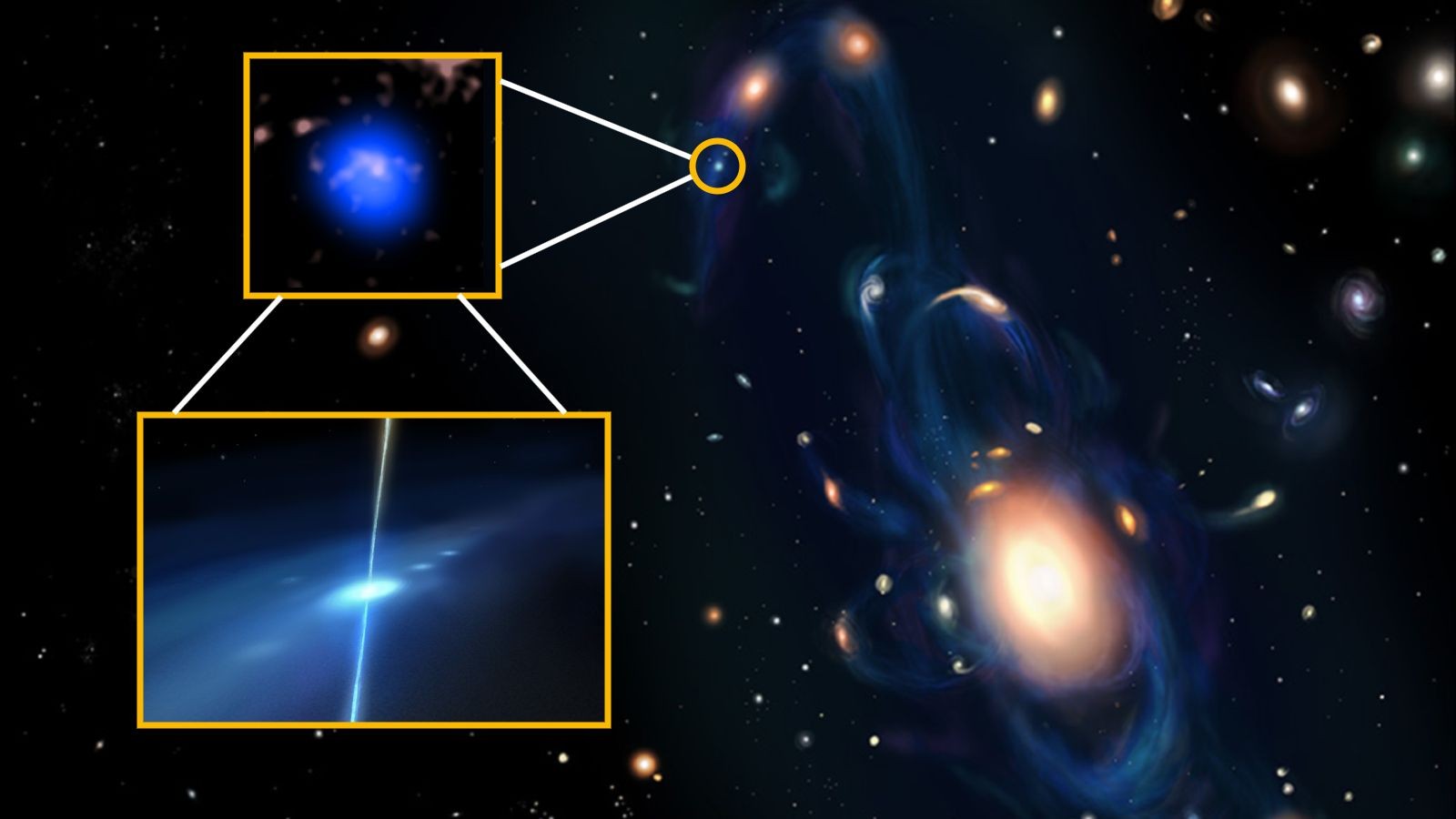
The GRB, dubbed GRB 230906A, was first observed in 2023 by the Fermi Gamma-ray Space Telescope. Initially, the signal appeared to come from an empty region of space, an anomaly since most GRBs are linked to active star formation within large galaxies. Further investigation using the Hubble, Chandra, and Swift space telescopes revealed that the burst originated from a small, previously undetected galaxy embedded in a vast stream of gas and dust – a remnant of ancient galactic collisions.
This mini-galaxy resides within a 600,000 light-year-wide stream of debris left over from multiple galaxies colliding and being torn apart in the early universe. The location suggests that the neutron stars formed roughly 700 million years ago, born from stars created in the aftermath of this cosmic crash. As study co-author Eleonora Troja from the University of Rome explains, “We found a collision within a collision. The galaxy collision triggered a wave of star formation that, over hundreds of millions of years, led to the birth and eventual collision of these neutron stars.”
The Two Mysteries Resolved
The first mystery the discovery addresses is why GRBs occasionally appear to originate from locations devoid of massive galaxies. The researchers now suggest that these bursts may be common in small, faint galaxies like the one identified, which are difficult to detect. This explains the anomalies previously observed by astrophysicists.
The second mystery concerns the infrequent detection of heavy metals—such as gold and platinum—outside of large galaxies. Neutron star mergers are known to produce these elements, but their presence in smaller galactic environments has been puzzling. GRB 230906A proves that these metals can be ejected into intergalactic space from less-massive systems, broadening our understanding of their cosmic distribution.
As study lead author Simone Dichiara of Penn State notes, “Finding a neutron star collision where we did is game-changing. It may be the key to unlocking not one, but two important questions in astrophysics.”
The findings underscore that extreme cosmic events like neutron star mergers are not confined to large galaxies, challenging previous assumptions about their distribution and the formation of heavy elements in the universe.