


Scientists have found something startling inside a nuclear fireball. It isn’t just heat. It isn’t just density. It is extreme, localized acceleration that might rewrite the rules of quantum chromodynamics.
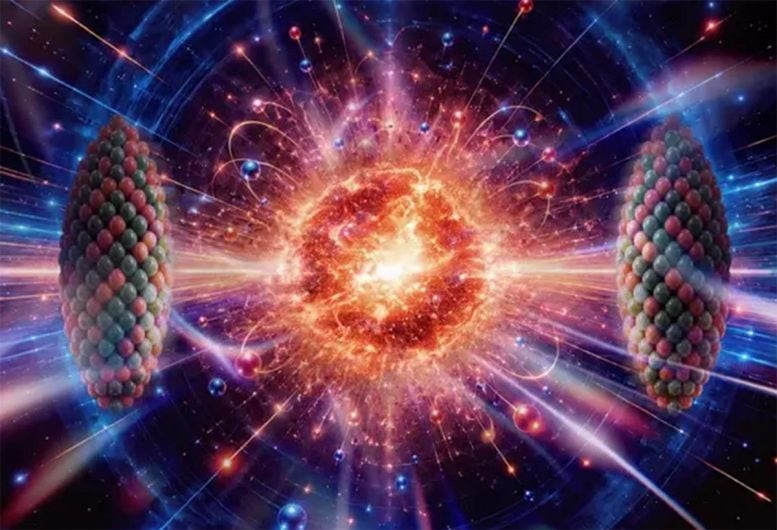
When atomic nuclei collide at nearly the speed of light, they don’t just bounce. They merge. For a split second, they become quark–gluon plasma. A hot, fast fluid where quarks and gluons roam free.
Most physicists focus on the rotation. The vorticity. The magnetic fields whipping through the plasma. But the acceleration driving this expansion? That has been ignored.
Why? Maybe because it’s hard to measure. Or maybe because hydrodynamics traditionally treats acceleration as a mere side effect, not a main character. But in electromagnetism, electric and magnetic fields go together. In hydrodynamics? Acceleration should be treated with the same gravity as vorticity. It’s just as fundamental.
A new study changes the game. Yu-Gang Ma and Xu-Guang Huang at Fudan University didn’t just look at fluid speed. They looked at how that speed changes right now, at this point. They combined two models: AMPT and UrQMD. Then they hit them with Gaussian smearing. A mathematical trick. It turns scattered particle positions into smooth maps of energy and momentum.
They ran this from low-energy collisions (3.5 GeV) up to ultra-relativistic blasts (2.76 TeV). The results? Profound.
The edge of the fireball
The acceleration wasn’t random. It pointed outward. Always. And it peaked at the very edge of the expanding fireball.
Here is the weird part. At that boundary, pressure crashes. It drops fast. Enthalpy density—the total energy measure of the fluid—is also low. Relativistic physics, via the Euler equation, says these conditions combine to create a pressure cooker of acceleration.
We’re talking proper acceleration measured in the fluid’s frame. Hundreds of MeV. Not kilometers per second. MeV. In high-energy physics, that is massive.
The source of this kick changed depending on the collision energy.
At lower energies, the nuclei slammed and stopped. Nuclear stopping created an early deceleration spike, hitting around 500 MeV before things sped up again. At ultra-high energies? The nuclei passed through each other like ghosts. They dragged the new plasma with them in brief, violent bursts of acceleration.
But the localization held true. The greatest acceleration stayed glued to the outer boundary. This means the effect is robust. It doesn’t care if you hit head-on or graze the side. The geometry barely matters. The edge always gets the boost.
Why this matters for QCD phase diagrams
This isn’t just fluid dynamics trivia. It touches the core of the strong force.
Remember the Unruh effect? It suggests that an accelerating observer sees empty space as warm. Like looking at a heated blanket instead of a cold void. If the plasma experiences several hundred MeV of proper acceleration, it might generate an effective temperature close to the critical transition point of Quantum Chromodynamics (QCD).
This introduces a terrifying possibility.
What if acceleration isn’t just a result, but a driver? A new control parameter.
Huang calls it the “acceleration axis.” Imagine the standard QCD phase diagram, mapped by temperature and density. Add a third dimension: acceleration. Does it shift the phase transitions? Does it change how quarks confine or deconfine? Does it influence chiral symmetry breaking?
If acceleration acts as a thermodynamic variable, it could reshape our understanding of how matter organizes itself under extreme stress. It could also generate strange transport effects. Things that complement or override the vorticity we usually watch.
This might explain spin patterns observed at RHIC and the LHC that currently make no sense. Particle spins are aligning in ways that rotation alone can’t fully account for. Could acceleration be the missing link?
Hunting for the signal
The theory is seductive. But is it real?
The next step is simulation refinement. The team plans to inject more realistic hydrodynamic evolution into their models. They are hunting for measurable signals. Specifically, they want to see if hyperon spin polarization patterns match the predictions of high-acceleration zones.
If experiments detect this, it changes everything. It turns a kinematic curiosity into a thermodynamic fact.
“Just as temperature and density define the map, acceleration may open a new dimension of that map,” Huang said. “By mapping this hidden axis, we hope to make non-inertial quantum effects visible to the eye.”
It’s a clean hypothesis. Elegant, even. But physics rarely stays clean for long.
The simulations show the acceleration is there. Real strong enough to potentially alter phase structures. Real localized enough to survive geometric variations.
Now comes the hard part. Proving it.
The data from current colliders might already hold the clue. Or it might be buried under noise. Researchers are looking. Hyperons are being spun. The acceleration axis awaits verification.
Will we see it? Or is the fireball just expanding, indifferent to our need for a third dimension?
Reference:
“Fluid acceleration in heavy-ion collisions”
Authors: Song-Ze Zhong, Xian‑Gai Deng, Xu‑Guang Huang, Yu‑Gang Ma
Publication: Nuclear Science and Techniques, July 25, 2026
DOI: 10.1007/ s41365- 026- 02044- 8


