


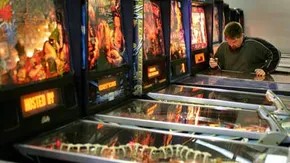
The ball drops. That’s it. That’s the whole point.
Since Gottlieb slapped the Humpty Dumpty table onto the scene in 1947, humans have been weirdly obsessed with watching a small sphere of steel bounce around a wooden box. You hit targets. You fly up ramps. You try not to let the thing fall into the drain. It’s chaotic physics wrapped in a cabinet.
Fast forward to the last five years. Manufacturers have stuffed these machines with screens, lights, and tech that cost more than a used car. But strip away the LED arrays and the digital displays? The goal hasn’t changed since the 40s. Score points. Keep the ball alive.
It sounds simple. It isn’t.
How pinball machines work
So how does it actually function? You’re not just pushing a button. You’re fighting gravity, magnetism, and your own thumb’s cramping potential.
The core mechanic is the plunger. You pull back, release, and hope for velocity. The ball hits the flippers —two mechanical paddles at the bottom of the playfield. These are your only defense. Miss a flip, the ball drops into the drain on the left or right. Game over. Or rather, life lost.
Between the flippers and the top of the table lies the playfield. This is where the chaos happens. Bumpers knock the ball away. Rollovers light up targets. Multiball modes release extra spheres, turning the table into a pinball pinball machine.
Modern tables add solenoids, solenoid-driven pop bumpers, and voice chips. They talk to you. They judge you. They tell you to “tilt” when you’re getting too aggressive.
“The goal of the game remains the same: score points and keep the pinball from going down the drain.”
Technologically? It’s a mess of wires. Electrically? It’s a marvel. Mechanically? It’s held together by hope and solder.
What comes next?
We’ll look at the tech inside the cabinet. Then we’ll look at where this goes.
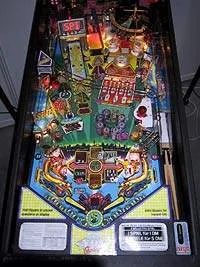

The mechanics of the playfield
You walk up to a modern pinball machine, and it hits you. It’s a chaotic tangle of wires, coils, and plastic, all screaming to keep that steel sphere alive. Your job? Don’t tilt. Don’t drain. Score points. It sounds simple until you’re sweating over the flippers.
These aren’t just paddles. They’re the last line of defense against the drain, that dark abyss at the bottom of the table. You hit the buttons—left or right, just below the glass—and snap. The ball goes up. If you’re lucky, it hits bumpers. If you’re skilled, it threads the ramps. Some tables even throw extra flippers at you, higher up, just to mess with your rhythm.
Which pinball should you use?
Let’s talk about the ball itself. It’s not just a marble. It’s a 1 1/16-inch steel sphere. Roughly 3 cm. It weighs 2.8 ounces. On a dry, unwaxed table, that thing can hit 90 miles per hour. Yes. You read that right.
Steel is standard. But steel has a flaw. It’s magnetic. Some machines use magnets to trap the ball in specific zones, forcing you to play a certain way. Not everyone likes that. Enter the powerball.
It’s ceramic. Lighter. Only 2.28 ounces. Because it’s lighter, it flies faster. Because it’s ceramic, it ignores the magnets. It’s a different game entirely. Smoother. Faster. Less predictable.
Why do you only get three balls?
The goal is clear. Hit targets. Hit bumpers. Keep it moving. If the ball slips, it goes down the drain. Game over? Not yet. You get three balls. Three chances to prove you aren’t a tourist.
Lose the third one, and you’re done. Unless…
You scored a replay. Or you got a match. These are the lifelines. The miracles. We’ll get to how those work in a second. But first, you need to understand the beast itself. How is this thing even built?
What is inside the backbox?
You’ve seen the front. The lights, the art, the playfield. But the real magic? It’s hiding in the back. The backbox isn’t just decoration. It’s the brain. The heart. The place where the electronics live, where the sound system breathes, and where the machine decides if you win or lose.
It’s heavy. It’s complex. And without it, you just have a fancy piece of furniture with a steel ball in it.
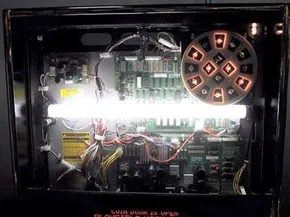

Inside the Backbox: The Brain and the Bait
The backbox isn’t just a decorative lid. It’s the engine room.
Inside sits the main controller board, the digital brain of the operation. Think of it like a computer motherboard, but one that lives behind glass and smells faintly of ozone. A ROM chip sits there, holding every rule, score multiplier, and game state necessary to keep the ball moving. Without that chip, the flippers are just plastic sticks.
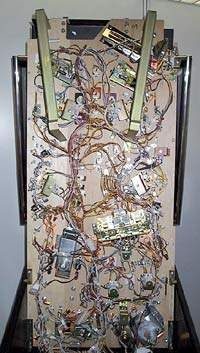
Connecting that brain to the rest of the machine is a nightmare of copper.
We’re talking about wiring. Massive amounts of it. Usually over half a mile (0.8 km) of wire snakes from the backbox down to the playfield. These thin veins carry commands to the electromechanical bumpers, the flippers, the ramps, and the targets. It’s a constant loop of data. You hit a bumper; the wire tells the board; the board tells the lights to flash.
The wire is the nervous system. The board is the brain.
Two other electronics components hide in there too. First, the dot-matrix display (DMD). Found at the base of the backglass, these screens are typically 128×32 or 192×64 pixels. They don’t just show your score. They give hints. They tell you how to save the ball or trigger a free game. It’s the game talking back to you.
Second, the speakers. Since the early 1990s, pinball has gotten loud. Digital sound replaced simple beeps. Now, full musical scores play alongside the clatter of the ball. Speakers flank the DMD, usually one on each side, filling the cabinet with noise.
But the backbox has a second job. A marketing job.
It needs to pull you in.
The backglass art does the heavy lifting. Professional artists craft these pieces to stand out in a crowded arcade. They are meant to stop you mid-stride. Some original paintings have sold to collectors for thousands of dollars. That’s art market value attached to a game cabinet. The DMD helps too, running elaborate animations that match the machine’s theme. It’s a visual hook.
The Playfield
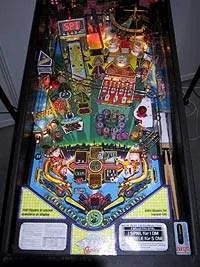
Inside the mechanics of a pinball playfield
The surface isn’t just a flat board. It’s a layered sandwich. A wood base gets slapped with multiple coats of paint and finish. This protects the wood and gives that glossy, high-friction look we all know. But the real trick? The angle.
The whole thing tilts toward you. Just 6 to 7 degrees.
That slight incline creates a hill. Gravity does the heavy lifting here. It pulls the ball down, speeding it up just enough to make the game feel alive without turning it into a free-for-all. You’re fighting physics, but it’s a fair fight.
Bumpers, ramps, flippers—they’re not magic. They’re bolted and glued right onto that wooden surface. Physical connections. Real hardware. But they don’t work in isolation.
Every single obstacle is wired back to the controller board. That board usually lives in the backglass area. It’s the brain. The computer needs to know exactly where the ball is. Always. If you hit a target, the board sees it. It calculates points. It triggers those satisfying special features. No wire, no reaction. It’s a closed loop of wood, steel, and code.

How the Plunger Actually Works
You drop the coin. The machine’s brain registers the credit. The screen screams Press Start. Simple enough.
That start button? It’s roughly the same size as your flipper buttons, usually hanging out on the front-left corner. Hit it. A ball drops from the trough into the launch lane. It sits there, waiting in front of the plunger.
Here is where things split based on how old your machine is.
On vintage tables, you physically pull the plunger back. You feel the tension. You let go. Snap. The ball flies onto the playfield. It’s tactile. It’s satisfying.
Newer machines? They’ve ditched the lever for a button or some themed gadget. You press it, a solenoid behind the ball fires, and the ball gets kicked into action. No arm workout required.
There’s a smart trick wired into that solenoid, though. The computer monitors it. If a ball rolls under the table and gets lost, or if you trigger a multiball mode, the system knows. It fires the solenoid automatically. Another ball launches without you lifting a finger. The game keeps moving.
The machine plays itself when you need it to.
Jackpot!

Mastering pinball scoring combinations
Most casual players just want to keep the ball alive. That’s the baseline. But experts? They’re chasing something else entirely. The goal isn’t just survival. It’s strategy.
Your score lives on the dot matrix display at the bottom of the backglass. This screen is the brain of the operation. In modern machines, it doesn’t just show numbers. It tells you what to do. Animations flash. Words appear. They guide your hand toward the right ramp or target. Ignore them and you’re just playing pinball. Follow them and you might actually win.
The real secret to high scores lies in combination shots. These aren’t random bounces. They’re specific sequences. Hit target A, then target B, then shoot the ramp. Do this correctly and you trigger a jackpot. The rules change depending on the machine’s theme.
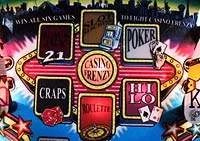
Take High Roller as a case study. You’re playing a poker-themed game. Your first job is to hit four specific poker targets. Once all four light up, the display and a physical sign on the table tell you to shoot the right ramp. This launches an interactive poker minigame on the screen. Win that hand and you could rack up millions of points.
But that’s just one mode. The table is full of them. Each is a self-contained game. When you clear them all, you unlock Casino Frenzy. Pinball nerds call this a Wizard Award. It’s where the big points live. The machine drops four balls onto the playfield at once. Point values for every target skyrocket. Hit the right ones during this chaos and you might snag the Super Jackpot. It’s the single biggest payout in the game.
Not every machine works this way. Some focus on ball-in-play time. Others demand precise sequences. Hitting bumpers gives you points, sure. But you won’t crack the high-score list without mastering those combination shots.
How to earn a free game in pinball
You’re down to your last ball. The screen flashes. Replay Value: 30 million.
This is the magic number. Hit it and you get a free game. Don’t count on it happening often. Most modern machines are calibrated so only the top 10 percent of players reach this threshold.
How do you know you made it? Listen for a loud bang. It sounds like something metal hitting the side of the cabinet from the inside. That’s the machine telling you—and everyone nearby—that you’ve earned another turn.
There’s a catch. After that first replay, the machine gets greedy. It raises the bar. The next replay value jumps to 150 percent of the original. It gets harder. Much harder.
The match feature
Luck still has a seat at the table. Every pinball machine has a match feature.
At the start of the game, the machine picks a random number ending in zero. 10. 40. 90. If the last two digits of your final score match that number, you win a free game.
The odds? Roughly seven percent or less. It’s rare. But it happens.
Why pinball machines tilt
Everyone hates it. The tilt sensor.
It’s there to stop cheating. Shake the machine hard enough and you can influence the ball’s path. Slingshots fire. Bumpers hit. Points soar. But the sensor knows.
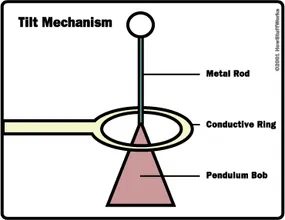
Inside the cabinet, a metal ring houses a cone-shaped pendulum bob. It hangs loosely in the center. Normally, it doesn’t touch anything. Shake the machine too violently and the bob hits the ring. Game over. The playfield goes dark.
Skilled players walk a fine line. They know exactly how much they can nudge the machine without triggering the alarm. It’s a delicate dance. Break it and you pay the price.

How Tilt Sensors Work and Why They Matter
Shake the cabinet, and the internal bob drifts toward the conductive ring. Contact means current. Current means the machine knows you moved it.
Older games? You lose the ball instantly. Brutal.
Most modern pinball tables are slightly more forgiving. They issue two warnings. After that, the flippers die. The ball drops. Game over.
But there is a harsher rule.
Slam tilts. This isn’t a gentle nudge. This is kicking the front glass. Picking the entire cabinet up. Heavy abuse. The sensors catch it. The game ends immediately. No warnings. No second chances.
“Slam tilts are heavy abuse of the game… usually in the form of someone picking the machine up or kicking the front end very hard.”
The Uncertain Future
So where does this leave pinball?
The mechanics are clear. The rules are strict. But the industry? That’s murky.
Collectors hoard vintage tables. New releases get louder, flashier, and more expensive. The physical act of playing remains unchanged, but the ecosystem shifts. Will tilt sensors stay this sensitive? Will digital replacements ever capture the tactile frustration of losing a ball because you leaned a little too hard?
We don’t know yet.
The machine waits. The bob sits in the center.
One shake away.


The ghost of Pinball 2000
It was supposed to be the future. Pinball 2000 promised a hybrid beast, a machine where physical flippers met digital targets on a video screen. Two games actually shipped. Revenge from Mars. Star Wars: Episode I. A third was cooking in the works. Then Williams/Bally pulled the plug on their pinball division. The idea died before it could really breathe. It’s a strange relic now, a “what if” frozen in time.
Stern stands alone
Back in the day, five companies fought for your quarter. Now? Just one. Stern Pinball survived the slaughter. Gary Stern runs the show. His father, Sam Stern, basically helped start Williams Electronics way back in 1947. The lineage is thick. Stern isn’t trying to revive the 1980s glory days. He’s aiming for the 18-to-35 male demographic in the US, kids who are already glued to TVs and video games. He plans to roll out three or four new tables a year. That’s it. That’s the strategy.
The global divide
Here’s the thing nobody talks about enough. Pinball is huge in Europe. Tiny in the US. Stern knows this. He’s banking on the international market to keep the lights on while he slowly chips away at the domestic scene. It’s a quiet persistence. No flashy announcements. Just machines.
The industry didn’t die. It just shrank down to fit in a garage.
If you’re hunting for more deep dives, the old web archives are still there. Internet Pinball Database. Pin Game Journal. They’re out there. Waiting for someone to click.


