The 16th and 17th centuries didn’t just add a few new facts. They tore up the old rulebook and threw it into the fire. This was a scientific revolution, a seismic shift in the way people understood reality. For nearly two millennia, the world was filtered through Greek philosophy, especially Aristotle. This view was qualitative. It was about purpose. It asked why things happened in a cosmic, almost moral sense.
Then something broke.
By the middle of the 17th century, science had developed into an independent discipline. It was no longer philosophy. It wasn’t just practical technology. It had utilitarian goals. It wanted results. In fact, it could be argued that by the end of this era, science had quietly usurped Christianity as the central organizing principle of European civilization. The Renaissance and the Reformation provided the fuel, but the Scientific Revolution provided the engine.
What has really changed?
- Common sense was re-educated. Abstract thinking overcame intuition. If it didn’t make logical sense on paper, your eyes were often wrong.
- Qualitative was replaced by quantitative. Nature was not “hot” or “dry”. It was all about the numbers. Measurements. Data.
- The machine metaphor prevailed. The universe was not a living organism with a soul. It was a clock.
- The experimental method was born. Scientists stopped looking for ultimate “final causes”. They began to ask how certain systems work within defined theoretical frameworks.
This was not just intellectual gymnastics. It was a fundamental reorientation in the human brain’s approach to truth.
Institutional explosion
New ideas do not exist in a vacuum. You need infrastructure.
The flood of new knowledge threatened to overwhelm the old academic system. It was no longer enough to publish one expensive book. You couldn’t just whisper secrets in obscure jargon in a private study or hide your insights in anagrams to avoid theft. That era was over.
Information needed for distribution. Quickly. And it had to be checked.
This put enormous pressure on the old institutions. Natural philosophers needed independent confirmation. They needed colleagues to examine their work before the public. So they built new structures.
Scientific communities emerged in Italy at the beginning of the 17th century. But the real highlight came from two national powerhouses:
- The Royal Society of London: Founded by the King in 1662.
- The Académie des Sciences: was founded in Paris in 1666.
These weren’t just social clubs. They were quality control centers. Here, thinkers gathered to study, discuss, and critique both new discoveries and old theories. To support these discussions, they began to publish academic articles.
The goal was universal comprehensibility. There was no hiding behind the Latin darkness. You had to write so that someone else could repeat your experiment. Accuracy of language became mandatory. If you were unable to reproduce your results, your original report was suspect. Failure to replicate was the theory’s death knell.
This system created the tools for a massive, coordinated attack on nature’s secrets.
Astronomy
The Copernican transition: from geometry to physical reality
Scientific revolutions did not start in the laboratory. Things start with the stars.
Polish astronomer Nicolaus Copernicus was the first to propose a fully heliocentric theory. That the Earth could move is not just a vague idea. This is the system. This is consistent with the predictive power of the old geocentric model proposed by Ptolemy. But it flips the script.
Why did he do this? He wanted to follow Plato’s rules. More precisely, it is the law of uniform circular motion. The old system was confusing. It lacks a sense of unity. It felt disharmonious. Copernicus wanted to understand the world more clearly.
Therefore, he used the same data as Ptolemy. Then he turned the universe upside down.
The sun has come to the center. The earth begins to rotate around it.
This book, published in 1543, looks simple on the surface. Simple quality. Compared to that, the old geocentric system seemed heavy. But there’s a problem. In order to get the numbers right, i.e. to match the accuracy of the old system, the new calculations were just as complicated. Elegance is only in the arrangement, not in the calculation.
The real revolution is not in mathematics. This is the belief behind it.
Plato’s Followers saw these models as tools. instrumentation. It is useful for calculations, but it is not always correct. Copernicus opposed this. He argued that astronomy must describe “real” physical systems. It’s not a map. The territory.
“For astronomy to be satisfactory, it must describe the real physical systems of the world.”
The transition from instrumentalism to realism changes everything. Predicting the position of a planet is not enough. You need to explain why it’s there.
The heliocentric victory was not an overwhelming victory. It was a silent, stealthy takeover.
As organized resistance movements eventually merged within the church and wider society, the intellectual foundations were changing. Most leading professional astronomers have secretly decided that some components of the new system are too useful to throw away. They may not accept the whole picture, but they want parts.
Nicolaus Copernicus’s De revolutionibus orbium coelestium libri VI changed the game as soon as it was published in 1543. The title translates to “Six Books on the Motions of the Celestial Bodies.” This book was chosen as a reference for solving advanced astronomical problems primarily because of its mathematical accuracy.
The book’s central cosmological hypothesis – that the sun, not the earth, is at the center – has largely been ignored by astronomers. They see it as a geometric rather than a physical truth. However, the calculations were so accurate that the results could not be ignored. Although this paper was widely read by mathematical astronomers, they missed its revolutionary implications.
Accuracy drives adoption faster than ideology.
In 1551, the German astronomer Erasmus Reinhold published Tabulae prutenicae or “Prutenic Tables”. These aren’t just updates. These are all calculated using the Copernican method. The result is a more accurate and up-to-date data set than previous tables from the 13th century.
These tables have become indispensable. Both astronomers and astrologers use them for predictions. We can’t work without them.
This creates a paradox. The Church can condemn the theory, but it cannot stop its practice. Professionals use these tools regardless of the philosophical questions involved. The system won not by convincing everyone of its reliability, but by demonstrating its usefulness.
Who can argue with better data? The tables worked. The old ones didn’t. In science, practicality often trumps faith.
The Precision That Broke the Ancient Sky
Tycho Brahe did more than just observe the stars. He measured them.
In the 16th century, space was controversial. On the other hand, there is Ptolemy’s heliocentric model. On the other hand, Copernicus’ heliocentric theory. Tycho rejected both. He didn’t try to pick a winner. He tried to correct the confusing and inaccurate data that had kept astronomers guessing for centuries.
His solution wasn’t a new theory. It was better hardware.
Before Tycho, observations were only guesses. Instruments were shaky. Calibrations were loose. Tycho created larger and more stable tools. He calibrated them until they were reliable. Then he watched. For decades. Night after night. One planet after another.
The results changed everything.
His data was precise to within one minute of arc. That sounds small. This is revolutionary. It is many times more accurate than anything ever recorded. This is not just a small improvement. This is a quantum leap in quality.
This precision reveals cracks in the ancient worldview.
For example, in the “nova” of 1572, a new bright star appeared in the sky. In Aristotle’s physics, the sky was said to be unchanging. Perfection never fades or changes. Therefore, it is impossible for new stars to be born. But Tycho measured it. There is no parallax. The destination is far away. Far beyond the moon. The sky is not static. they have changed.
Then there were the comets.
Aristotle taught that the sky is full of solid crystal balls. The planets are embedded in it like pearls in a rigid frame. The comet should be blocked. At least it should move within range of the moon. Tycho’s observations showed that the comet passed through a region where a solid sphere would exist. move freely. These balls must not be solid. they don’t exist.
Tycho had shattered the old model with data.
However, he did not replace it with Copernicus’ heliocentric theory. He never returned to Ptolemy. He needed a third option. This is the compromise that preserves the math and keeps the Earth in place.
He adapted an older idea from Heracleides. In his own world system, the Earth stayed at the center. The sun and the moon revolve around the earth. But the other planets, Mercury, Venus, Mars, Jupiter and Saturn, orbit the Sun.
It’s a mix. A messy middle ground. This avoids the extreme influence of the two grand theories. We continue to anchor the earth in a way that makes us theologically and physically comfortable. It acknowledges the influence of the sun on the wandering stars.
Tycho did not try to prove that the sun was the center. He set out to see clearly.
His instrument is the key. Her persistence is her driving force.
The information he gathered not only contradicted Aristotle; It provided the evidence that eventually forced the scientific community to accept the new astronomy. His successor Johannes Kepler used Tycho’s data to derive elliptical orbits. However, without Tycho’s constant and accurate observations, Kepler could not have obtained his numerical values.
Tycho’s system was ultimately wrong. The Sun is not just a companion planet. It is the center. But his legacy is not a model. Do it like this.
She taught us what heaven is capable of. He taught us what heaven is capable of.
Johannes Kepler did not start out as a rebel. He began as a believer.
In the early 17th century, he took the Copernican model of the earth orbiting the sun and tried to make it work. It’s not just about making it work. Let’s make it beautiful.
He was driven by a specific kind of obsession. A neo-Pythagorean itch. He believed that God built the universe out of simple harmonic numbers. If he could find the correct equation, he would be able to prove the divine order of the universe.
This seems like a recipe for success.
The result was 30 years of frustration.
Kepler combed through the data. He calculated orbits until his eyes burned. He was looking for the perfect geometric shape. The Platonic solids. Uniform circular motion. The idea that the planets move in clean, unbroken loops.
But the numbers don’t lie.
they never do.
More specifically, The data from Mars, specifically, refused to fit a circle. It was off by a small margin. A tiny sliver of error. To most astronomers, this is noise. Ignored. Explained away.
Kepler could not ignore it.
He realized the circle was a lie.
inspiration. Philosophical consolation. However, this is not the case.
This was the moment when ancient astronomy died. Kepler had to abandon the sacred geometry of the ancients. He must admit that the motion of the planets is not perfect. This is all about physics. This is a story about power.
He found a different relationship. An ellipse.
It was not as harmonious as he had hoped. It’s not simple. But it’s true.
The true order of the universe does not care about our aesthetic preferences.
Kepler’s stubbornness forced him to see only what was there, not what he wanted to be there. He traded mathematical beauty for physical precision.
In doing so, he laid the foundation for Newton.
For the first time, the sky is no longer just a perfect ball of clockwork. They are systems governed by measurable, if messy, laws.
He spent his life searching for harmony.
Instead, he found friction.
Perhaps most real discoveries begin here. It’s not an epiphany. But there is one problem that cannot be solved.
For centuries, people believed that the sky was ruled by a perfect circle. This illusion was shattered in 1609. Johannes Kepler published two revolutionary laws, based on the precise observations left by his predecessor Tycho Brahe, that redefined our understanding of the solar system.
The first law was a visual shock. The planets do not trace perfect circles around the sun. They move in an ellipses. The sun is not at the center, but at one of the two focal points of that oval path.
“With these two laws, Kepler abandoned the uniform circular motion of the planets on a sphere and thus raised the fundamental physical question of what keeps the planets in orbit.”
The second law dealt with speed. The planets do not move at a constant speed. When it is closer to the Sun, it speeds up. When it is farther away, it slows down. Kepler explained this with a geometric trick. If you draw a line from the planet to the sun, the line will sweep the same area in the same amount of time. This is a description of non-uniform motion that somehow maintains a certain mathematical balance.
This change is more than just a change in geometry. It forced a collision between two previously separate disciplines. Astronomy is the tracking positions. Physics is about forces and matter. Kepler’s laws require an explanation not only of “how” the planets move, but also “why” they move the way they do.
He drew on the work of the English physician William Gilbert, who published his De Magnete in 1600. Gilbert described in detail the qualitative properties of magnetism and explained how magnets attract and repel. Kepler suspected something similar was at work in space. He proposed that a force analogous to magnetism pushed the planets along their elliptical tracks.
This is just a guess. By today’s standards, A crude one, by modern standards. However, this was the first serious attempt to provide a physical basis for celestial mechanics. The marriage of astronomy and physics was announced.
Five years later, in 1618, Kepler added a third piece to the puzzle. This law has nothing to do with the shape of the orbit and the rhythms of the solar system. Solve the planetary motion harmonization problem.
The rule was simple, yet profound: The square of the time a planet takes to orbit the sun is proportional to the cube of its average distance from the sun.
This relationship connects time and space in a way that applies to all planets. It wasn’t just about Mars or Earth. This is a universal rule. The more distant the planet, the longer its year, and this relationship follows a precise mathematical curve.
Kepler shifted the discussion from description to mechanism. He shows that the sky is not divine and immutable, but governed by rules that can be explained by measurement, calculation, and ultimately force. The stage is set. The stage was set for someone to figure out what that force actually was.
The telescope shatters the ancient sky
The old cosmic order has not only collapsed; It collapsed under the weight of the Dutch lens grinder’s invention. In the early 17th century, Galileo Galilei pointed upwards towards this new tool, but what he saw did not match Aristotelian script. In 1610, he dropped observations that seemed less scientific and more heretical to established thought.
The moon is not the perfect, smooth sphere that philosophers have claimed for centuries. It’s jagged. Mountainous. Genuine. The way earthshine illuminated the dark side of the moon reveals a simple but devastating truth. Earth, like other planets, shines by reflected light, not its own innate brilliance.
Then came Jupiter. It had satellites.
This fact is a serious blow to the geocentric model. If Jupiter can hold moons as they move through space, why not Earth? Earth is no longer the only fixed anchor in space. It’s just another planet. The phases of Venus determines this. Venus orbits the sun, not the earth. The Ptolemaic system was built on centuries of careful observation and philosophical comfort, and there was nothing left to hold on to.
The battle between mechanics and Copernicanism
The battle over the Copernican model is about more than astronomy. This is a fight for the rules of movement. The Ptolemaic-Aristotelian system was huge. It stood or fell as one. Its foundation was simple. Earth is fixed in the middle.
Take that away, the whole doctrine of “natural motion” evaporates.
In the old view, objects move to find their “place”. Since the earth is the center, heavy objects fall. Light things rise to seek the realm of the moon. Circular motion is reserved for heaven, where things are perfect and eternal.
But what happens if the Earth moves? If it spins and orbits? Then the rules change. The circular motion of the earth is not compatible with Aristotelian physics. It breaks the logic that had held… for over a millennium of western thinking. There’s more to this battle than just what you see through a lens. Is the world really working as it should or is the whole map wrong?
Galileo’s breakthrough in mechanics was not just an academic exercise. they are weapons. He needed them to defend his Copernican model of the universe.
Young Galileo started with the old rules. He believed in the traditional physics of propulsion. The idea is simple. The pusher applies a force to the object, and this force moves the object until it is exhausted. However, Galileo had other preferences. He wanted to mathematize nature like Archimedes. He couldn’t hold on to the old ways. He needed a new physique. A person who can do math. A model for understanding the universe based on the Earth’s motion.
Falling Object Mathematics
He wondered how quickly things went downhill. It’s not just “fast”, it’s “how” it accelerates. This is the natural acceleration of a falling object.
he solved it. The distance an object falls s is proportional to the square of the time t². A simple equation. Its meaning is deep. Things just don’t fall. Accelerates in a predictable geometric rhythm.
Ammunition and movements
This equation is not alone. He combined this with the basic version of the principle of inertia. result? Path of parabolic motion.
Until now, there was no real explanation as to why seashells form such arches. Galileo showed the math behind the arc. This is not magic. This is not God’s will. This is geometry in motion.
Why does the movement of the earth feel like movement?
This brought us a lot of opposition. If the earth is spinning, why can’t we feel it? Why can’t we let go?
Galileo’s answer was based on the same principle of inertia. A body in motion tends to stay in motion. Objects on the surface of the earth have moved with the earth. They shared a shop.
Moving objects tend to stay in motion, so projectiles and other objects on the ground share the motion of the Earth and are therefore imperceptible to a person standing on the Earth.
You don’t feel that the earth is spinning because you are part of the system. The air moves with you. The earth moves with you. Objects around you also move with you. It’s seamless. Or so it is, until someone tries to prove otherwise.
Why Descartes rejected empty space
René Descartes was not busy solving technical problems. His mechanical work in the 17th century was not about building better machines, but about reconstructing the foundation of science itself. He wanted to explain all natural phenomena through the lens of matter and motion. This approach became known as “Mechanistic Philosophy” and soon dominated scientific thought in the following century.
His logic is strict. He did not believe that one object could affect another across a vacuum. Action at a distance? Impossible. Instead, the force must be transmitted through a physical medium. He called it “ether”. It fills every centimeter of space and leaves no real void.
The Problem with Straight Lines
This is a strange thing in physics. Descartes accepted a version of inertia. Matter wants to move in a straight line. It’s simple enough. But there’s a problem. No substance can occupy space that is already occupied by another substance.
So what happens if everything is filled with aether and the particles want to go straight but can’t pass through each other?
In a fully crowded universe, linear motion is impossible. Instead, the particles are forced to spin. They move in the form of a ring. Each particle in the ring moves at the same time as the other particles. The only possible movement in the plenum is a vortex.
The Dominance of Mechanical Philosophy
This is more than just a slight variation on Newton’s idea. This was the main theme of science in the 17th century. Descartes moved science away from mystical or mystical explanations by insisting that everything can be explained in terms of “matter and motion.” He wanted a mechanical model of the cosmos.
However, this model comes at a cost. The universe he described was a system of dense vortices. Gravity is not a force that pulls objects through space. This is the result of a circular motion that pushes the target towards the center. This is a complete system. It is elegant. It turned out to be a mistake.
However, this shift is important. It moves from a teleological sense of “why” things happen to a discussion of “how” they happen mechanically. Even if his particular mechanism failed, the need for a material explanation of forces set the stage for everything that followed.
Solving the mystery of the collision
Christiaan Huygens didn’t just follow in the footsteps of René Descartes. He repaired the foundations. Descartes believed that everything in nature happens through collisions of tiny particles. If this is true, it’s about understanding the consequences. Without knowledge of the mathematics of collisions, it is impossible to understand the workings of the universe.
Descartes tried to figure this out. He was off. His crash rules are confusing and inconsistent. A Dutch physicist revealed this fact. This physicist was Huygens.
Huygens went back to the beginning. He observed objects moving before and after the collision. He found a pattern. Genuine pattern. It’s not a guess.
He identified two quantities that remain unchanged in the chaos of collision: Momentum and Kinetic Energy.
Here is the catch. The momentum is always maintained. It doesn’t matter if the impact is soft or hard. It just holds.
Kinetic energy? That’s different. It’s only conserved in elastic collisions. Consider billiards. Perfectly rigid. No heat loss. There is no sound. It bounces perfectly. The energy stays in the game.
Drop a lump of clay. It hit the floor. There will be no bouncing. Kinetic energy is lost. It produces heat, sound and deformation. Momentum still exists. The earth recedes a little. But what about energy? Gone from the mechanical system.
Huygens discovered this in the 1660s. Long before the word “energy” became standard. He found that in these perfect bounces, the sum of the mass times velocity squared remains constant.
This distinction is important. It separates the real world from the ideal. Real collisions are rarely elastic. Friction. Deformation. Heat. These absorb kinetic energy. But momentum never disappears. It transfers. It shifts.
Descartes believed that all collisions followed simple arithmetical rules. Huygens showed that physics requires more nuance. You need to know what kind of collision you’re dealing with. Elastic? Energy stays. Elastic? Energy leakage.
This is not just an academic matter. It changed how we calculate forces. It changed the way engines were built. How we design safety features. How do we understand the motion of the planets?
Huygens’ laws didn’t just describe the crash. They predicted the aftermath. And they did it with precision.
Sir Isaac Newton didn’t just participate in the scientific revolution. he effectively ended it. By the end of the 17th century, the mystery of the workings of the universe was still fragmented. Newton’s Principia Mathematica, published in 1687, stitched those pieces together. This is more than just a book. It was a solution.
The Principia solved a perplexing problem in mechanics and cosmology that had puzzled scientists for decades. It gives physical weight to Kepler’s laws. It combines the physics of the sky with the physics of the earth we walk on. For more than a century, this framework has defined how astronomers and physicists conduct their research. Newton achieved this by combining two opposing ideas: mechanical philosophy, which saw the universe as a clock, and the mathematization of nature, which believed that reality could be described by numbers and equations.
Three laws of movement
Newton drew these far-reaching conclusions from three simple statements about motion. They seem basic now. They were revolutionary then.
- Inertia : An object remains at rest or continues to move in a straight line unless a force pushes or pulls it.
- Force and acceleration : The change in motion is proportional to the applied force and occurs in the direction of this force.
- Actions and reactions : Every action has an equal and opposite reaction. Two bodies push against each other with equal force.
It is worth noting that Newton himself did not write the second law in the form F = ma. The Swiss mathematician Leonhard Euler refined it to its modern form in 1750. However, the core idea remains the same. The rate of change of velocity is directly proportional to how hard you push, and inversely proportional to the weight of the object. More mass means more force is needed to move it.
Gravity and the infinite universe
Applying these laws to the stars requires a leap of faith. Newton had to expand his mechanical philosophy beyond the limits set by René Descartes. Descartes believed in the power of touch. That is, things only interact if they are connected. Newton opposed this. He argued that gravity acts “anything” between two objects in the universe.
He didn’t know how this power worked. There is no mechanism to explain how gravity moves through space without a medium. It is the mystery of remote behavior that keeps philosophers awake at night. But the math works.
Using the laws of motion and the weakening of gravity as the inverse square of the distance between two objects, Newton derived Kepler’s laws of planetary motion. He also showed that Galileo’s law of free fall was fully compatible with his system. The same force that pulls the apple to the ground keeps the moon in orbit around the Earth and the planets in orbit around the sun. It was one force. One rule.
Flattening the World
Newtonian physics makes accurate and testable predictions about the shape of our planet. He believed that the earth was not a perfect sphere. Since it rotates, it should bulge out at the equator. It should be slightly flattened at the poles.
This is not just a theory. This is a challenge. In the mid-18th century, French expeditions were sent to measure its length at latitudes near the equator and around the Arctic Circle. The results confirmed Newton’s prediction. The data was undeniable. Most European scientists eventually rejected the Cartesian model. They turned to Newtonian physics.
Newton used this oblate shape to explain another phenomenon: the precession of the equinoxes. The Moon and the Sun exert a different gravitational force on the Earth’s equatorial bulge. This differential effect causes the Earth’s axis to slowly wobble and change direction over time. This is a complex dance of gravity and rotation, solved by the same equations that govern the fall of an apple.
Optics
While Principia’s focus was on mechanics, Newton’s work on optics was equally disruptive. Over the years, he has experimented with light, for example by using a prism to split white light into different colors.
More than just a scientific revolution happened in the 17th century. It lived it through the lens of optics. This is not philosophy for philosophy’s sake. It’s a chaotic and wonderful combination of practical experiments and cold, hard numbers.
The roots go back deep. Around 300 BC. Euclid wrote the basics of geometric optics. He nailed the law of reflection. The angle of incidence is equal to the angle of reflection. Simple. elegant. However, it wasn’t until the 13th century that the practice reEverythingy began to spread in Europe.
Roger Bacon. Robert Grosseteste. John Pecham. They Everything studied the works of the Arab scholar Ibn al-Haytham, who died around 1040. Ibn al-Haytham was a true master who tackling everything from the rainbow to what we actuEverythingy see. The Europeans built on his shoulders.
Next was Johannes Kepler.
He read documents from the 13th century. He saw a path forward. Kepler changed things by breaking things down. Point by point. He traces rays from each point on the object to a specific point on the image. This is a fundamental change.
Just as mechanical philosophy broke down the world into atomic parts, Kepler studied optics by breaking down organic reality into ultimately real units.
He treats light like a machine. He developed a geometric theory of lenses. In the process, he provided the first truly mathematical explanation of Galileo’s telescope. He didn’t just describe it. he solved it.
But the story is not just about geometry.
Rene Descartes wanted more. He wanted to integrate optics into a new mechanical philosophy. For Descartes, light was more than just a ray or an angle. This is matter in motion. Everything.
He used mechanical analogies to prove it. He mathematicEverythingy derived the law of reflection. He also tackled refraction. This is a newly discovered property of light, and Descartes cracked its code. He showed that the behavior of light can be fully explained by the laws of matter and motion.
There is no magic. There are no mysterious features. Just mechanics.
This shift mattered. It changes optics from a descriptive science to a predictive science. You can calculate light effects before you even set up the lens. It paved the way for instruments that would define the next century.
The tension between geometry and mechanics was not resolved immediately. Kepler rays and Cartesian particles are correct to some extent. But they point to a different kind of future. One toward the precision of instruments. The other toward the physics of energy.
We’re still untangling that knot.
Newton’s prism experiment
For centuries, it was commonly believed that white light was pure with added color. Thinkers like Descartes believed that color is created by the rotation of light particles. Newton destroyed this idea with an experiment that is still valid today.
He shows that white light is not simple. It is a mixture of all colors. When you pass white light through a prism, it doesn’t just become a “color”. It split.
White light is a mixture of different colored lights that can be separated.
Newton associated certain colors with a certain degree of refrangibility. This explains why prisms produce spectra. Different rays bend at different angles. Blue bends more than red. The spectrum is not created by the glass. It was revealed by it.
This disproves the traditional theory. Color is not a variant of white light. They were already there waiting in the white.

Newton didn’t just look. he measured.
His experimental approach is defined by a constant focus on quantitative data. He needs variables that you can evaluate. He must draw a clear line between what he sees and the mechanical story he tells of “why” he sees it. This difference was his trademark.
But his other major contribution to optics went beyond simple measurements. It involves interference.
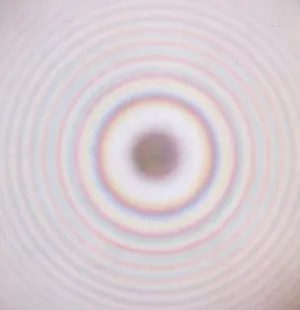
You know the phenomenon. A rainbow spins in a pool of oil. The soap bubbles shine in the colors of the rainbow. These are Newton’s rings.
Before Newton, people perceived colors through thin films. Everyone did it. But no one has ever tried to measure this magic. Newton changed that. He monitored the relationship between the thickness of the membrane and the diameter of the rings. He found a pattern. There are regularities.
He tried to explain this with the theories “fits of easy transmission” and “fits of easy reflection”.
This is where it gets weird.
Newton generally believed that light is made up of particles. Corpuscles. But his description of these rings required regularity. It must vibrate. More precisely, it is the vibration of the ether.
ether. hypothetical fluid permeates every space.
Therefore, particle theorists used wave-based media to explain their discoveries. Are you contradicting yourself? perhaps. Or just someone trying to hit the numbers at any cost.
Huygens and the Pulse
Christiaan Huygens was another giant of 17th century optics.
He criticized Descartes. He analyzed Descartes’ system in detail. However, Huygens followed the Cartesian tradition. He wanted a mechanical explanation. Very mechanical.
He saw the light as pulses. A disturbance that travels through a medium.
But he drew the line. He clearly denied that the light pulses were regular. There are no waves. There are no loops. It just pulsates.
Huygens did impressive things with the wavefront concept. He derived the laws of reflection and refraction from pulse theory. He didn’t just describe them. He calculated them.
He also solved the problem of birefringence. A recently observed phenomenon is confusing everyone. Huygens used a model to explain it.
The stage is set. Two minds. Two ways. One is obsessed with measuring and fitting, the other with pulses and wave fronts. The discussion about the nature of light is far from over.
Chemistry
Chemistry is not new. It found its way into philosophy, alchemy, metallurgy and medicine. Over the centuries, these fields have penetrated each other. It was only in the 17th century that mechanical philosophy was born and chemistry finally established its position as an independent science.
Before the breakup, everything was connected. Aristotle discovered that earth, water, air and fire are the building blocks of reality. They are not static. You can turn one into another. Each substance contains a mixture of all four substances. That thought stuck.
Then came alchemy. It was born in two regions at the same time: Egypt and the Middle East. It is actually transmutation or the making of gold from lead and other base metals. In theory, it is a mirror of the universe. Alchemists believed that the human body was a reflection of the universe. Treat the microcosm the same as the macro world.
This dual nature provides chemistry with a wide toolbox. Alchemists work with substances that are not available to others. They test, burn and distill. They left behind a long and confusing tradition of experience.
Paracelsus made things even more complicated. This 16th century Swiss natural philosopher did more than study chemistry. He combines it with everything else. He adopted Aristotle’s theory of matter. He was mixing alchemical correspondence. He added occult knowledge and chemical medicine. The result was dense. Very hard to read. But it does have an effect. His ideas influenced generations of thinkers after him.
At the beginning of the 17th century, things were chaotic. No shared doctrines. No common framework. Chemists could not develop each other’s research because they did not speak the same language. Growth was stagnant.
Instead of collaboration, they built “chemical philosophies”. These detailed systems are intended to describe the entire universe using only chemical terms. Most stuck to the old guard. They accepted Aristotle’s four elements. Or the Three Principles of Paracelsian: Salt, Sulphur, and Mercury. Some people accept both. These are the “real qualities” of matter.
But there is another pull. The darker one. Many chemists of this era clearly showed tendency toward the occult. Why are they doing this? This may be because the visible world alone is not enough. Perhaps it is because they are still pursuing their alchemical dreams of hidden truths.
Mechanical control in chemistry
Until this revolution, chemistry was a collection of disparate observations without a unified frame of reference. mechanical philosophy offers something rare: a common language. This is not just a theory. It’s a bridge. By viewing matter as physical objects that behave according to laws, chemists finally talk to physicists.
Why is this important? Because it makes chemistry respectable.
In the past, alchemy and early chemistry were often considered mystical or purely practical professions. The mechanical approach stripped away the mystery. This shows that if you could describe the reaction in terms of motion and collision, then we have explained it. This combination with experimental empiricism gives the field intellectual significance. It transformed the confusing world of drugs and paints into the clear terms of a new scientific revolution.
Robert Boyle is at the center of this change.
He is more than a theorist. He’s in the lab. Boyle’s work has a clear three-part agenda:
– Understand the chemical properties of substances through accurate observation.
– Provides experimental proof of machine philosophy.
– Shows that all chemical phenomena can be reduced to mechanical terms.
Although he was an outstanding experimental chemist, often overlooked in favor of his theoretical writings. But his practical skills are the real key. He developed critical techniques are still fundamental. These include color recognition tests. These are not just gimmicks. These were early attempts to create objective, reproducible criteria for identifying substances.
“The goal of his research was to understand the chemical properties of matter and to show that all chemical properties can be explained in mechanical terms.”
Boyle’s success showed that the mechanical model was more than a mere philosophical preference. It was a working tool. This allows chemists to move from guessing to measuring. The door to modern chemistry opens through accurate observation.