Silence. Just silence.
For decades astronomers listened to the static of deep space expecting hot gas giants to scream radio signals at them. These worlds were supposed to be monsters. Jupiter-level magnetic fields or worse. Hundreds of times stronger than Earth’s. The math said yes. The physics said yes.
So why nothing?
Turns out the answer might be embarrassingly simple.
The planets just don’t have those huge fields. New data suggests they’re quieter, weaker, and far more similar to the giants in our own backyard. Which means all those decades of waiting for a shout was maybe a mistake. You have to learn what quiet sounds like.
“It’s the first time we compare the magnetic environments of other planets,” says Julia Seidel, who leads the study.
This isn’t about finding life on a ball of fire. Well. Not directly. It is about figuring out how magnetism works so we can eventually look at tiny rocky worlds and see if they survive too. Survival means protection. Protection means magnetic fields keeping star radiation away.
But get there through wind.
The wind was the clue.
Seidel’s team looked at seven ultra-hot exoplanets using big telescopes in Chile and Hawaii. We’re talking planets boiling at 3000+ degrees Fahrenheit because they sit so close to their suns that one side cooks while the other freezes in eternal shadow. The pressure creates hellish winds.
Fast. Really fast.
4,500 mph on the low end. Up to 15,50 mph at the peak. For context Jupiter’s best winds are barely breaking a grand. These planets are whipping iron through the sky like shrapnel. They measured it by watching how that iron swallowed starlight. Shift the light see the speed. Simple optics.
Except the pattern was wrong.
Here is the problem: hotter planets have more heat. Heat creates pressure. Pressure should push harder. So logically the hottest worlds should have the fastest winds. Right?
Wrong.
The data showed the opposite. The hotter the planet the slower the wind got. Counterintuitive? Completely. Vivien Parmentier notes it’s the exact reverse of what basic thermodynamics should give you if the atmosphere were free-flowing.
Something was hitting the brakes.
And only one force fits that role. Magnetic drag.
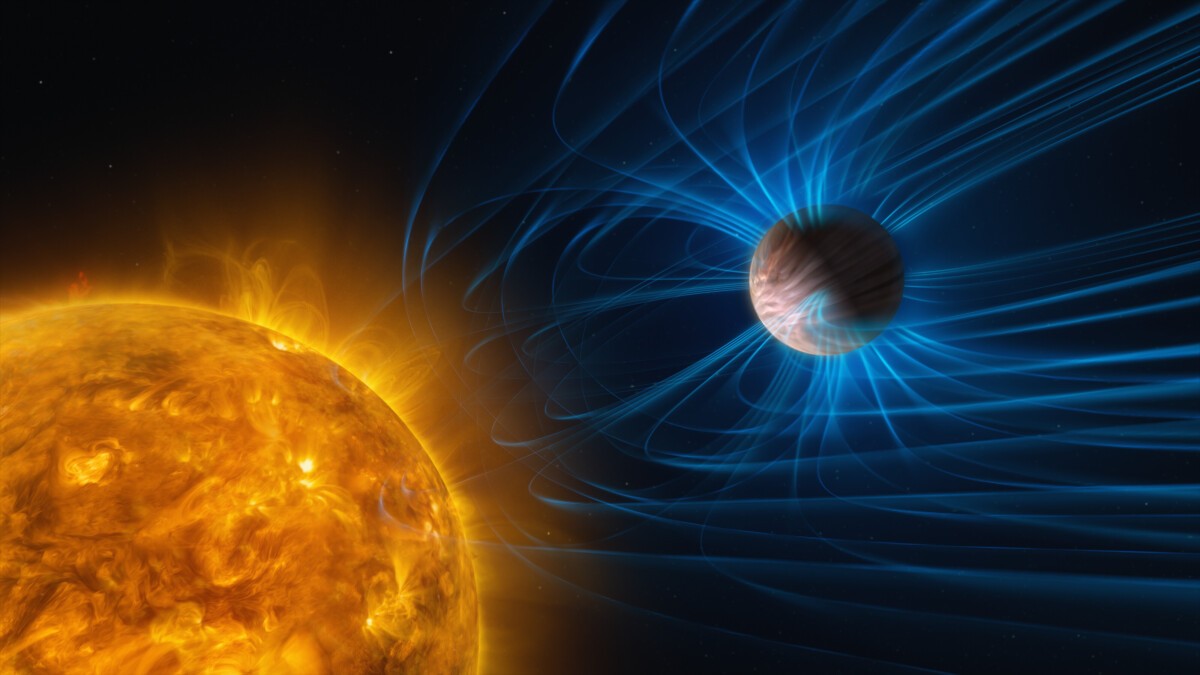
Gas hates magnetic fields. It wants to move freely but fields pin it down. Resisting flow creates friction. Slows the gas down. If you see hot planets moving slowly you can back-calculate how strong that magnetic pinch must be.
The result? Normal. Not monstrous. Just like Jupiter. Maybe Saturn. Definitely not the hundred-times-stronger nightmare some theorists promised us.
Does this mean we stop listening? Probably not. But maybe we change frequency. Or expect less noise. The mystery of the missing radio bursts might just be that the speakers weren’t plugged in hard enough to begin with.
Which brings us back to why anyone cares.
Magnetic fields shield planets. Strip the field strip the atmosphere. Lose the air lose the water. Lose the chance for anything biological to stick around. So if ultra-hot gas giants are normal maybe rocky super-Earths are normal too.
It is a comforting thought. A hopeful one.
Bibiana Prinoth from ESO imagines skies full of auroras on these worlds. Colors dancing between eternal day and night curtains of light tearing through a violent sky.
Pretty picture. Scientific truth buried underneath.
The winds tell the secret now. The magnetic field is hiding in plain sight braking the flow. We finally hear it because it’s holding its breath.