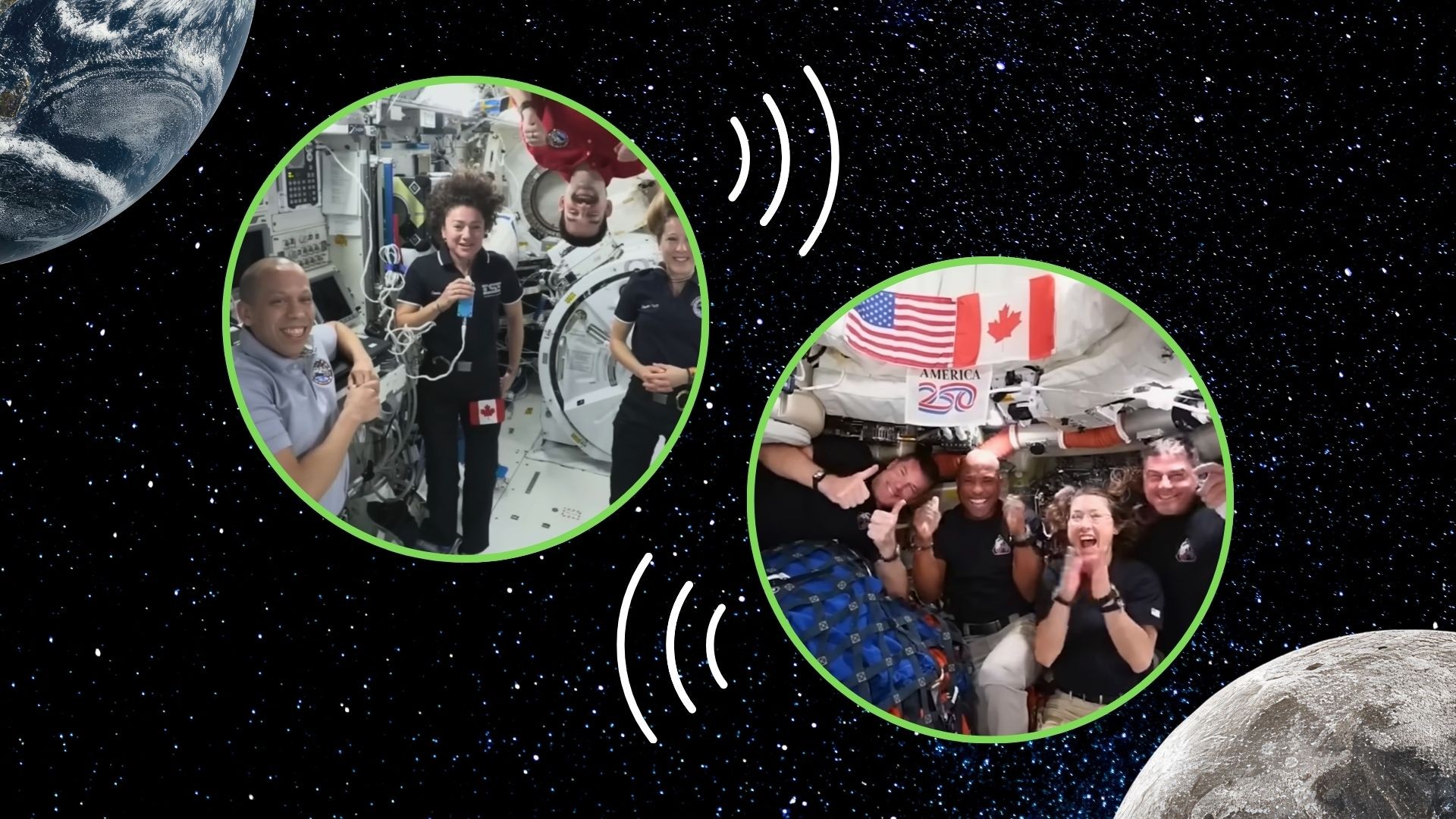
In a historic moment for space exploration, the crew of the Artemis 2 mission conducted the first-ever ship-to-ship communication between astronauts orbiting the Earth and those traveling toward the Moon. This livestreamed call bridged a massive gap of approximately 232,141 miles (373,595 km), marking a new milestone in how humanity connects across the solar system.
Bridging the Cosmic Gap
The scale of this distance is difficult to grasp through numbers alone. To put it into perspective, the distance between the two crews was equivalent to sailing the distance between Boston and the Panama Canal 92 times over.
Despite the vastness of space separating them, the tone of the conversation was remarkably human. Rather than focusing solely on technical telemetry, the astronauts from both the International Space Station (ISS) and the Artemis 2 spacecraft shared stories about their views, their food, and the unique psychological challenges of living in microgravity.
Lessons from the ISS: A Foundation for Lunar Flight
A central theme of the conversation was how the experience gained on the ISS serves as a vital blueprint for lunar missions. NASA astronaut Christina Koch highlighted that the operational principles learned during long-term stays on the ISS—such as managing high-risk, real-time environments—are being directly applied to the Artemis mission.
The transition from Earth orbit to lunar orbit brings both practical and logistical shifts:
– Operational Continuity: The “flight operations principles” used on the ISS remain the backbone of deep-space travel.
– Spatial Challenges: Astronaut Victor Glover noted that unlike the ISS, which has multiple modules to spread out activities, the Artemis spacecraft requires much more careful coordination to avoid “spatial conflicts” between crew members.
– Daily Life: Basic tasks, such as eating and managing water in microgravity, remain a shared learning curve for all space travelers.
The “Overview Effect” and Human Connection
The astronauts also touched upon the profound psychological impact of seeing Earth from space—a phenomenon often called the “Overview Effect.”
Koch described how looking back at Earth emphasizes not just its beauty, but the “blackness” surrounding it, which serves to highlight how precious and fragile our home is. This perspective reinforces a sense of universal connection; seeing the planet as a single, isolated entity emphasizes that all humans share the same life-sustaining environment.
Lighthearted Moments Amidst the Mission
Despite the high stakes of deep-space travel, the call was filled with camaraderie and humor:
– The Rookie Experience: Canadian Space Agency astronaut Jeremy Hansen shared anecdotes about the learning curves of his first flight, including accidental mishaps with water dispensers.
– Orbital Thrills: Astronaut Reid Wiseman recounted the “mind-bending” experience of the translunar injection burn, where the Earth appeared to grow rapidly in the window as the spacecraft accelerated toward the Moon.
– Space Menus: The crews even compared their meals. Interestingly, both crews favored spicy foods (like spicy green beans), as taste sensations tend to dull in microgravity.
“It’s fun to be up in space with you at the same time,” remarked Jeremy Hansen, capturing the unique bond shared by those venturing into the final frontier.
Conclusion
This historic call serves as more than just a technical feat; it demonstrates that as humanity moves further from Earth, the social and operational bonds formed in low Earth orbit will be the essential threads that hold deep-space missions together.
Summary: The Artemis 2 crew successfully completed a historic long-distance call with the ISS, bridging hundreds of thousands of miles to share technical insights, psychological reflections, and the human camaraderie essential for the future of lunar exploration.