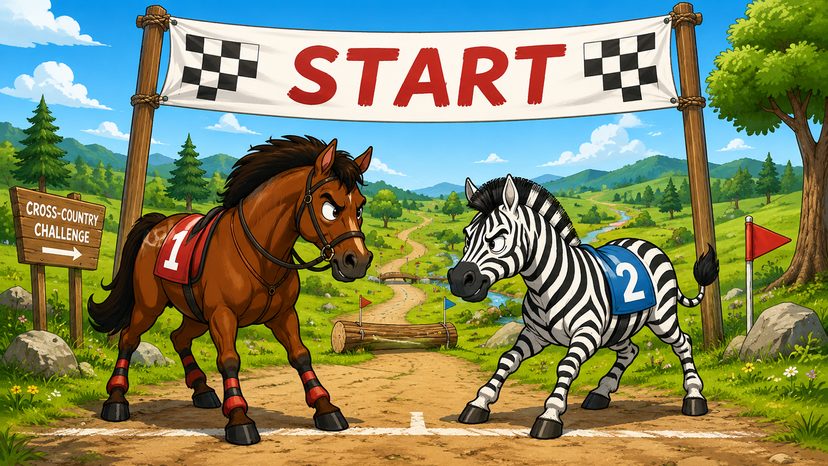
It’s easy to think that zebras have an advantage. They are closely related to the striped wild horse, bred in the harsh savannahs of Africa. they are strong they are fast. they are always on guard.
But if you put aside the survival context and look straight ahead, the answer is clear. A racehorse beats a zebra.
Zebras are not slow. They are true runners with the speed to evade predators. However, this racehorse was selectively bred for this job. Go faster on straight and oval tracks. Efficient step mechanics. Includes high performance tuning.
Sizing Up the Competition
Modern thoroughbred racehorses are purpose-built athletes. In published race profiles, the top speed is typically around 40 miles per hour (64 km/h). They are typically about 15 to 17 hands (60 to 68 inches) tall. They weigh around 1,000 to 1,200 pounds (454 to 544 kilograms).
A zebra is a small wild animal of the equine family. Encyclopedia Britannica says they are large, single-toed ungulates built for fast, long-distance movement. The height at the withers is usually about 47-55 inches (119-150 cm). According to the San Diego Zoo, Grevy’s zebras are the largest equids in the wild, weighing up to 990 pounds (449 kilograms).
The original horse frame design had an advantage for racehorses. Longer legs. Bigger frame. Breed improvement especially for racing use. For generations, choices have been made based on speed.
Zebras have a toolkit for survival. tenacity. Agile. awareness. Fast enough to keep a predator working towards dinner.
Top speed: Racehorse Wins
Zebras run very fast. Much zoo and wildlife literature indicates that zebras have a top speed of about 35 to 40 miles per hour (56 to 64 km per hour), depending on the species and conditions.
This is not “farm animal trots away from you” speed. This is the speed at which “your car is going neighborhood speed and the zebra is still in the frame”.
However, racehorses can reach slightly higher top speeds. This enables greater competitive efficiency. Thoroughbred horses are bred to have a stride length. Cardiovascular capacity. Muscular strength. The ability to continue running at high speed for a certain distance.
Zebras can move. Racehorses are designed to run faster through centuries of selective breeding.
“Horses are designed to run faster through centuries of selective breeding.”
100 meter run
Horses can win even in very short sprints. But this is one of the better opportunities for zebras.
The zebra’s acceleration is important in nature. You have to blow away lions, hyenas and other predators. Usually start from a standing position. Should still be avoided. Veer. React quickly. Instead of just staying in the perfect lane.
However, racehorses are trained to break fast. Speed up efficiently. On a clean, flat, straight track, your horse should be able to accelerate quickly. Increase your stride length after a certain distance to extend your lead.
400 meter run
When it comes to 400 meters, the advantage of horse racing becomes even clearer.
This is exactly the distance needed for breeding and training. Horse races can be sped up. Settle into a high-speed gallop. Keep driving until the end. Its body structure is designed to consistently produce high power in short and medium-distance races.
Zebras can run fast. But it was not bred or trained for track time sprints. This natural speed is for survival. Burst away. Veer. Stay with the herd. Don’t get caught.
From there, Striped Wild Cousin begins to realize that the horse has a trainer. training program. Probably a weirdly expensive supplement routine.
Mile Race
In most controlled environments, horses can still win the mile.
Thoroughbred racing is often fall around this general distance range. Horses are trained to control their speed over more than a short sprint. Unable to maintain maximum speed throughout the journey. But they are really good at pacing. Accelerate. Finishing hard.
Zebras have the ability to travel and travel long distances. But migrating endurance is not the same as running fast miles. Zebras were born to travel. Survive. Hide from predators. Not to run a sub-elite equine track race.
Long distances and uneven terrain
Horses win on well-kept fields. In the rugged terrain of the Predator Country, the problem is not as clear.
Zebras live with rocks. Dust. Rut. brush. hot. Uneven footing. Sudden danger. They are tough and agile. They also have strong herd instincts and tested moves to survive.
Horses are strong and fast. But it’s also optimized for serviced racetracks and controlled racing environments. Rough surfaces increase the risk of injury. Benefit from the reduced efficiency of the polishing process.
Therefore, if the race turns into a long, ugly cross-country race in the rugged savannah terrain, the zebra’s chances of winning improve.
Heat resistance and durability
Zebras may be able to cope with harsh, open environments better than many racehorses. They evolved under heat. drought stress. Predator. travel long distances. How tough they are doesn’t necessarily show in their speed charts.
Horse racing is elite. But they are also managed athletes. They were fed. Trained. Cooled down. Vetted. Protected from poor footing. Their speed is amazing. However, its performance varies depending on the conditions.
in hot conditions. on rough ground. After a lot of trouble. Zebras become even more competitive.
But one clean race? The horse still has it.