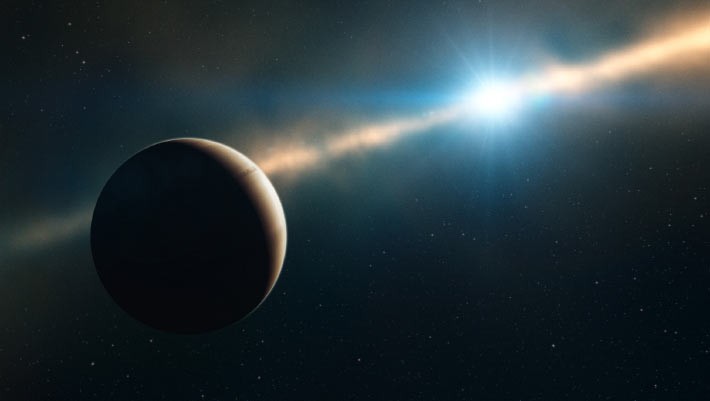
We thought we knew where Beta Pictoris b came from.
Turns out, the carbon isotopes lied.
Astronomers used the upgraded GRAVITY+ instrument on the ESO Very Large Telescope Interferometer to peek inside the atmosphere of this young giant. They wanted the carbon isotope ratio. Specifically, the mix of Carbon-12 and Carbon-13 locked up in carbon monoxide.
Why does it matter?
Isotopes have the same protons but different neutrons. Slightly different masses, mostly similar chemistry. In space, they stick with oxygen to form 12CO and 123CO.
By measuring the ratio, you should be able to tell if the planet formed inside or outside the CO snowline.
The snowline. That radius where it’s cold enough for gas to freeze. Form inside the line, you breathe CO gas. Form outside, you crunch on CO ice. Simple physics, right?
Wrong.
Beta Pictoris b orbits at 8 astronomical units (AU) from its star. Way closer than the snowline. If previous data were true, this Jupiter-mass behemoth—weighing 9 to 13 Jupiters—should have formed out in the cold dark and migrated in. That’s a long way to travel.
Antonia von Stauffenberg and her team at the Max Planck Institute weren’t buying the old data. They suspected the original GRAV instrument was too fuzzy. It gave a low ratio. A result suggesting the planet did form out past the ice line.
“We advised caution in interpreting the results,” they noted. “GRAVITY may have been inadequate.”
So they ran the numbers again. With the sharper eyes of GRAVITY+.
The new ratio? Higher. Much higher.
It matches what we see in the solar system. The interstellar medium. And a dozen other young gas giants. Consistent, yes. But disappointing.
The shift moves the formation point back to the inner, warm disk. Where the planet sits right now. No grand migration drama. No cosmic commute across the system. Just local origins.
This feels bad for the method.
If every young giant has the same carbon isotope signature, the signature tells you nothing. The variance during formation is too subtle for current tech to catch. We are missing physics. Some key mechanism in CO ice chemistry remains invisible.
So the birthplace of wide-orbit giants? Still a mystery.
There was a glimmer, though. A hint of flux variation tied to the planet’s 8.7-hour spin. Maybe clouds? Chemical churns in the upper atmosphere? It’s faint, likely noise, but it suggests the weather out there is changing.
Beta Pictoris b refuses to hand over its autobiography. We’ll need better tools to read it.