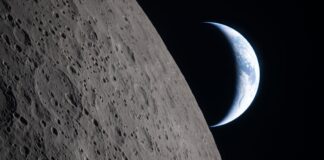
New research suggests that the Moon’s most ancient, darkest craters may hold the greatest concentrations of water ice. This finding is a significant breakthrough for future space exploration, as these “cold traps” could provide the essential resources needed for long-term human habitation on the lunar surface.
The Search for Lunar Water
For decades, the presence of water on the Moon was a subject of intense scientific debate. In the 1960s, scientists theorized that the Moon’s south pole—where the sun’s angle is so shallow that certain crater interiors remain in perpetual darkness—could host water ice. However, the Apollo missions of the late 1960s and early 1970s initially seemed to debunk this, as the lunar soil (regolith) brought back to Earth was completely dry.
The narrative shifted in 1994 when NASA’s Clementine mission detected radar signals suggesting ice, a finding later confirmed by the Lunar Prospector and the Lunar Reconnaissance Orbiter (LRO).
Why this matters for astronauts:
Water is the “gold mine” of space exploration. If harvested from the Moon, it can be used for:
– Life support: Drinking water and breathable oxygen (via electrolysis).
– Propulsion: Hydrogen and oxygen can be combined to create rocket fuel, turning the Moon into a refueling station for deeper space missions.
A Slow Accumulation, Not a Single Event
A major question has long persisted: How did the water get there? Did a single, massive comet strike the Moon billions of years ago, or did the water arrive gradually?
By analyzing surface temperature data and modeling the thermal evolution of lunar craters, a research team led by Paul Hayne has reached a compelling conclusion: The water arrived gradually.
The researchers noted that water ice is not distributed evenly; it is “patchy.” If a single massive impact had delivered all the water, one would expect a more uniform distribution. Instead, the team found that the craters with the most ice are the ones that have been in shadow for the longest period—some for over 3 billion years.
The Role of Lunar “Tilt”
The study highlights a complex factor: the Moon’s tilt relative to the Sun and Earth is not static. Over billions of years, the angle of illumination has shifted. This means:
– Some craters that are dark today were once bathed in sunlight.
– Some craters that were “cold traps” 3 billion years ago may no longer be.
– When ice is exposed to sunlight, it sublimates (turns directly from solid to gas), either escaping into space or migrating to other shadowed regions.
Potential Sources of Lunar Ice
Since the water was likely deposited over a long period, the researchers propose several possible delivery methods:
1. Continuous Impacts: A steady stream of smaller asteroids and comets hitting the Moon over billions of years.
2. Volcanic Activity: Water being released from the Moon’s interior during periods of intense volcanism that created the lunar maria (the large, dark plains).
3. Solar Wind & Earth’s Atmosphere: Hydrogen from the solar wind bombarding the surface, potentially reacting with oxygen that has leaked from Earth’s atmosphere over eons.
Looking Ahead: The Next Frontier
While models provide a clear picture, the exact origin of the water can only be confirmed through direct physical analysis.
To bridge this gap, Paul Hayne is leading the development of the Lunar Compact Infrared Imaging System (L-CIRiS). This advanced thermal camera is scheduled to fly to the Moon in late 2027 via Intuitive Machines’ CP-22 lander. This mission will provide high-resolution thermal data, helping scientists pinpoint exactly where the most valuable ice deposits are located.
“Ultimately, the question of the source of the moon’s water will only be solved by sample analysis,” says Hayne.
Conclusion: By identifying that the Moon’s oldest craters are its richest water reservoirs, scientists have provided a roadmap for future lunar outposts, shifting the focus from searching for water to strategically targeting the Moon’s most ancient shadows.