They found it. Finally.
The Bc*+ meson. Not just the ordinary Bc+, but its excited cousin. It exists at CERN’s Large Hadron Luminosity Frontier.
Here’s the setup. You know protons. You know neutrons. They’re hadrons, built of quarks stuck together by the strong force like glue that never dries. Usually, these things come in two flavors. Baryons. Three quarks. Or mesons. One quark. One antiquark. Simple. Clean.
Except it isn’t always.
Some mesons pack heavy weight. Charm quarks. Bottom quarks. They are the lab rats of nuclear physics. Letting us peek under the hood of the strong force. That force binds them. We still don’t fully understand how.
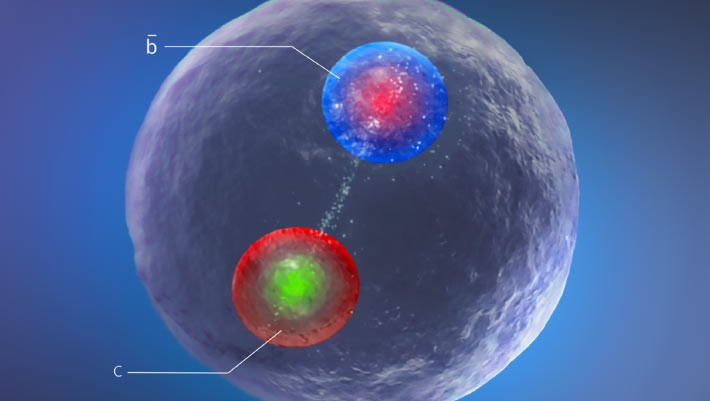
The Bc+ meson? It’s special. Two heavy players. A charm quark. A bottom antiquark. But the team wanted the excited state. The Bc*.
So they smashed protons into other protons. Hard.
The Bc*+ is unstable. Fragile. It decays almost instantly into a Bc+ and a photon. If you see the photon and the decay bits together, you have proof. A smoking gun.
Except the photon is shy.
The mass gap is tiny. Just a sliver of difference. The resulting photon carries almost no energy. Invisible to standard detectors. Too quiet. Too low.
Did you know standard photon ID techniques failed here? They looked right past it.
The ATLAS team had to get creative. They didn’t hunt for the photon directly. They hunted for its shadow.
They watched for the photon converting inside the tracking detector. Turning into an electron and a positron. A pair of tracks. Starting from the same spot. But displaced. Not at the original crash.
Low energy tracks. 100 Me transverse momentum. Lower than what ATLAS usually cares about. They built a custom reconstruction tool. A dedicated procedure to find ghosts.
It worked.
The mass difference? 64.5 MeV. Plus or minus 1.4.
“Within range of theory,” they said. But not perfectly aligned with the latest high-precision math. Close enough. Close.
It feeds the models. It sharpens the picture of the strong nuclear force. Maybe slightly. Maybe not enough yet.
The paper lands in Physics Review Letters. Another brick in the wall. Another clue about how the universe sticks together. Or doesn’t.
We look for patterns. We find small deviations. Then we keep smashing things.