A rare fossil from Antarctica is rewriting our understanding of how vertebrates moved from water to land. By peering inside the skull of a 380-million-year-old fish, scientists have uncovered brain structures and sensory adaptations that bridge the gap between aquatic life and early four-legged animals.
This discovery offers a crucial missing link in evolutionary history, showing exactly what physiological changes allowed fish to begin the journey toward becoming tetrapods—the ancestors of all modern land vertebrates, including humans.
A Window Into the Devonian “Age of Fishes”
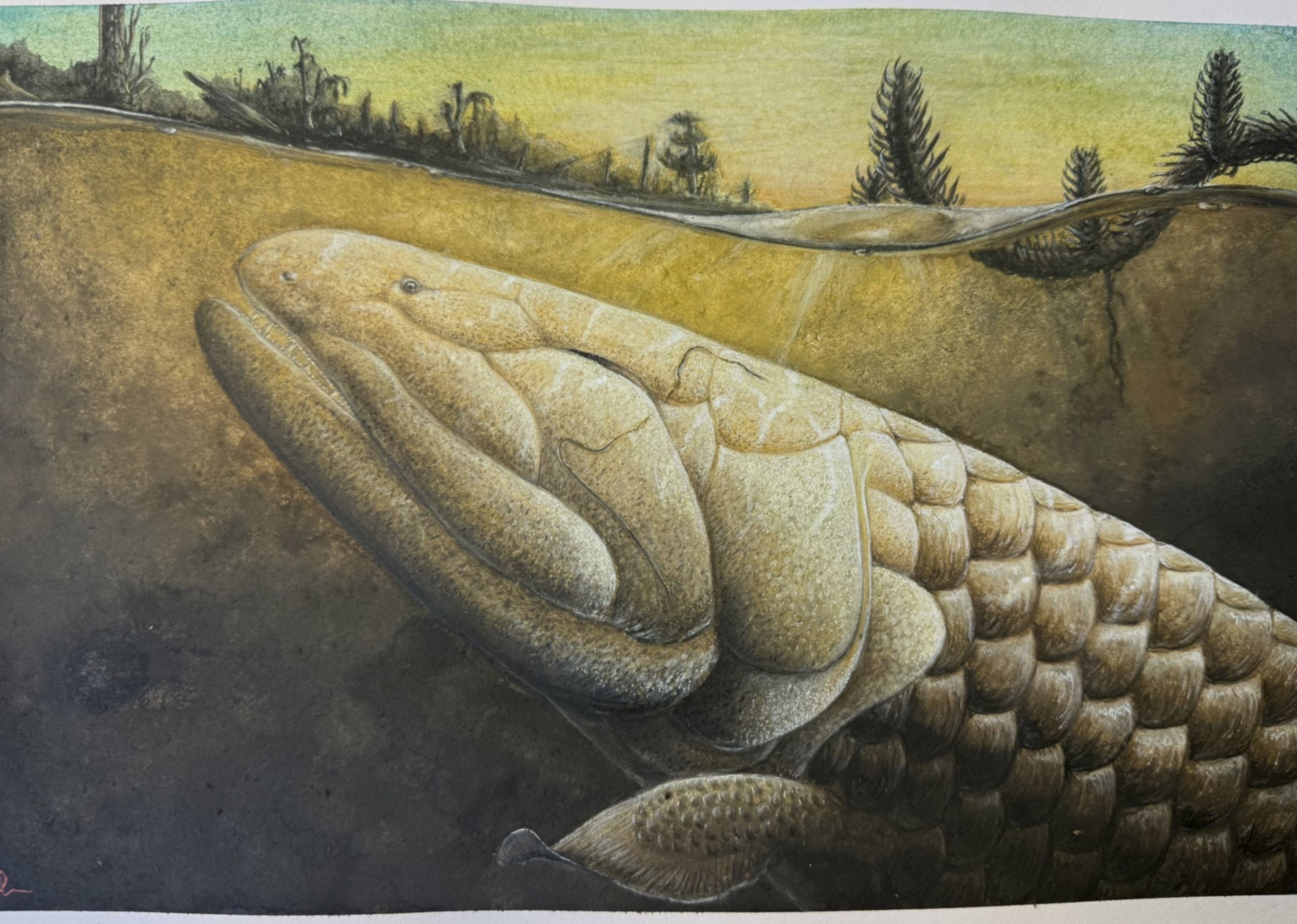
The subject of this study is Koharalepis jarviki, a large predatory fish that lived during the Devonian Period, a time often referred to as the “Age of Fishes.” While many fossils from this era exist, Koharalepis is unique. It is the only known specimen of its kind, found in freshwater deposits in Antarctica’s Lashly Mountains.
Researchers at Flinders University utilized advanced non-destructive imaging techniques, including neutron tomography and synchrotron scanning, to examine the fossil without damaging it. These methods allowed them to visualize the internal anatomy of the skull, braincase, shoulder girdle, and backbone in unprecedented detail.
“We chose to focus on Koharalepis as it is the only fossil in the entire family to preserve the internal bones of the skull,” explains Corinne Mensforth, lead author and PhD candidate at the Flinders Palaeontology Lab. “This gives us valuable insights into its braincase and neuroanatomy.”
Brain Structures That Hint at Life on Land
The most significant finding is that Koharalepis possessed brain features similar to those of early tetrapodomorphs—the group of fish most closely related to land animals. Specifically, the fossil revealed two key adaptations that suggest a life spent near the water’s surface:
- Air Intake Openings: The top of the skull featured openings designed for additional air intake. This suggests the fish may have been supplementing oxygen from water with air from the atmosphere, a critical step toward breathing on land.
- Light Detection: The brain contained an organ capable of detecting light and regulating circadian rhythms. This indicates the fish was highly attuned to day-night cycles, likely hunting or navigating in shallow, sunlit waters.
These features highlight a transitional lifestyle. Koharalepis was not fully terrestrial, but it was adapting to environments where air and land played a growing role in survival.
An Ambush Predator with Unique Senses
Koharalepis grew to approximately one meter in length and was an ambush predator. Despite its size, it had relatively small eyes. This physical trait suggests that vision was not its primary hunting tool. Instead, the fish likely relied heavily on other senses—such as smell, lateral line detection (sensing vibrations in water), or electroreception—to locate prey.
This sensory profile paints a picture of an animal thriving in murky, shallow freshwater environments, waiting for smaller animals to come within striking distance. It underscores the diversity of survival strategies among early vertebrates as they explored new ecological niches.
Connecting Australia and Antarctica
The discovery also sheds light on ancient geography. Koharalepis belongs to the Canowindridae family, a group that once roamed across East Gondwana, the supercontinent that included present-day Australia and Antarctica.
“This precious fossil… highlights the ancient links between Australia and Antarctica,” says Dr. Alice Clement, coauthor of the study. “It is important to study such specimens from the Devonian Age of Fishes, when the waters teemed with predatory lobe-finned fish like this that are closely related to land animals.”
Fossils of Canowindrids have been found in both regions, providing tangible evidence of how species migrated and evolved as continents shifted over hundreds of millions of years.
Why This Matters for Evolutionary Biology
For decades, scientists have debated the exact sequence of changes that allowed fish to become tetrapods. While limb development has been well-documented, the neurological and sensory changes required for life on land have remained less clear.
- Neurological Transition: The braincase of Koharalepis shows that the neural infrastructure for processing air-breathing and light detection evolved before limbs were fully adapted for walking.
- Behavioral Clues: The evidence of surface-dwelling behavior suggests that the move to land was not a sudden leap, but a gradual adaptation to shallow, oxygen-variable waters.
Emeritus Professor John Long, who helped describe Koharalepis in 1992, notes that modern imaging has finally unlocked these secrets. “This has enabled us to understand some of the behavior, adaptations, and relationships of Koharalepis to its environment… and how fish first left the water to live on land approximately 385 million years ago,” he says.
Conclusion
The Koharalepis jarviki fossil is more than just a relic of the past; it is a detailed map of a pivotal moment in life’s history. By revealing how early fish adapted their brains and senses to thrive near the surface, this discovery illuminates the subtle, incremental steps that eventually led to the conquest of land by vertebrates. It reminds us that the journey from water to land was driven not just by new limbs, but by new ways of perceiving and interacting with the world.