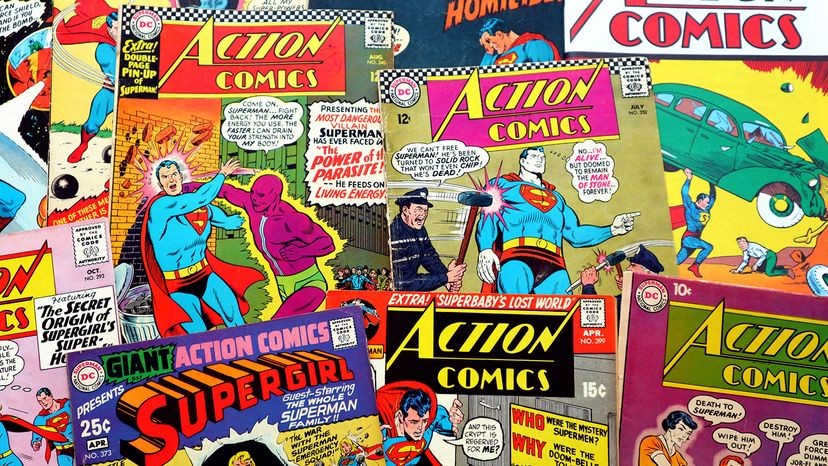
The DC Universe doesn’t just host heroes. It’s filled with cosmic forces and reality-warping villains who can flip the script on existence itself. From the gold-age punch-ups in Action Comics to the multiversal shattering of Dark Crisis and The Infinite Crisis, the most powerful DC characters have consistently broken the mold of what a superhero can do.
These aren’t just people with big muscles or laser eyes. They are entities that shape worlds, challenge deities, and force us to question the very definition of power.
1. Superman
He’s the Man of Steel, but that’s barely scratching the surface. In the comics, Superman’s strength isn’t static. It scales. He pulls planets. He survives supernovas. He has bench-pressed the weight of the Earth itself.
Why does this matter? Because it establishes a baseline for the rest of the pantheon. If Superman can’t move it, does anyone else have a shot? The answer, usually, is no. Or at least, not without help.
He represents hope. But he also represents raw, unadulterated force. When he gets serious, the sky darkens. The ground cracks. And the rest of the DC Universe holds its breath.
2. Wonder Woman
Steve Trevor might have been the guy who crashed into her island, but Diana of Themyscira was the one who taught the world what true power looks like. Created by psychologist and suffragette William Moulton Marston, she debuted in All Star Comics #8 back in 1941. She wasn’t just another superhero in a cape; she was a princess, an ambassador, and a warrior who carried the weight of her Amazonian heritage on her shoulders.
Her arsenal isn’t just about brute force. Sure, she has godlike strength and durability that rivals even Superman’s, but her real edge lies in her intellect and her compassion. Lasso of Truth? That’s not just a shiny rope. It’s a psychological tool that forces absolute honesty, making her one of the most formidable tacticians in the Justice League. She fights for love and peace, not just victory.
Then there’s the matter of her lineage. As the daughter of Zeus and Hippolyta, she’s literally divine. This heritage grants her abilities beyond the standard super-suit: flight, super-speed, and enhanced healing. She doesn’t just punch bad guys; she outthinks them, outmaneuvers them, and occasionally, out-prays them. Her presence in the DC Universe isn’t just about firepower. It’s about balance. She brings a moral clarity that even the Man of Steel sometimes struggles to maintain.
And let’s not forget the gear. The Bracelets of Submission aren’t just for blocking bullets. They’re symbolic. They represent the constraints she broke free from to become a hero. When she clashes them together, the shockwave doesn’t just knock enemies back. It sends a message. You don’t mess with an Amazon.
So, when you compare her to other heavy hitters, the difference is subtle but profound. Superman protects the status quo. Wonder Woman challenges it. She doesn’t just save the day; she questions why the day needed saving in the first place. That’s why she’s not just a character. She’s a statement.
The Flash: Barry Allen vs. Wally West
Speedster lore gets complicated fast. You have Barry Allen, the forensic scientist who started it all, and Wally West, his nephew who eventually took the mantle. Both wear the red suit. Both run faster than light. But they aren’t the same.
Barry is the classic archetype. The accident with the chemicals and the lightning bolt. He’s the anchor. The original. When people think “Flash,” they usually picture Barry’s serious demeanor and his connection to the Speed Force as a cosmic constant.
Wally? He’s the wild card. More expressive. More emotional. He grew up in the shadow of his uncle, which created friction. Friction makes for good drama. He didn’t just inherit the powers; he earned them through sheer will and heart.
Which one is faster? Depends on who you ask.
Barry holds the title longer in most continuities. Wally has moments where he breaks every known record. There’s a reason he’s often called the greatest speedster of all. He doesn’t just run. He understands the speed.
The dynamic between them is key. Barry is the steady hand. Wally is the spark. One stabilizes the timeline. The other disrupts it. Sometimes they work together. Sometimes they race.
It’s not just about who crosses the finish line first. It’s about how they handle the responsibility. The Speed Force is a messy place. It eats people. It changes them. Barry has seen the worst of it. Wally has lived it.
Why does the distinction matter? Because the Flash isn’t one person. It’s a legacy. A torch passed down. Red suit. Yellow lightning. That’s the visual. The soul is different.
Barry brings order. Wally brings chaos. You need both. The DC Universe wouldn’t work with just one.
The Flash has the Speed Force. That’s a whole other layer of physics-breaking magic that lets Barry Allen step sideways through reality, outrun the concept of death itself, and generally make time look like a suggestion rather than a law. It’s a power set that puts him in the stratosphere of DC’s heavy hitters.
But speed isn’t the only way to bend the universe. Sometimes you need willpower. Or at least, a really bright construction laser.
Willpower Over Wavelengths
Enter the Green Lantern Corps.
Hal Jordan and John Stewart aren’t just guys with flashlights. They’re intergalactic peacekeepers backed by the Emotional Electromagnetic Spectrum. The green light? That’s Willpower. It’s raw, stubborn, human (and non-human) determination given form.
Unlike the Flash’s speed, which is often treated as a natural instinct or a scientific accident, a Green Lantern’s power is mental. It’s about focus. About staring into the void of the universe and saying, “Not today.” The ring constructs energy into anything the user can imagine, provided they have the mental fortitude to hold the shape.
This makes them tricky to fight. You can’t outrun a wall of solid green energy that appears instantly. You can’t punch through a construct if the Lantern is focused. Hal Jordan, with his pilot’s reflexes and reckless bravery, brings a chaotic energy to the ring. John Stewart, the architect, brings precision. One builds fortresses in seconds; the other builds sniper nests.
The Human Factor
The real difference between these two power sets comes down to control.
The Flash’s abilities are often tied to his emotional state and physical conditioning. If he’s distracted, he slips. If he’s hurt, he slows. It’s biological.
Green Lantern’s power is psychological. A Lantern can create entire ecosystems, starships, or weapons of mass destruction based on a fleeting thought. But if they doubt themselves? The ring fails. This creates a constant tension in their stories. They’re gods with a off-switch made of insecurity.
“A Green Lantern’s greatest enemy is often their own mind.”
Where Do They Stand?
When you compare raw output, the Flash usually wins in a straight race. But in a fight? It’s messy.
Hal Jordan has gone insane. He’s been Parallax. He’s unraveled time itself. John Stewart has held back armies of Apokolips with nothing but a stick and sheer grit. Both have punched through planets. Both have survived in the vacuum of space without breathing.
The Flash breaks time. The Lanterns build the stage time plays on.
It’s a different kind of power. Less about velocity, more about vision. And while Barry Allen runs the race, Hal Jordan and John Stewart decide where the finish line is.
That’s why they stick around. Because willpower is harder to break than speed.
The Magic Barrier
You can build a laser cannon with a green light bulb in space, but you can’t out-will a guy who bends reality with a smile. That’s the gap between the lanterns and Doctor Fate. He isn’t just casting spells. He’s the chosen agent of the Lords of Order. His golden helmet? It’s not just a costume piece. It’s a library of cosmic wisdom and ancient sorcery. When Kent Nelson wears it, he becomes one of DC’s strongest magical entities. Period. Willpower gets you far. But magic? Magic gets you everywhere.
The Silent Observer
Then there’s J’onn J’onzz. Martian Manhunter doesn’t need a ring. He doesn’t need a spellbook. He just needs to be there. His telepathy can dismantle a mind before it finishes forming a thought. He can phase through walls. He can fly. He is essentially an alien version of Superman with better stealth skills. But his real power is subtle. He understands isolation. He understands loss. That makes him dangerous in a way a green beam never could. He watches. He waits. And when he moves, it’s usually too late.
6. J’onn J’onzz
Look at Martian Manhunter. You see the green skin, the stoic pose, maybe a hint of sadness. You don’t immediately think “world-ending threat.” That’s the point. J’onn J’onzz is the definition of underestimated. Underneath that calm, almost monk-like demeanor lies a power set that makes the average superhero look like they’re playing with training wheels.
We’re talking super strength that can move planets. Flight that leaves sonic booms in its wake. Shape-shifting so perfect it fools eyes and sensors alike. Telepathy sharp enough to read minds across galaxies. And intangibility? He can walk through walls like they’re smoke.
Is he as fast as The Flash? No. But ask him if he’s as strong as Superman. He’d say no, but his raw power output often rivals the Man of Steel’s. That’s why he’s a mainstay in the Justice League. Not because he’s the flashiest. Because he’s the most versatile. He’s the anchor. When things get metaphysical, J’onzz is the one who knows how to untangle the knot.
“His calm demeanor hides power that rivals even Superman.”
He doesn’t need to shout. He doesn’t need to pose. He just is. And that’s scarier.
7. Lucifer Morningstar
Now, let’s step away from the planet-saving heroes and talk about the guy who owns the club in the afterlife. Lucifer Morningstar.
This isn’t the TV version. This is the comic book version. The literal fallen angel from Neil Gaiman’s Sandman universe. He’s not just a villain. He’s a force of nature with a suit.
Think about that for a second. Godlike ability to reshape reality. Want a new universe? Done. Want to rewrite history? Sure. Want to turn your enemies into a flock of birds? Why not? Most DC heroes operate within the laws of physics. Lucifer is the law.
He’s more powerful than most heroes or villains can comprehend because he doesn’t just fight you. He unmake you. Or he doesn’t. It’s his choice. His boredom is the only thing keeping him in check. And let’s be honest, that’s terrifying.
You might think Superman could punch him. You’re wrong. You can’t punch an idea. You can’t punch the concept of evil. Lucifer is evil. And he’s bored.
8. The Spectre
If Lucifer is the boss, The Spectre is the middle manager with a god complex and a holy sword.
The Spectre isn’t just a character. He’s the Wrath of God. Literally. He’s the avatar of divine vengeance, and he doesn’t take requests. He takes orders from The Presence, and he delivers punishment with zero room for appeal.
Power level? Off the charts. He can erase existence. He can judge souls. He can fly through dimensions like they’re curtains. And he’s not nice. He’s not friendly. He’s angry. All the time.
Why do people forget him? Because he’s terrifying. And terrifying things are hard to build toy lines around. But in terms of raw, unadulterated power, The Spectre
Fueled by the wrath of God, the Spectre is a supernatural entity that punishes evil with terrifying power. Once bonded to human hosts like Jim Corrigan, the Spectre is a near-unstoppable force of divine judgment.
9. Swamp Thing
If the Spectre is the fist of God, Swamp Thing is the voice of the Earth itself. Alec Holland was a botanist whose body was fused with the Plant Elementals of the Louisiana bayou, resulting in the green, plant-based guardian known as Swamp Thing. He isn’t just a monster in a swamp. He is the literal embodiment of the Green, the universal life force that connects all plant life across the planet.
The tragedy of his origin story is what makes him compelling. He lost his human form, his memories, and his identity, yet retained his humanity through sheer force of will. This duality allows for some of the most philosophical storytelling in comics. He is both a detective solving crimes in the mud and a cosmic entity debating the nature of life and death with Death herself.
Unlike the Spectre’s wrath, Swamp Thing’s power is rooted in connection. He can manipulate plants, regenerate from a single seed, and sense disturbances in the natural world. But his real strength lies in his role as a mediator. He bridges the gap between the human world and the elemental plane, often acting as a reluctant hero who would rather tend his garden than fight a war.
“I am not a man who happens to be made of plants. I am a plant that happens to remember being a man.”
This internal conflict defines his character. He is constantly searching for a place where he belongs, caught between two worlds that reject him. That sense of alienation resonates deeply, especially in stories that tackle environmental decay and corporate greed. Writers like Alan Moore and Scott Snyder have used his platform to explore how industrialization disrupts the natural order, making Swamp Thing more than just a superhero. He is an ecological conscience.
His abilities are vast and varied. He can create plant constructs, fly via vines, and communicate with all flora. In some iterations, he has even traveled to the elemental plane of fire and ice. But his most terrifying power is his connection to the Earth itself. When threatened, he doesn’t just fight. He unleashes the full weight of the biosphere against his opponents. It’s a reminder that nature is not passive. It fights back.
The Contrast Between Divine and Natural Justice
While both entities serve as protectors, their methods and motivations are starkly different. The Spectre operates on a binary moral code established by the Presence. Good and evil are clear-cut, and judgment is swift and absolute. There is no appeal process. Swamp Thing, however, exists in the gray areas. He sees the complexity of life, the interdependence of ecosystems, and the nuance in human actions.
This difference in perspective often leads to friction when their paths cross. The Spectre might see a corrupt businessman as evil to be punished. Swamp Thing might see a desperate man trying to feed his family in a broken system. These interactions highlight the tension between rigid divine law and fluid natural law.
Fans often ask which entity is more powerful in a direct confrontation. The Spectre has the backing of the entire cosmos and can erase beings from existence. Swamp Thing has
But the Green isn’t just a battery; it’s a biological internet. Through it, Swamp Thing accesses the collective memory of every leaf, vine, and root. He doesn’t just control plants; he understands the ecosystem as a single, breathing entity. This connection allows him to regenerate from a single seed. He’s been reduced to ash, only to sprout back stronger. The rule is simple: as long as there is life on Earth, he cannot truly die.
His power scale shifts depending on who is holding the pen. In some iterations, he can heal a blighted planet. In others, he fights gods. But the core mechanic remains: he is the immune system of the natural world. And when that system detects a threat? It reacts.
10. Black Adam
The Weight of Magic and Might
Black Adam isn’t just a guy who hits things hard. He’s a former champion of Shazam, which means he carries magical powers welded to raw, unadulterated brute force. It’s a volatile mix. His morality is complicated, to say the least. This duality makes him something more interesting than a standard villain. He’s dangerous. He’s also a formidable antihero. You can’t quite pin him down to one side of the ledger.
These characters don’t just punch hard or run fast. They bend the rules of existence itself. The source of their power might vary—born of science, sorcery, or the divine—but the effect is the same. They rewrite what’s possible. DC Comics knows this. Their stories shine brightest when they explore these extremes. It’s where the real drama lives.
This piece was crafted with AI assistance. Then it was put through the wringer. A HowStuffWorks editor fact-checked every detail. The goal was accuracy. Not just speed.