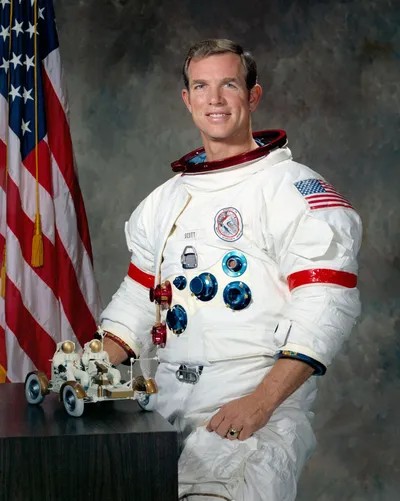
David Scott didn’t just land on the Moon. He survived a near-catastrophe that nearly killed him and Neil Armstrong before he ever got the chance. Born in San Antonio, Texas, in 1932, Scott’s path to the lunar surface was paved with rigorous engineering and high-stakes risk. He graduated from West Point in 1954, joined the Air Force, and sharpened his skills at MIT and Edwards Air Force Base. By 1963, he was selected as part of NASA’s third astronaut corps.
His first big test came with Gemini 8.
March 16, 1966. Scott and Commander Neil Armstrong were tasked with the first-ever space docking. They matched velocities with an uncrewed Agena target vehicle. It worked. For a few moments, they held hands in orbit. Then, an electrical failure sent them spinning. The craft tumbled wildly out of control. If they had stayed docked, the spin might have crushed the capsule. They separated. It was a frantic, manual fight to regain stability. They landed just 10 hours and 42 minutes after launch. The mission was aborted. But they were alive.
That survival instinct served him well. Four years later, Scott returned to space as the command module pilot for Apollo 9. Launched on March 3, 1969, the mission tested the Lunar Module in Earth orbit. Scott, along with Commander James McDivitt and Lunar Module Pilot Russell Schweickart, proved the hardware could handle the vacuum. They docked. They undocked. They passed every check. It was the dress rehearsal for history.
Scott was built for this. His background in aeronautics wasn’t just academic. It was practical. When systems fail in space, theory doesn’t help. Muscle memory and cold logic do.
The Long Road Home and Away
The dust from the Hadley-Rille landing had barely settled before Dave Scott was back in the grind. The Apollo 15 crew—Scott, Jim Irwin, and Al Worden—had touched down on July 26, 1971, after a three-and-a-half-day jaunt to the lunar surface. They didn’t just poke around. They drove.
Using the Lunar Roving Vehicle, they carved out 28 kilometers of territory across three separate treks. They spent more than 17 hours walking on the Moon, right at the base of the Apennine Mountains. When they finally splashed down on August 7, the mission was a triumph. But for Scott, the real work was just beginning.
He didn’t retire to a beach house. Not immediately.
Bridging the Cold War Divide
Between 1972 and 1975, Scott served on the administrative staff for the Apollo-Soyuz Test Project. This wasn’t desk work in the traditional sense. It was political tightrope walking. The US and the USSR were still rivals, but they were learning to share the sky. Scott helped navigate the bureaucratic minefield that turned two hostile superpowers into cooperative partners.
It was a strange pivot. From the vacuum of space to the humid bureaucracy of Washington.
He later took the helm at the Dryden Flight Research Center at Edwards Air Force Base. Edwards is where you go to push jets until they break, or until they break you. Scott understood the edge. He knew what happened when machines exceeded their limits. He managed the research that kept American pilots alive as technology outpaced safety protocols.
Leaving the Orbit
The call of the lunar module faded. By 1977, Scott walked away. He left the space program, traded his flight suit for a business suit, and moved to Los Angeles. The public sector was behind him. Private business was the new frontier.
He didn’t vanish. He stayed in the conversation.
In 2004, he did something few astronauts ever attempted. He co-authored a book with a man who was once considered an enemy. Two Sides of the Moon: Our Story of the Cold War Space Race was written with Soviet cosmonaut Aleksey Leonov.
Leonov. The man who floated outside his capsule, tethered by a single cord, staring into the void. Scott and Leonov sat down together to write that story. Not as politicians. Not as generals. As men who had seen the Earth from the same angle.
It’s rare to find a narrative that doesn’t lean on hero worship. This one didn’t. It leaned on the shared silence of high orbit. The shared fear of the tether snapping. The shared realization that the flag on the ground mattered less than the view from above.
Scott’s journey didn’t end with the splashdown. It continued through boardrooms, research centers, and eventually, a page co-written with a Russian. The moon landing was the beginning. The reconciliation was the harder part.
Did it work? The book says so. The history says so. But the real story is in the handshake that followed the launch.