Space-based telescopes changed everything. Before them, astronomers were blind to most of the universe.
Looking up from Earth’s surface has always been a frustrating exercise in limitations. The atmosphere acts like a thick, cloudy filter. It blocks large chunks of the electromagnetic spectrum. We can see visible light. We can catch some radio waves. A little bit of infrared sneaks through. But the rest? Gone. Absorbed before it ever hits our lenses.
Putting instruments above the atmosphere solved this. It opened the floodgates. Now every region of the spectrum is fair game. Even for the wavelengths that do reach the ground, space offers a clearer view. No atmospheric turbulence. No airglow. Just raw, steady data.
This wasn’t an overnight shift. It started in earnest in the 1960s. Space agencies in the United States and elsewhere began building specialized spacecraft. They worked independently and in cooperation. The goal was simple: explore cosmic phenomena across gamma-ray, X-ray, ultraviolet, visible, and infrared bands.
The early results were staggering.
The First Breakthroughs
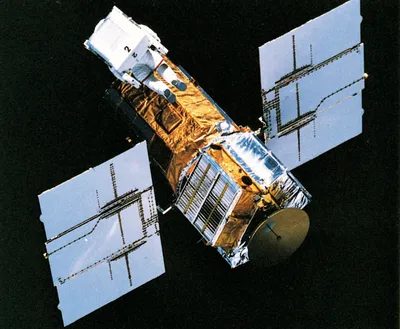
The International Ultraviolet Explorer (IUE) launched in 1978. It focused on faint objects in the ultraviolet spectrum. Then came the Infrared Astronomical Satellite (IRAS) in 1983. Its mission was to map the sky in infrared. The result? Hundreds of thousands of new stars and galaxies were discovered. We had been missing most of the sky’s heat signatures.
By the 1990s, the hardware got sharper. The Hubble Space Telescope (HST) arrived in 1990. It delivered images of unprecedented resolution in visible and ultraviolet light. It became the public face of modern astronomy.
But Hubble wasn’t alone. The Compton Gamma Ray Observatory (CGRO) launched in 1991. It let scientists investigate sources in the high-energy gamma-ray spectrum. Then the Chandra X-Ray Observatory arrived in 1999. It opened up the X-ray universe.
These weren’t just general observatories. Some were specialists. Yohkoh (1991) and Hinode (2006) were designed specifically to study the Sun. They looked at its volatile surface and magnetic fields in ways ground-based instruments couldn’t.
Beyond Low Earth Orbit
Most of these observatories stay close to home. They orbit Earth. But some ventured further. A few exploited orbits around the Sun itself.
Consider the Solar and Heliospheric Observatory (SOHO). Launched in 1995, it didn’t orbit Earth. It moved to a gravitational balance point called L1. This is one of the Sun-Earth Lagrangian points. It sits about 1.5 million kilometers (0.9 million miles) sunward of Earth.
Why go there? Because SOHO could observe the Sun uninterruptedly. It never passed through Earth’s shadow. Continuous observation meant no data gaps. It watched for solar storms and heliospheric changes in real-time.
Other missions drifted away intentionally. The Spitzer Space Telescope launched in 2003. It was an infrared observatory. It needed to be cold. Earth’s thermal radiation interferes with infrared detection. So engineers placed it into a solar orbit. Its period of revolution causes it to drift away from Earth at 15 million kilometers (10 million miles) per year. It leaves our planet’s heat behind. It keeps the sensors chilled.
This strategic drifting paid off. Spitzer mapped dust clouds and saw through cosmic dust that visible light couldn’t penetrate.
The evolution of these platforms shows a clear trend. We moved from blocking wavelengths to exploiting every single one. We moved from low Earth orbit to Lagrangian points and deep solar drift. The tools got more specialized. The questions got more complex.
We still launch new observatories. The James Webb Space Telescope is just the latest iteration