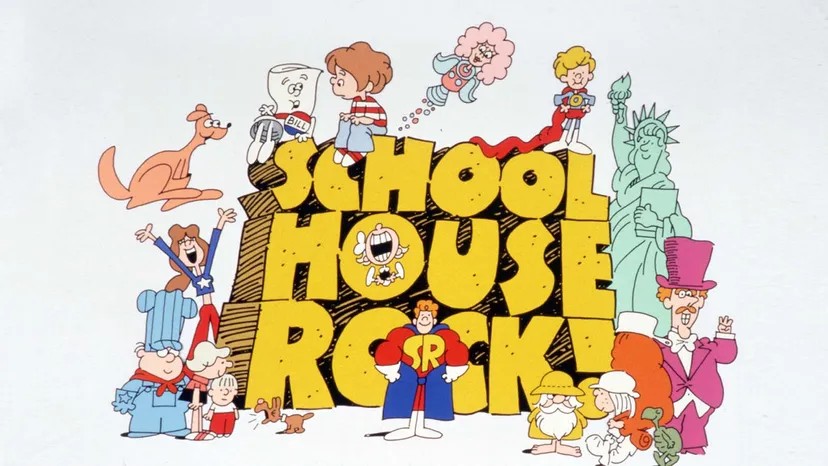
January 6, 1973. You’re probably still in your pajamas, the blue light of the TV shining on your face, waiting for the cartoon to start. You’d think we’d be just relaxing on a Saturday between Super Friends and Roadshow. But in the next three minutes, reality changed. Before you know it, you’ll be multiplication.
As “Schoolhouse Rock!, the series that redefined Saturday morning television was born.
This is not part of a regular episode.
This is an interstitial program, a short, self-contained section designed to fill the gaps between the main programs.
The concept was the brainchild of Tom Yohe, a New York advertising executive who noticed the problem. What kinds of sounds do children struggle with on their multiplication tables? radio.
Yohe pitched the idea to ABC. They took it.
The result was “Multiplication Rock”, the first season of this phenomenon. These short animations are 3 minutes or less. It has a catchy hook and lyrics that will stick in your mind for decades. The series ran until the mid-1980s and went on a short hiatus before resuming in the 1990s. But this morning in 1973, it was new.
The intro plays.
As your body grows bigger
Your mind grows flowered
Learning is great
Because knowledge is power!
It’s Schoolhouse Rocky
That chip off the block
your favorite school building
Schoolhouse Rock!
How ‘Schoolhouse Rock!’ Began
The origin story is simpler than you think. It didn’t come from a classroom or a government initiative. It started in an ad agency. Tom Yohe and lyricist/producer Bob Dorough wanted to make education stick. They know that children learn best through music. So they created songs that taught basic math, grammar, and geography.
ABC agreed to air the program. The network wanted something educational and fun. The shorts fit perfectly. It’s short enough to grab attention. It’s fun so it doesn’t feel like homework. And they’re unlike anything else on TV.
The first season focused entirely on multiplication. In each video, a number fact into a memorable tune. Three Is a Musician with rhythm. I’m just a bill personified legislation to teach civics later on. But it starts with the numbers.
By the end of the first week, the children were humming tunes about seven times seven. Parents were confused but intrigued. The teachers were impressed. ABC had created a new format for educational content.
The show aired continuously for several years. It has evolved. It added seasons for grammar and science. But is it scary to study for the first time on a Saturday morning? It is unique. You don’t know what you are being taught. You just knew the song was catchy.
It’s a trick. Because the music remains, so do the lessons. You forgot your textbook. You remember the melody.
When David McCall took his family to a dude ranch in Wyoming in the early 1970s, he didn’t want to revolutionize education. He just wanted the advertising agency McCaffrey & McCall to give him time. But as I drove through the Midwest, a strange thought occurred to me. Her son is trying to learn times tables. The same kid can recite all the Rolling Stones lyrics.
Why does the brain focus on music but ignore math?
This seems like a puzzle worth solving. When McCall returned to New York, he took the idea to George Newall, a co-creative director at the agency. Mr. Newall immediately recognized the potential. They need songs.
Initial attempts with own songwriters failed. That’s not right. So Newall, who plays jazz piano part-time, stepped in to help. He contacted Bob Doroughugh.
Dorough is known for writing quirky and educational songs about everyday things like mattress labels. He is also a jazz pianist. When he met McCall, the ad man gave him strict instructions. Don’t talk down to children.
“I don’t know how I got so lucky,” Dorough said in 2017, a year before his death at age 94. “Apparently [McCall] had tried other songwriters, but most of them wrote down to kids. When I met McCall, he said, ‘Here’s my idea. Try it, but don’t write it for children.”I really care about children.”
The fabric is back. She glanced at her daughter’s textbook. A few weeks later he returned with an introduction.
It is called “Three Is a Magic Number”.
The track is less than 3 minutes long. It was catchy. It covers the symbolism of all three: faith, hope, charity; heart, mind, body – before moving on to shapes, addition and multiplication. The McCaffrey & McCall team listened and was blown away.
McCall serves on the board of the Bank Street College of Education in New York. He asked schools in different regions to test the song. The results are clear. Teachers and students love it. They found something special.
Tom Yohe, the agency’s art director, immediately began creating a storyboard. With the help of ABC Senior Vice President Radford Stone, the group pitched the song and visuals to Michael Eisner. Eisner is ABC’s vice president of children’s programming.
He wasn’t the only one in the room. Eisner brought in animator Chuck Jones. Jones wrote “The Road Runner,” “Wile E. Coyote” and “Pepe Le Pew.” He also directed How the Grinch Stole Christmas.
They played Doroughugh’s demo. They showed the frames.
“What are you thinking?” Eisner asked Jones at the end.
“Buy it,” Jones replied.
And just like that, an advertising executive and a jazz musician ended up on television on Saturday morning.
Where did Schoolhouse Rock start?
The show did not start as a television series. It started as an advertising experiment. McCaffrey & McCall wanted to see if educational content could hold attention. They used ABC as a testing ground.
The network agreed to air the shorts. But they’re not just random songs. Designed to teach specific concepts. Mathematics. grammar. history. Science.
Each episode focused on a single topic. The animation style is consistent. The music was catchy. The messages were simple but not dumbed down.
This approach worked. The shorts became a staple of the Saturday morning cartoons. They ran for years. They taught generations of children how to conjugate verbs and understand the three branches of government.
Why does this format work?
The success of Schoolhouse Rock is no accident. It is based on three key elements.
–music. These songs are written by jazz and rock experts. They are well constructed and emotionally appealing.
–Animated. Chuck Jones Studio was responsible for the visual effects. The style is clean and expressive. It fits the melody of the music.
– Content. The theme is very important. It covers the basics of the curriculum that teachers strive to follow.
This combination creates an unforgettable experience. Children want to listen to these songs again. They learn without realizing that they are learning.
This method is still under investigation. Teachers use it to explain why music helps memory. The brain processes rhythm and melody differently than text. It creates multiple avenues for memory.
Schoolhouse Rock proves that entertainment and education don’t have to compete with each other. They can reinforce each other.
テレビ放送にはどのような影響がありますか?
『スクールハウス ロック』が劇場公開される前、土曜日の朝は再放送と低予算アニメでいっぱいでした。 ウェブには何か新しいものが必要です。 彼らには両親が承認する何かが必要です。
Early Days: Rock meets the Grammys
“Schoolhouse Rock!” didn’t start out as a TV staple. The show first aired on ABC over the weekend of January 6, 7 and 8, 1973. To celebrate, creator Thomas McCall and his wife Boni hosted a premiere party at their Manhattan apartment. They called the whole crew. Before it became an animated short series, the concept was an album called “Multiplication Rock”. This naturally became the theme of the first season.
Four songs will be performed for the first time: “My Hero, Zero”, “Elementary, My Dear”, “The Four-Legged Zoo” and “Three Is a Magic Number”. These are written by David Doroughugh. He also played them. The plan was simple: one song per number. Dorough messed this up by combining 4, 6 and 8 into one piece. He had to figure out a way to separate them. He went hiking with his daughter Aralee and her friend Lisa. That’s when he got the idea of a “four-legged zoo”. This is a story about a school trip to the zoo. Aralee and Lisa actually are on the chorus on the final recording.
Dorough soon became the musical director. He sang all but two songs. He added jazz singer Grady Tate to ``Naughty Number Nineen'' ja Blossom Dearien ” Figure Eight.” The project earned Doroughugh a Grammy nomination in 1974, but “Sesame Street Live” picked up the statue instead. The show itself was nominated for eight Daytime Emmy Awards between 1974 and 1997, winning four of them.
Grammar Rock and the birth of a lyricist
The second season of Grammar Rock aired in 1973–1974. “Conjunction Junction” aired this season. This song is probably the most famous song in the entire series. Written by Dorough. Former Merv Griffin trumpeter Jack Sheldon performed the song. McCall developed a visual that connected the vehicles together.
Lynn Ahrens also appears here. She was just a secretary in the copywriting department of advertising agency McCaffrey & McCall. Mr. McCall heard him playing the guitar during his lunch break. He asked her to write. The result is: “A noun is a person, place, or thing.” Ahrens became a full-time songwriter. She went on to write fifteen more songs for the show. These include “A Victim of Gravity”, “Interplanet Janet” and “Interjections”.
Fun fact: The little girl who screamed, “Damn! This is the end!” Lauren Yohe appeared at the end of “Interjections”. She was six years old at the time.
American rock and animation politics
The creators channeled the excitement of the mid-1970s bicentennial into the third season of America Rock (also known as “History Rock”). They tell the story of freedom from British rule in . They responded to the War of Independence with “shots heard round the world”. Early inventors earned a reputation as the “Mother Necessity.”
And then there is the “Three-Ring Government”. It includes checks and balances. It wasn’t broadcast until 1979. The delay? The authors are worried about offending politicians. Times have certainly changed since then.
However, the most popular song of the season was “I’m Just a Bill”. Screenplay by Dave Frishberg. Jack Sheldon is at it again. The song tells about the arduous process of approving a bill. Frishberg plays piano on this song. Sheldon plays the trumpet. They recorded it on the same day as “Conjunction Junction”. It’s the same band. It’s the same energy.
Science Rock and the Digital Transition
Remember the cartoon about Isaac Newton getting hit on the head with an apple? This is from . This was a song from the 1978-1979 season of Science Rock. This song clearly has a 1950s feel to it. By Lynn Ahrens. The Tokens performed it. You may know them from their 1961 hit “The Lion Sleeps Tonight.”
Ahrens also created “Interplanet Janet” for this season. Janet is a solar system Ms from the future. There’s also a song called “Telegraph Line” about the nervous system.
Science Rock aired from 1978 to 1979, but the whole process was organic. The songwriter came up with the idea. If the creative team likes it, the song will be ready in 2-4 weeks. Dorough signed the lyrics. It is then assessed by consultants from the Bank Street School of Education. ABC did the final evaluation. Once everything is done, it’s time to manually animate the features.
The Scooter Era and the End of an Era
That changed during the “Scooter Computer and Mr. Chips” season (1983-1984). ABC executive Squire Rushnell commissioned the theme. The idea is that children are afraid of computers. This time, the creative team determined the theme. They passed it on to Frishberg, Ahrens and Dorough. Recurring characters include Scooter Computer and Mr. Chips. A scooter is a child who skates. Mr. Chips is a roller skating computer.
The last season of original run was not that popular. People misunderstood the title. “Software” is also referred to as “software and hardware”. Scooter is a boy, not a computer. The songs referenced the BASIC language, bytes and data processing. They get old quickly.
“Schoolhouse Rock!” ABC has switched its timeslot to “ABC Funfit,” starring Olympic gymnast Mary Lou Retton. Only then did the authors realize the effect. The show became a touchstone for generations of Saturday morning kids. When it disappears, the audience misses it. I really missed it.
How Student Action Saved Schoolhouse Rock
The show’s revival wasn’t just due to a sudden change in management. It came back because UConn students started a petition. The request is simple. Bringing Schoolhouse Rock back to ABC’s Saturday morning lineup.
ABC listened.
By 1993, the classic training series was revived. Of course, all the old popular shows are also rebroadcast. But they also added two new Grammar Rock songs. Bob Dorough is back with “Busy Preposition”. Lynn Ahrens participated in “The Story of Mr. Morton.”
And so begins a new season of Money Rock. It was presented from autumn 1994 to 1996. The course changes to finance. Songs include Dave Frishberg’s “$7.50 Once a Week” and Tom Yohe’s “Tyrannosaurus Debt”.
The students’ petition changes the programming
It’s not just nostalgia. It serves the viewer’s genuine interest. The network looks at the numbers. They witnessed the engagement. They decided to leave the lights on in the classroom.
But why stop there? Money lessons are new. Grammar songs are sharp. But the public still demands more. It’s not just the old hits. But to a new topic. A new angle.
The revival was successful. A few years anyway. Then the cycle changes again. As always.
The Advertising Blueprint for Education
The genius behind the phenomenon wasn’t just musical talent. It was marketing. The creators were advertising executives who traded boardrooms for kitchen tables after hours. They treated history lessons like products. The goal? Sell knowledge with the same punch as a soft drink jingle.
Newall and Yohe noted in the official guide that the show lived by ad discipline. Vivid concepts. Limited time. Every second counted. It wasn’t the first time music was used for memorization. Chants go back thousands of years. But this mix was different. Jazz. Folk. Doo-wop. The visuals mirrored the world kids actually lived in. It wasn’t abstract. It was immediate.
This blend of short, sharp visuals and catchy tunes did something powerful. It opened minds to heavy topics. “Sufferin’ ’til Suffrage” tackled women’s rights. “The Great American Melting Pot” looked at immigration. Even “Report from the North Pole” brought up global warming. The lyrics were simple, but the impact was deep.
From Saturday Mornings to Policy Briefings
The format relied on repetition. Airings every Saturday. Again and again. Months passed. Concepts stuck. Kids could recite the Preamble to the Constitution word-for-word. Ahrens’ lyrics in the song “Preamble” mirrored the historical document almost exactly. The folk music style helped. The visuals didn’t hurt either. “Right On!” in big yellow letters sat under historical signatures. It was hard to forget.
Just like those earworm commercial jingles, education and entertainment merged into pure memorization. Adults noticed. Before digital recording was even a thing, the demand grew. Government agencies wanted cassettes of “I’m Just a Bill” to train staff. They used the song to explain the legislative process. Medical schools grabbed “Telegraph Line” for biology classes. It helped students wrap their heads around the nervous system. The method worked.
A Cultural Touchstone That Stuck
Americans still use these songs. They are tools for communication. In 2013, Barack Obama referenced “I’m Just a Bill” during a CNN interview. It wasn’t just a nostalgia trip. It was a shared cultural reference. You see it everywhere. “The Simpsons” uses it. “Family Guy” leans on it. Movies like “Reality Bites” and “School of Rock” drop it in as an inside joke. It’s part of the fabric now. The songs outlasted the Saturday morning cartoons. They became language.
Stage, screen and legacy
The TV show may have ended, but Schoolhouse Rock! It didn’t fade into the ether. It just changed costumes. For Gen X, this is not the end. It was the starting point for another life that felt bigger, louder and more enduring than a Saturday morning cartoon.
Take the stage. The play opened in Chicago in 1993 and premiered in the basement of a vegetarian restaurant. Sounds niche? The public doesn’t care. After a few months and a sold-out production, it opened off-Broadway in New York. Eventually the band returned to Chicago and performed under Theater Bum Chicago until 1997. Today, the group still tours the country. New kids learn about “Rufus Xavier Sarsaparilla” and “The Melting Pot of America” not only from television, but also from the theater. The media has changed. The mission didn’t.
Next, consider the weight of the music industry. In 1996, Atlantic Records released Schoolhouse Rock! Rocks. This is not just a retelling. Moby covered “Verb: That’s What Happens”. Sidewalks solve the “no more king” problem. Are alt-rock giants focused on grammar and history? It was a powerful move. The 25th Anniversary VHS Collection was released in 1997, with each season individually packaged for collectors who didn’t want their tapes gathering dust.
Modern echoes in the digital world
Fast forward to 2009. In celebration of Earth Day, Walt Disney Studios Home Entertainment has released “Schoolhouse Rock Earth.” Original creators Bob Dorough, David Ahrens and Tom Newall return to the studio. They do not act alone. Jack Johnson joins the crowd and brings surfer’s calm to the lyrics about climate change, recycling, rainforests and carbon footprints. Twelve songs. The environmental anxiety of the new generation is on a familiar track.
Our cultural footprint continues to grow. In 2013, to celebrate the program’s 40th anniversary, the Kennedy Center hosted a sing-a-long featuring Dorough. More than 2000 people gathered. It was the largest audience gathered at the Millennium stage at the time. People didn’t just watch. They sang. Loudly.
Let’s talk about Saturday Night Live. Yes, SNL is a parody of Schoolhouse Rock!. In 2014, they adapted “I’m Just a Bill” with a twist to mock the glacial pace of the political process. But they are not the first. 16 years ago, “Conspiracy Theory Rock!\ as part of the “TV Funhouse” segment. The show disappeared from reruns, and it was rumored that NBC had banned the show because it was too controversial. While these claims are false, the myth persists.
From rock to rap
Schoolhouse Rock! didn’t just entertain. This shows that education can exist in music videos on the national stage. It lays the foundation. Decades later, that foundation work still bears very different fruit.
Enter Flocabulary. Launched in 2005, the learning program rose to prominence in 2017 and teaches everything from math and science to financial literacy through hip-hop videos. This is a Schoolhouse Rock! for the playlist generation.
Flocabulary founder Alex Rappaport puts it bluntly. “Rap songs are easy to remember, but it’s hard to remember the definition of a word like ‘obsequious,'” he explains. The goal? Increase student motivation by making learning fun. Schoolhouse Rock! did it for kids in the 70s and 80s. Flocabulary does it for the ones listening to Kendrick Lamar today.
Rappaport admits that Flocabulary is not directly inspired by the classic series, but comparisons are inevitable. MTV’s Kurt Loder saw this early. In October 2005, he told MTV News, “Anyone who remembers Schoolhouse Rock! will love Flocabulary.”
That moment mattered. “That’s when we knew this was going to work,” Rappaport recalls. Now, at conferences, he asks the room, “Remember Schoolhouse Rock!?” Nine out of ten teachers start singing “Conjunction Junction”. It’s an instant trigger. A shared cultural memory that bridges decades.
The songs changed. The beat shifted. But the hook remains the same. We sing to learn. Once you’re in it, you can’t really get out.