The universe shouldn’t exist. That’s the problem.
According to our best theories, the Big Bang spat out matter and antimatter in equal parts. They should have collided. Annihilated. Left behind a cold, empty void of photons. Instead, we are here. Stars. Planets. You. Something went wrong. Or rather, something went right for matter, and wrong for antimatter.
Physicists have chased this ghost for decades. Now, the CMS Collaboration at CERN has thrown more fuel on the fire.
They used the biggest sample of beauty mesons yet. The goal? To measure time-dependent CP violation in B(s) decay with a precision that makes previous attempts look like amateur hour.
The AI angle
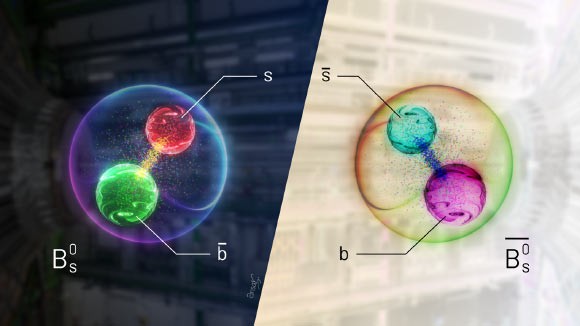
Here is the gritty detail. Neutral beauty mesons are unstable. They are made of a beauty antiquark paired with a down-type quark. But they have a quirks: they can spontaneously swap identities. A meson turns into its own antiparticle, then swaps back. Again and again.
By watching how often the matter version decays versus how often the antimatter version decays, we get a number. A tiny difference. That difference is Charge-Parity violation. It’s the smoking gun we’ve been looking for.
But measuring it is a nightmare.
The researchers analyzed proton-proton collisions collected between 2022 and 2025. That is recent. Very recent. They reconstructed specific decays of roughly 1.4 million B0 mesons and 16,000 B0s mesons.
The B0s contain a strange quark, not a down quark. Small difference? No. Huge distinction for the data.
The hard part? Pinpointing which was which the instant it was born. Before it decayed into a J/ψ meson and a neutral kaon.
Previous methods were clumsy. This time? They used artificial intelligence.
The algorithm looks at muons, electrons, and jets from the collision event. For the B0s, it checks nearby particles too. It builds a picture of the initial state. The result? A significantly sharper identification of the meson’s origin. Less noise. More signal.
Why does this matter?
“The measured CP violation is in line with predictions of the Standard Model.”
That sentence should make physicists nervous.
Or relieved. Depends on how you look at it.
The data aligns with the Standard Model. The CP violation measured in the decay of a B0s particle into a J/psi and a neutral kaon is the most precise ever recorded. It fits. It fits perfectly.
And that’s a problem.
If the Standard Model explains all the imbalance, then it’s a tidy, boring explanation. It implies the math we already have is correct, and we’re just refining the numbers. But the imbalance was massive. The Standard Model’s predicted CP violation isn’t big enough to account for all the matter in the universe.
So either the measurement is missing something. Or there’s new physics lurking just beyond the current model, hiding in the errors we haven’t caught yet.
This isn’t just an incremental update. It’s a stress test. A decades-old hypothesis got a major upgrade. The CMS team didn’t just confirm the imbalance; they tightened the noose on the theories that try to explain it.
We have more data now. Better data. AI-washed, high-precision, beautiful messiness of 1.4 million decays. The question remains: does the math hold? Or is the universe hiding something deeper in the decay patterns?
We’re looking closer than ever. And the answer isn’t as clean as we’d hoped.