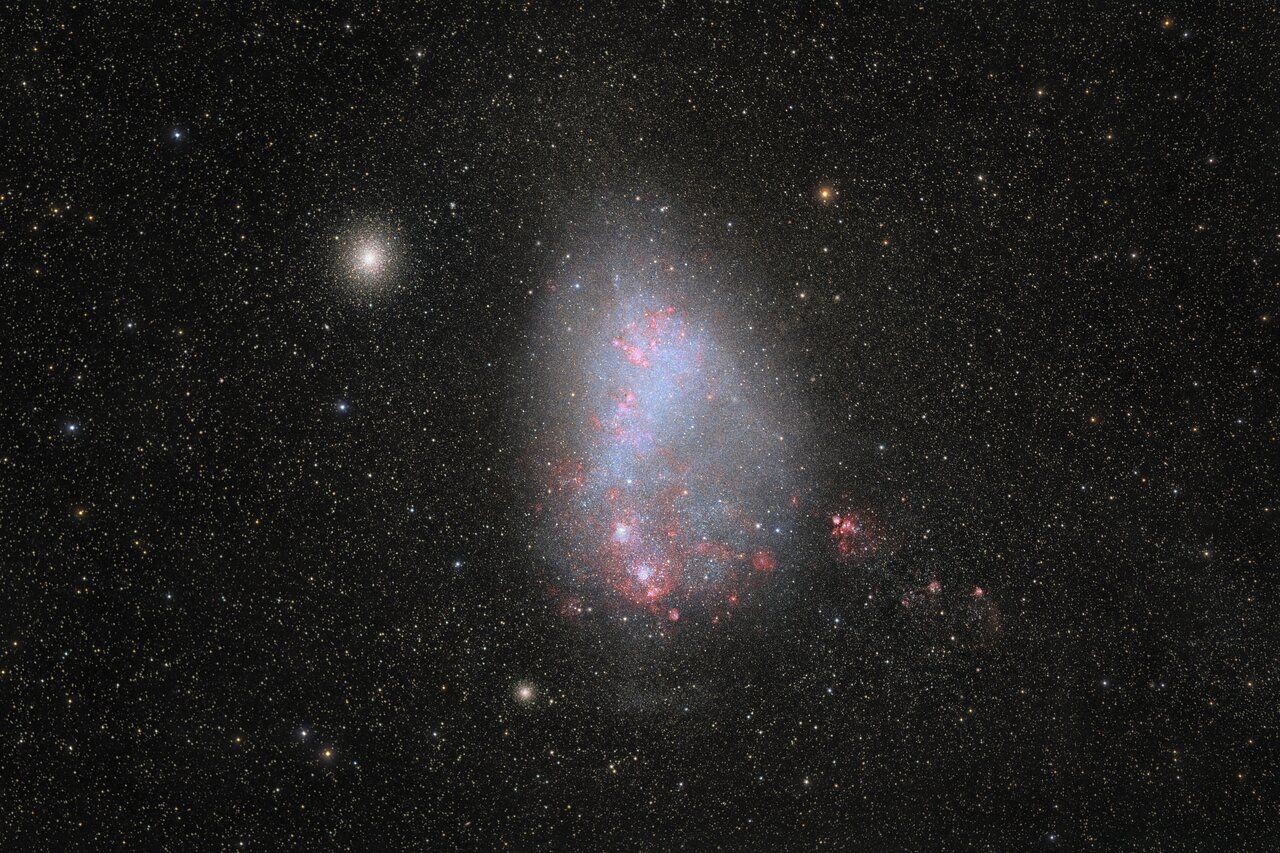
A breathtaking new image of the Small Magellanic Cloud (SMC) is challenging perceptions of what amateur equipment can achieve. While the photograph possesses the clarity and detail typically associated with multi-billion dollar space telescopes, it was actually captured from the ground using a standard camera and a telephoto lens.
The Subject: A Neighbor in the Cosmos
The Small Magellanic Cloud is a dwarf galaxy containing hundreds of millions of stars. Although it is categorized as a “neighbor” to our own Milky Way, it remains incredibly distant, situated approximately 200,000 light-years away.
Despite this vast distance, the SMC is bright enough to be visible to the naked eye from the Southern Hemisphere. This proximity and brightness make it a prime target for astronomers and astrophotographers alike, serving as a gateway for studying how smaller galaxies interact with larger ones like our own.
Technical Achievement: From Earth to the Stars
The image was captured by Petr Horálek, a NOIRLab Audiovisual Ambassador, atop Cerro Pachón in Chile. Far from using the sophisticated sensors of a satellite orbiting in deep space, Horálek utilized:
– A high-quality camera
– A wide-aperture telephoto lens
– Four hours of dedicated exposure time under dark Chilean skies
The result is a level of detail that mimics the output of professional observatories. This feat highlights the growing intersection between professional science and high-end consumer technology, proving that with patience and the right optics, the “impossible” can be captured from a terrestrial vantage point.
Bridging the Gap Between Science and Public
This achievement is part of a larger effort to democratize space science. Horálek’s work is supported by the NOIRLab Ambassador program, a collaborative initiative involving the Vera C. Rubin Observatory.
The program’s goal is to bridge the gap between complex astronomical research and the general public. By using accessible tools to produce professional-grade imagery, ambassadors help translate the silent, distant wonders of the universe into something tangible and awe-inspiring for local communities.
This image serves as a powerful reminder that the tools for discovery are becoming increasingly accessible, turning the night sky into a laboratory for anyone with the right lens and enough patience.
Conclusion
By capturing a high-detail view of the Small Magellanic Cloud using terrestrial telephoto equipment, Petr Horálek has demonstrated the remarkable potential of modern astrophotography. The image not only showcases the beauty of our galactic neighbors but also underscores the success of initiatives aimed at bringing space science closer to the public.