


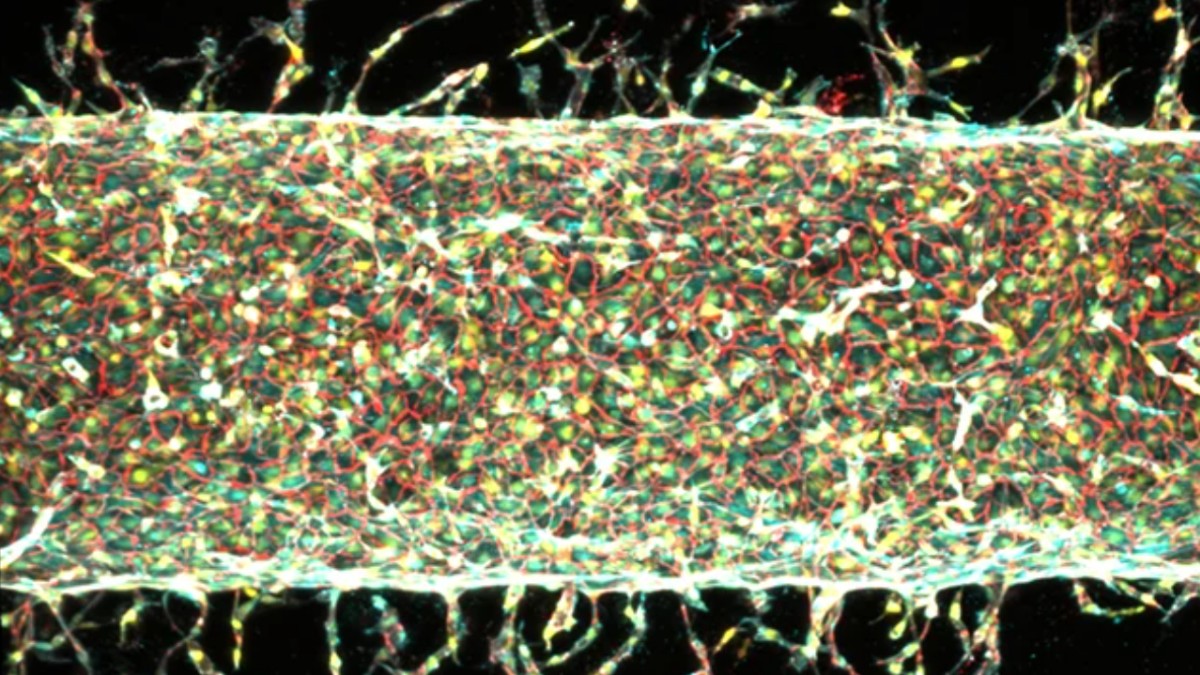
Lab-grown organs are the holy grail of regenerative medicine. We want replacements. We want cures. But biology is messy. Building a heart in a dish is harder than it looks. Especially the plumbing.
Blood vessels. Specifically, the capillaries.
These microscopic threads are essential. They deliver oxygen. They feed nutrients. Without them, lab-grown tissue dies. The problem? They’re tiny. Capillaries can measure just 0.005 millimeters across. Thinner than a human hair by a factor of 34. Blood cells can’t squeeze through side-by-side. They go single file.
For years, scientists have struggled to engineer these networks with precision. Chemical cues help, sure. You can drip growth factors onto a Petri dish. But chemicals diffuse. They’re messy. You can’t direct the flow with high resolution.
Now, MIT researchers have a new tool. Magnets.
In a study published in PNAS, the team details how they use magnetic forces to stretch and guide blood vessel cells into specific shapes. It’s not magic. It’s mechanics.
The Mechanics of Magnetic Angiogenesis
The setup sounds simple but requires precision engineering.
Think of a microchip. Inside this chip, endothelial cells are suspended in a collagen gel. Collagen is the body’s main structural protein. It provides the scaffold. Embedded within this mix is a tiny magnet.
External magnets surround the chip. These external fields can be manipulated in three dimensions.
“The ability to program blood vessel growth with physical clues may enable reproducible and scalable fabrication.”
— Ritu Raman, MIT Mechanical Engineer
Here’s how it works: The external magnets pull on the internal magnet. This pull transfers to the cells. The researchers stretch the developing vessel network back and forth.
This mechanical force triggers a biological response. It enhances the number of new capillaries.
“We thus need other types of patternable clues that can help us build tissues with ordered vessels,” Raman notes. Chemical patterns are too broad. Magnetic pulling is targeted.
How Mechanical Forces Trigger Growth
The team didn’t just guess this would work. They looked at the mechanism.
Blood vessel formation is called angiogenesis. Scientists know mechanical pressure affects it. But how?
To find out, they used cells engineered to lack the PIEZO1 gene. This gene codes for ion channels. Think of these channels as cell gatekeepers. They respond to physical pressure.
When PIEZO1 was removed, fewer blood vessels formed. The difference was stark. This confirms that ion channel activation is critical. The cells feel the magnetic pull. They respond. They grow.
By adjusting the magnetic field strength, the researchers controlled the outcome. Want shorter vessels? Adjust the pull. Want longer? Increase it. Want more branches? Modify the direction.
It’s a level of control previous methods couldn’t match.
3D printing helps. But it often lacks the cellular integration needed for functional tissue. Chemical seeding is passive. Magnetic steering is active.
Why This Matters for Artificial Organs
We’re still early in this process. Prototype stage. The initial results are promising, though.
The goal is clear. Implanted tissues. Engineered organs that restore function after injury or disease.
But an engineered heart with no blood supply is just a meat cube. It needs perfusion. It needs flow.
Raman’s team emphasizes that healthy tissues depend on organized vascular networks. State-of-the-art protocols often fail here. They create the cells, but not the structure.
This new approach bridges that gap. It offers a way to fabricate tissues that are not just biologically compatible, but functionally viable.
The next step isn’t just growth. It’s function.
The researchers will now test blood flow. They need to see if the created arteries and veins actually pump. If the capillaries deliver oxygen under pressure. They’re starting with muscle tissue.
“We are now investigating how precisely patterning vessel growth can help improve muscle functioning,” says biomedical engineer Jessica Shah.
Imagine a patch of heart muscle that heals because it has its own immediate blood supply. Or skin grafts that integrate instantly because they’re already vascularized.
The physics is sound. The biology checks out. The magnets are pulling.
But will it scale? Can we build a whole kidney this way? Or just the vascular tree within it?
The answer isn’t in the magnets. It’s in the next round of experiments. Blood flow. Real perfusion. Living tissue.
We’re closer. But the capillary beds are still microscopic. And biology, for all our tools, remains stubbornly complex.


