The James Webb Space Telescope keeps finding things it shouldn’t be able to find. Like a supermassive black hole that apparently popped into existence before the galaxy holding it even figured out who it wanted to be.
This messes up the script.
For years, the accepted cosmic timeline was simple enough. Stars form. Stars die. Collapsed cores become stellar black holes. They eat. They merge. Given billions of years of aggressive gluttony, they grow into the supermassive monsters anchoring the centers of modern galaxies. It was a linear, patient process.
Webb is telling us we got the order wrong.
Little Red Dots
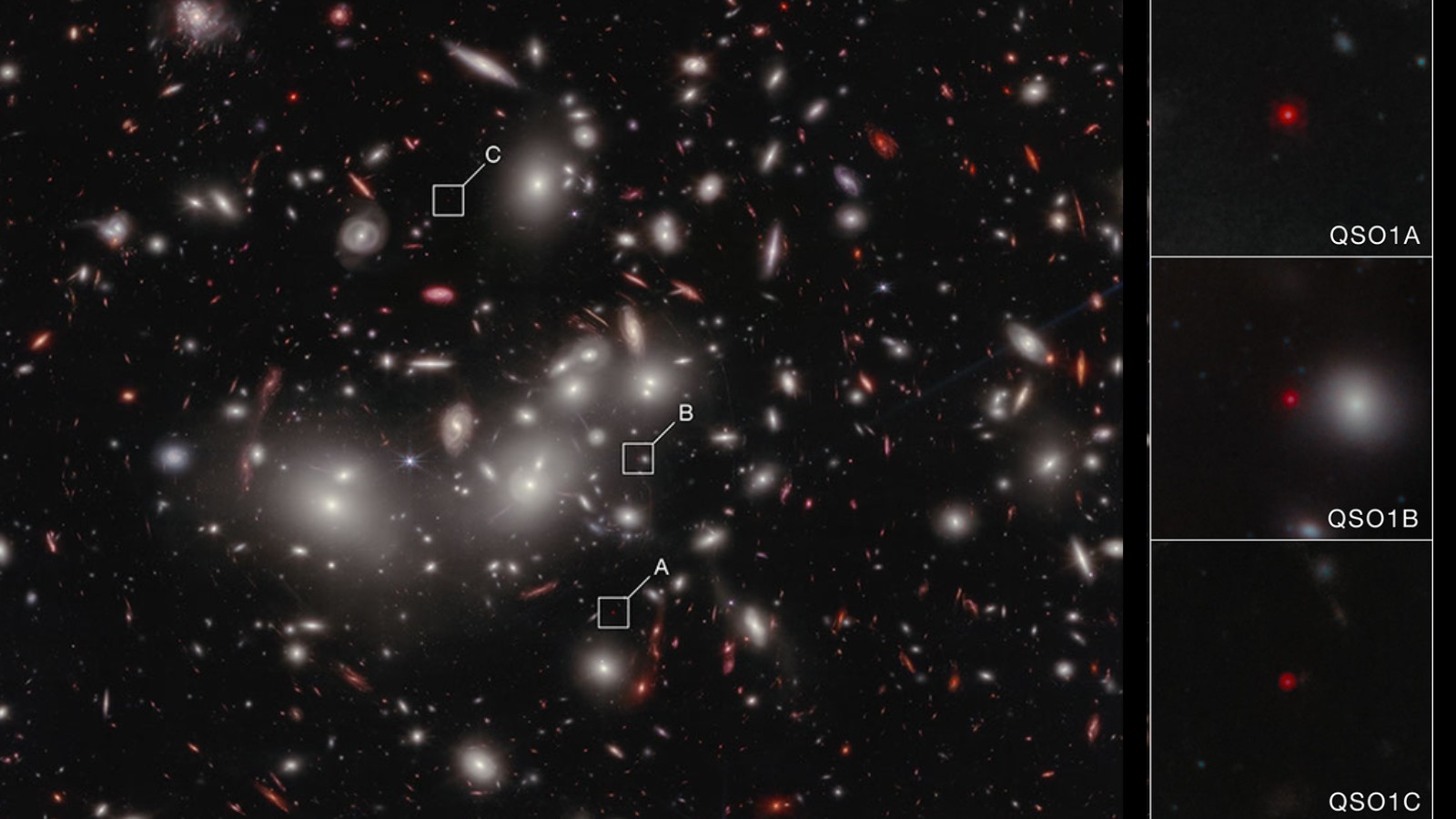
Back in 2022, JWST astronomers found something odd in the data. Compact, dusty blobs they jokingly named Little Red Dots. At first, they thought it might be a new galaxy type. Then they realized how common these things were in the infant universe, only to vanish roughly 1.5 billion years post-Big Bang.
But the real headline isn’t the dots. It’s what’s inside them.
The $10 billion observatory has pulled out supermassive black holes dating to when the universe was barely a baby—under 1 billion years old. Here is the problem. The known recipes for growth, involving feeding on gas or merging with smaller black holes, just don’t have time to work. A black hole millions of times heavier than our Sun shouldn’t exist that early. It’s mathematically rude.
The new study suggests a radical fix: these black holes didn’t start small. They were born huge. Directly. Without needing a massive star to collapse first, without waiting for millions of years. And critically, without needing to gorge on material from a host galaxy that hasn’t finished assembling itself yet.
“This is a paradigm shift,” Roberto Maiolino from the University of Cambridge says. “A total revisiting of the classical scenarios.”
They published this in Nature and MNRAS. Not exactly a casual observation.
Einstein Did the Heavy Lifting
To prove this, the team stared at one specific Little Red Dot: Abell2744-QSQ1.
It sits 700 million years past the Big Bang. Its light has been traveling for over 13 billion years just to reach us. The object is tiny—only about 1,300 light-across—but it’s loud.
Studying it would be impossible under normal circumstances. Except for Einstein.
Gravitational lensing bent the light from QSO1. The Pandora’s Cluster (Abell 2744), sitting between us and the distant dot, acted as a magnifying glass. Warping spacetime. Curving the light paths. It let Webb see details otherwise blurred into invisibility.
Initially, the data suggested QSO1 housed a black hole 40 million times the mass of the Sun, wrapped in hydrogen and helium gas. But previous measurements of early universe black holes were indirect guesses based on how local universe black holes behave. Dangerous assumption, that. Maybe the baby universe plays by different rules.
So they checked the gas motion.
Using JWST’s NIRSpec instrument, they mapped how the gas moved around the central mass. If the mass were spread out—like a bunch of stars clumping together—the gas would drift chaotically. Instead, the gas moved with perfect Keplerian motion. It orbited a single, dense center exactly like planets orbit the Sun.
Which means the mass isn’t spread out. It’s concentrated. All of it.
“Ignas Juodžbalis, another team co-leader, put it plainly. If there were a lot of stars involved, you wouldn’t see this rotation. The gas only behaves this way when there’s one massive anchor at the heart.”
They could finally weigh it. Directly.
Born Big
The number came back at 50 million solar masses.
Here is the kicker: that single black hole accounts for 66% of the Little Red Dot’s total mass.
In our modern local universe, supermassive black holes make up a tiny fraction of their galaxy’s weight. QSO1 flips that ratio thousands of times. The black hole isn’t a passenger in the galaxy. The galaxy is currently forming around the black hole.
Which leaves one nagging question: where did it come from?
A collapsed star is off the table. The math doesn’t support gradual feeding. The team leans toward two theories. One, it grew from a “heavy seed” formed by the direct collapse of a gas and dust cloud. Two, it was birthed in the immediate, chaotic moments of the Big Bang itself, via a mechanism physics doesn’t yet name.
Either way, the sequence of events we taught in textbooks looks like fiction. The host arrives late to the party.
The team thinks QSO1 isn’t a one-off glitch. They suspect most Little Red Dots share this quirk: black hole first, galaxy later. Now they’re going to check the others. See if the universe is consistently breaking its own rules.