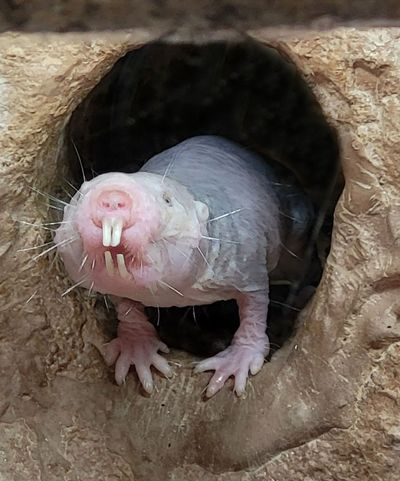
They look like they were rejected by evolution. Pink, wrinkled, and largely hairless, the naked mole rat (Heterocephalus glaber ) is one of those creatures that forces you to double-check the textbook. This burrowing rodent belongs to the family Bathyergidae and is defined by its oddball appearance. Despite the name, they aren’t completely bare. They have about 100 fine, whisker-like hairs scattered across their skin. These tiny sensors help them navigate the pitch-black world underground where sight is useless.
Their heads are built for hard labor. Broad and muscular, they house powerful jaws anchored by four prominent incisors. These teeth are their primary tools, designed for excavating dirt and maneuvering through tight spaces. But the real reason scientists obsess over this little animal isn’t its digging technique or its resemblance to a raw sausage. It’s the biology. Naked mole rats live significantly longer than other rodents. They rarely get cancer. And they live in a society that mimics human civilization in ways that are still poorly understood.
Subterranean Architecture in East Africa
You won’t find these animals in a pet store or a zoo exhibit. They live underground in the grassy, semiarid regions of East Africa. Their range includes Ethiopia, Kenya, Somalia, and Djibouti. Here, they construct massive, complex tunnel systems that can stretch up to 4 kilometers (2.5 miles) long and dig as deep as 2 meters (6.5 feet).
The engineering is relentless. Each tunnel is roughly 4 centimeters (1.5 inches) in diameter. The rats create these passages by gnawing through soil with those specialized front teeth. It’s a coordinated effort. They sweep the excavated dirt up to the surface in an assembly-line fashion, keeping the tunnels clear. These tunnels aren’t just holes in the ground; they are interconnected chambers. Some are for nesting. Others serve as nurseries for the young. Others are stocked with food. It is a structured habitat, not a chaotic warren.
Why the Naked Mole Rat Matters
The naked mole rat is a biological anomaly. Most small mammals die young. A mouse might live two or three years. A naked mole rat can live over 30. That is an outlier in the mammalian world. And cancer? It’s practically nonexistent in them. Their cells produce a unique form of high-molecular-weight hyaluronan that stops tumors from forming. This isn’t just a quirky fact for a trivia night. It’s a potential key to human medicine.
“Naked mole rats are renowned for their long life spans, low cancer rates, and colonial habit.”
Understanding how their bodies resist aging and disease could rewrite our approach to human health. But before we can apply their biology to ourselves, we need to understand the environment that shaped them. Their underground world is harsh. Low oxygen. High carbon dioxide. Resources are scarce. This pressure likely drove the evolution of their social structure and their cellular repair mechanisms.
They live in colonies. One queen. Many workers. A few breeding males. The rest are sterile workers who dig, forage, and defend. It’s a eusocial system, rare among mammals. Only naked mole rats and the Damaraland mole rat exhibit this level
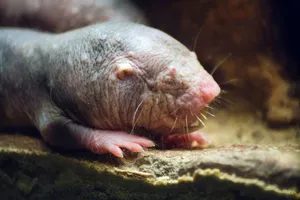
Forget the fur. The naked mole rat looks more like a wrinkled, pink earthworm than a mammal. They are tiny things, usually hovering around 7.5 cm long and weighing just 28 to 42 grams. But in the dark, pressurized tunnels of East Africa, that size is irrelevant. What matters is the biology.
These rodents have evolved to survive where nothing else can. Their eyes are so small they are practically blind. They lack external ears entirely. In fact, their inner ears are missing the structures needed for cochlear amplification, meaning they have lost the ability to hear high-frequency sounds that boost noise before it hits the brain. Hearing is dead. Vision is gone. Instead, they feel the world.
Fine hairs all over their bodies act as sensitive whiskers, detecting air currents and vibrations in the tight burrows. Their short legs are built for squeezing through dirt. And their teeth? They are essentially tactile sensors. Nearly one-third of the somatosensory cortex in their brain—the part that processes touch—is dedicated exclusively to their teeth. One-quarter of their total muscle mass is concentrated in their jaws. They are built to bite and feel, not to see or hear.
Eating to Live Underground
Naked mole rats are herbivores. They don’t hunt. They don’t chase. They eat roots and tubers found underground. But the soil is tough. Digging for food is an exhausting, energy-draining process. To survive, they have to be efficient.
If they find a large tuber, they don’t destroy it. They eat the inside, leaving the outer skin intact. The tuber stays alive. It continues to grow. The colony returns to it later. It is a sustainable food source, far more reliable than a one-time meal.
They don’t need to dig for water either. The moisture from their plant-based diet is enough. But the energy cost of digestion and nutrient absorption is high. So, they practice coprophagy. They reingest their feces. It sounds gross, but it is a biological necessity to maximize every calorie and nutrient they can extract from poor-quality food.
The Queen and the Colony
This is where things get strange. Naked mole rats are one of the few truly eusocial mammals. This means they live in large, hierarchical colonies where almost everyone works for the benefit of a few breeders.
At the top is the queen. She is the only female who reproduces. She mates with a few selected males and can produce litters four or five times a year. An average litter has about 12 pups, but it can swell to 30. That is one of the largest litter sizes for any mammal.
The rest of the colony has jobs. Workers are smaller, about 35 grams. They dig, gather food, and care for the young. Soldiers are bigger, around 55 grams. Their size is a weapon. They use their bulk and large teeth to protect the queen and the colony from snakes and other predators.
The colony’s structure isn’t just social. It is thermal. Naked mole rats cannot regulate their own body temperature. They are poikilothermic, like reptiles. In the cold, crowded tunnels, they huddle together in massive groups to conserve heat. The colony itself is the heater.
Defying the Laws of Aging
Most mammals follow the Gompertz law. Developed by Benjamin Gompertz, this mathematical equation states that the risk of dying increases exponentially with age. In humans, that risk doubles every eight years after age 30.
Naked mole rats break this rule.
They can live for 10 to 30 years. Other small rodents live for a few years. The naked mole rat’s chance of dying appears to remain constant throughout its entire life. It does not increase with age. They do not age in the traditional sense. They just… exist. Longer.
The International Union for Conservation of Natural Resources lists Heterocephalus glaber as a species of least concern. They are not endangered. But they are certainly unique.
The Cancer Resistance Mystery
Why do they live so long? Why don’t they get sick?
Research points to one key factor: resistance to tumorigenesis, the formation of malignant tumors. While a few cases of cancer have been reported in naked mole rats, the incidence is significantly lower than in other animals of similar size, including humans.
The secret lies in a sugar molecule called hyaluronan. This molecule is present in all animals, helping cells maintain structure. But in naked mole rats, it is different. The molecules are enormous—about five times larger than those found in mice, rats, or humans.
These supersized hyaluronan molecules do not break down as quickly as they do in other species. They create a crowded cellular environment that physically prevents cells from clumping together to form tumors. It is a natural barrier against cancer.
Is it a cure for human cancer? Maybe not directly. But it is a clue. A biological blueprint written in DNA, hidden in a blind, hairless rodent living in the dark. We are still trying to read it.