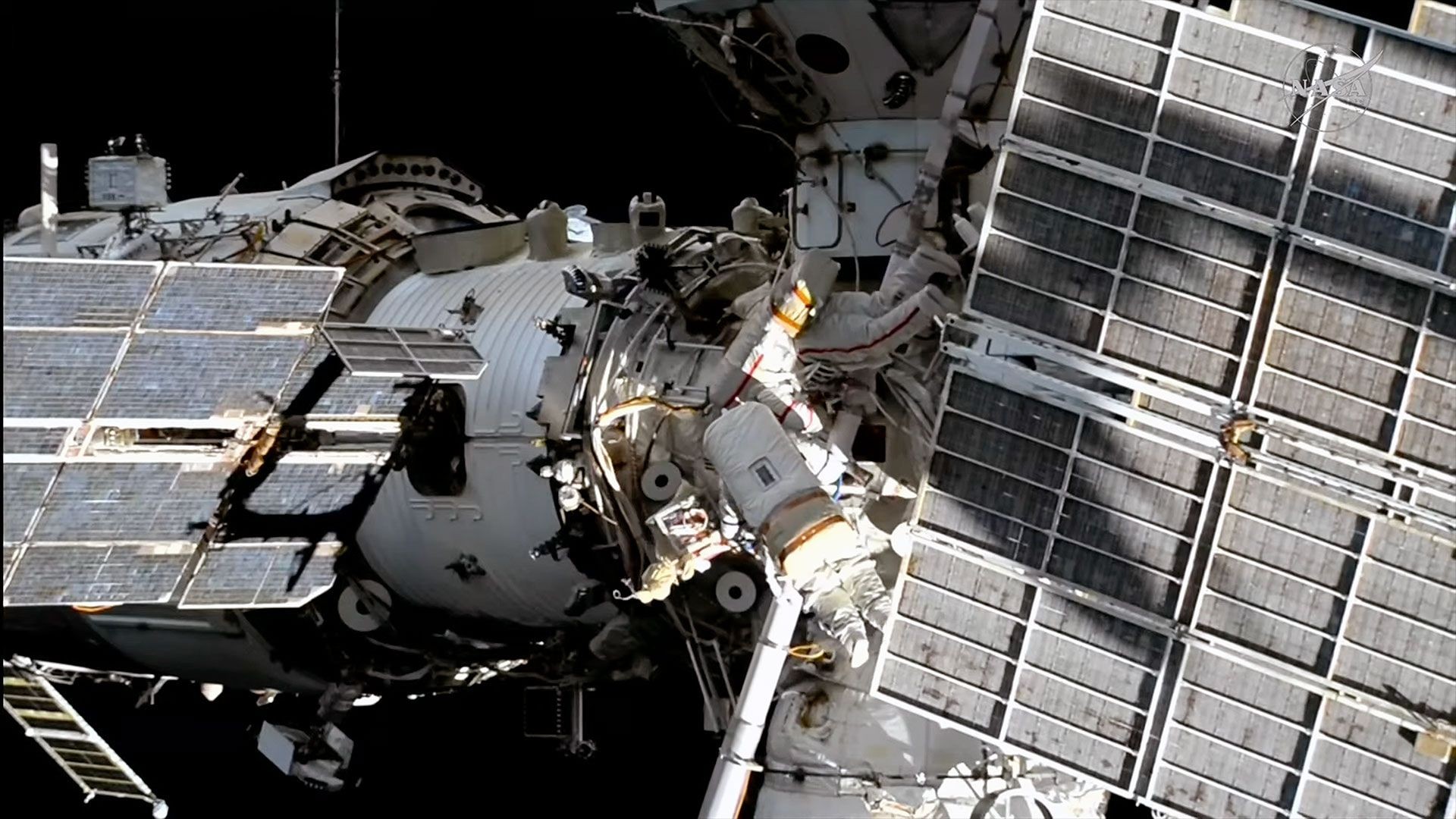
They went out. The sky is cold up there, vacuum doesn’t care if you’re having a bad day, but today it seemed manageable enough for the two cosmonauts manning the airlock on Wednesday. May 27. The clock ticked from 10:18 a.m. until just after 4 p.m. Eastern Daylight Time. That is 6 hours and 5 minutes of floating in the void, tethers humming with the weight of the station orbiting below them.
Expedition 74’s commander Sergey Kud-Sverchkov paired with flight engineer Sergei Mikaev for the Extravehicular Activity, EVA for short, which is just fancy talk for walking where humans aren’t meant to tread. They had a list.
First item on the docket was a new eye on the sun, specifically a telescope named Solntse-Teragerts, clamped onto the outside of the Zvezda service module. This device isn’t looking for stars; it is staring hard at the sun’s violent moods.
The goal? Capture data on strong solar flares. The kind that knock out power grids. This hardware will run through 2028, helping scientists refine prediction models before the next big flare hits. Simple concept, heavy science.
Then came the ride.
Not the kind with music, but the sort that puts you on the end of a mechanical limb. They hitched a ride on the European Robotic Arm (ERA). It stretches forty feet long, twelve meters of precision steel and joints, carrying the two men over to the Nauka mini-research module like toys being swapped across a playroom table. There they needed a cassette from the Ekran-M experiment. Inside that container are ultra-thin films made from gallium arsenide, grown so pure in the microgravity environment that you couldn’t replicate them here on Earth, the weight just messes up the crystal structure.
But hardware fails. Space is hostile.
They tried to get the cassette. It stuck. Then a pair of pliers fell, tumbling silently away into the darkness. Then ground control sent commands to the experiment’s interior mechanisms that did nothing at all, the gears refused to bite. Panic is expensive and stupid, so they didn’t do it. Instead, they worked around the problem. Found another angle. Pried it loose eventually, securing the sample to bring back inside where it belongs.
While hanging out there in the silence, Kud-Sverchkov stopped. They took a moment for RKK Energia, Roscosmos’ old design bureau, turning 80 years old this month. August 1946 sounds like forever ago, but space history is young. The duo held up a card with the anniversary logo and smiled for the cameras.
Not long after Kud-Sverchkov drifted over and asked Mikaev what day it was.
“The 27th.”
“Today is St. Petersburg’s birthday.” Kud-Sverchkov sent out congratulations to the city’s residents, calling it our northern capital, a soft moment amidst the technical grind.
They moved on to Poisk to check on the Progress MS-33 cargo ship, specifically the Kurs antenna that refused to open back in March. It was broken then, so the crew docked by hand. Now they photographed it and tightened it up. No fanfare. Just fixing things.
Finally the cleanup.
A Biorisk container got pulled inside, filled with bacteria and seeds. A bundle of dirty window sponges got tossed into orbit to burn up later. Everything on the checklist got crossed off, even if some boxes had to be checked with duct tape and stubbornness.
Kud-Sverchkov is the veteran here, now logging over twelve hours of his life in the vacuum. Mikaev, his first time. Does it get easier? Or does it just become routine. We’ll see when they pull off the gloves.