This week’s science roundup feels like digging through a junk drawer that somehow holds the keys to ancient secrets, planetary doom, and a cheap way to kill tumors.
It started in Laos.
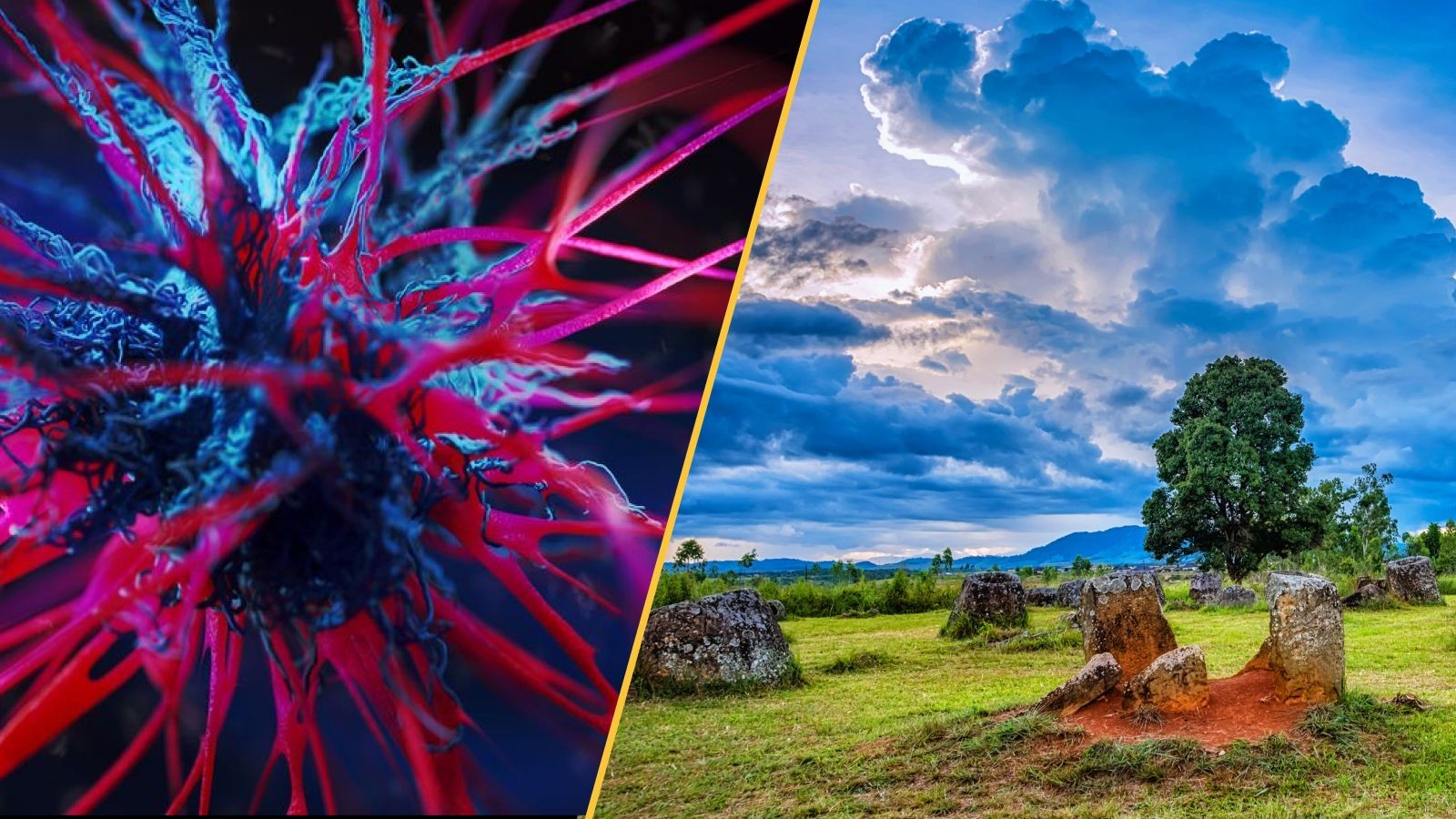
For nearly a century, the Plain of Jars has just… sat there. Two thousand hollowed-out stone urns scattered across the Xieng Khouang highlands. Archaeologists stared at them. Shrugged. Wondered.
Now they stopped shrugging.
They looked inside.
One jar held the bones of at least 37 people. Hundreds of jars later? The site was a massive burial complex. A place to worship ancestors for generations. Not storage for rice. Definitely not storage for jars. Just death. Very old, very deliberate death.
Speaking of dead people hiding secrets in dirt—this week was heavy on graves. Satellite maps found circular mass graves older than the Egyptians. Down under, Australian ancestors spent 500 years feeding their pet dingo’s grave. In Poland, skeletons were caught in an eternal hug, revealed as a same-sex burial. Out in the Arctic? Poor 17th-century whaler remains show how brutal the ice was.
And just like that, we finally have an answer for why the Giza pyramids haven’t crumbled after 4,600 years of sand and wind.
The heat is on rice
Global warming is moving 5,000 times fast.
Faster, at least, than rice can evolve.
That is the bad news.
Nicolas Gauthier, from the Florida Museum of Natural History and the rest of us, analyzed 9,0000 years of data. The conclusion is harsh. We are hitting a hard temperature ceiling for rice growing regions. We call it the thermal limit.
If you break it, rice breaks.
A billion people eat this stuff. They make their living from it. The farmers are standing at the edge of a cliff, staring down at temperatures that crops just won’t handle. Gauthier said we’re getting “closer to the limits of whatwe can reasonably adapt to.”
Reasonable adaptation. That sounds comfortable until you realize the thermometer isn’t moving reasonably.
A pill for two problems
Here’s something weird.
Montelukast. You probably know it as an asthma drug. Cheap. Common. For allergies, too.
It also fights cancer.
Specifically the hard-to-treat kind. Triple-negative breast cancer. The kind that shrugs off standard therapy. Early lab tests showed the drug stops tumors from hijacking immune cells. It untangles the knots that let cancer resist immunotherapy.
Scientists want to test it in patients now.
Imagine buying your cancer med at the corner pharmacy next to the Tylenol. It might actually happen.
What’s under your feet (and in your head)
How hot is Earth’s core?
Scorching. It’s been scorching since the heavy stuff sank down when the planet was still a floating ball of molten rock. But how do you measure fire that is thousands of miles down? You can’t put a thermometer in the mantle. Science had to get clever to find out.
Is the oldest art really the oldest?
We thought we knew about prehistoric art.
Specifically, that painting in Indonesia. Dated to 67,808000 years old using uranium-thorium dating. A technique that measured radioactive decay. It generated headlines. It changed history books.
Now, a new study says the math is shaky.
Maybe not flawed, just… shaky. The dates might not be what they seem. Is the science behind the timeline broken? Live Science checked it out. The verdict: doubt is real. The headlines need a rethink.
The weekend read
If you need to escape or educate yourself over the long weekend:
- Colorectal cancer in young people isn’t a glitch, it’s a pattern. Here is what is driving it.
- Ebola in Central Africa. Experts warn it will be a nightmare.
- The Mongol Empire’s founder lives on in crossword clues. Solve for Genghis.
- Radio astronomers don’t just think aliens exist. They are convinced contact is imminent.
- Do you prefer “PMOS” over “PCOS”? Vote now.
A galaxy born in a blast
Look at the Whirlpool Galaxy.
It is beautiful. Messy. Violent.
Webb and Hubble combined their eyes for this one. You see colorful gas clouds? Those are nurseries. The bright-white spots? Stars blasting away their own cocoons. The big star clusters clear out the gas faster than the little ones do.
So the universe looks this way because the first stars were explosions that swept the board clean.
More news
- Negative time is real. Atoms confirmed it.
- China built the world’s biggest floating wind turbine. It powers 4,20000 homes a year.
- Singapore found a new jellyfish species. It is deadly. Do not swim.
- Thailand found the “Last Titan”. Longest-necked dinosaur in Southeast Asia.
- China has a mech robot. Four legs, then two. Transformer for the working class.
- AI models are eating all our data. Scientists found a way to stop the cannibalism.
“If you enjoyed this, you really need a weekend project. Maybe digging? Or reading?”