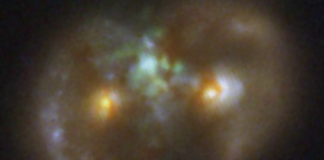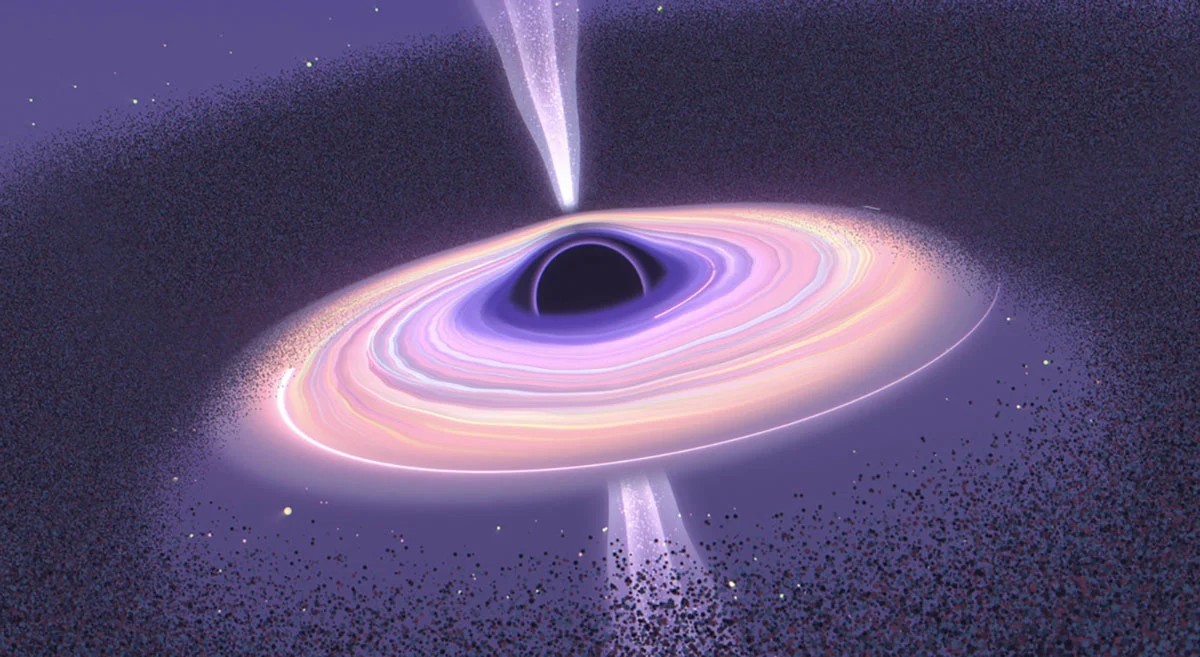
Galaxies collide. Stars fly. Gas explodes. But the real trouble happens at the center. Supermassive black holes dance together, tighten their grip, and merge. Usually, they stay put. Sometimes? They get kicked out. Hard.
Astronomers have chased these “recoiling” black holes for years. It’s hard to spot a runaway monster against the backdrop of a bright galaxy. A new team on arXiv suggests we stop looking just at the empty spot where the black hole used to be. Look at the black hole instead. Specifically, the dust it’s dragging behind it like a runaway bride with a messy veil.
The kick is physics
It comes down to Einstein. General relativity has a funny quirk. If two black holes have different masses, or if their spins are mismatched, the gravitational waves they spew out aren’t symmetrical. One direction gets a heavier push. Newton says equal and opposite. The new, merged black hole gets shoved in the other direction. Fast. Hundreds of kilometers per second. Maybe thousands. It becomes a cosmic speeder.
What sticks?
The inner accretion disk. That hot, swirling mess of gas right next to the event horizon doesn’t want to be left behind. It’s gravitationally glued to the black hole. This stuff creates the Broad Line Region (BLR). Fast gas, weird Doppler shifts. The theory isn’t new—simulations predicted it decades ago. The idea? If you move fast, you keep some dust. If you move slow, or aren’t moving at all, the dynamics differ.
The correlation is weirdly clean
The study checked the numbers. They found a link between the velocity offset (how fast the black hole is zipping away from its home galaxy’s core) and the amount of dust surrounding it. More speed, more dust? Seems counterintuitive, you might think. Or maybe it makes perfect sense depending on your physics frame of mind.
Did it hold up? Yes. Mostly.
The team ran a control. They looked at the Narrow Line Regions (NLR). The NLR is far out, loosely bound, supposed to be abandoned during the merger recoil. No correlation there. None. Exactly what they wanted to see. It proves the signal wasn’t just a statistical ghost or a fluke of the data fitting. The inner stuff stays. The outer stuff gets left in the dust. Literally.
“A modest but highly significant positive correlation”
Wait. There’s a glitch.
Blue-shifted black holes—the ones moving towards us—are actually more dusty than the red-shifted ones moving away. The pure recoil model says otherwise. You’d expect symmetry, or at least a different bias. The authors scratch their heads. Maybe the spectral fitting is biased? Maybe we don’t fully understand the physics happening at the same time? It’s an asterisk in the report, a little rough edge on a sharp finding.
Why bother?
Correlation isn’t causation. This is a statistical pattern, not a definitive photograph of a kick in progress. But think about what’s coming. LISA. ESA’s space-based gravitational wave detector. It will wake up soon and start screaming data.
The authors think up to 50 percent of the quasars we already know might be post-merger recoilers. Imagine that. Half the lights in the sky are runaways?
If so, we have a treasure trove waiting. We might finally have a way to track these titans not by where they aren’t, but by what they are. A dusty trail. A high-speed exit.
Will it change how we map the universe? Maybe. Will it solve everything? No. But for a clue, it’s pretty solid. And isn’t that all science ever really is? Clues, pieced together in the dark.