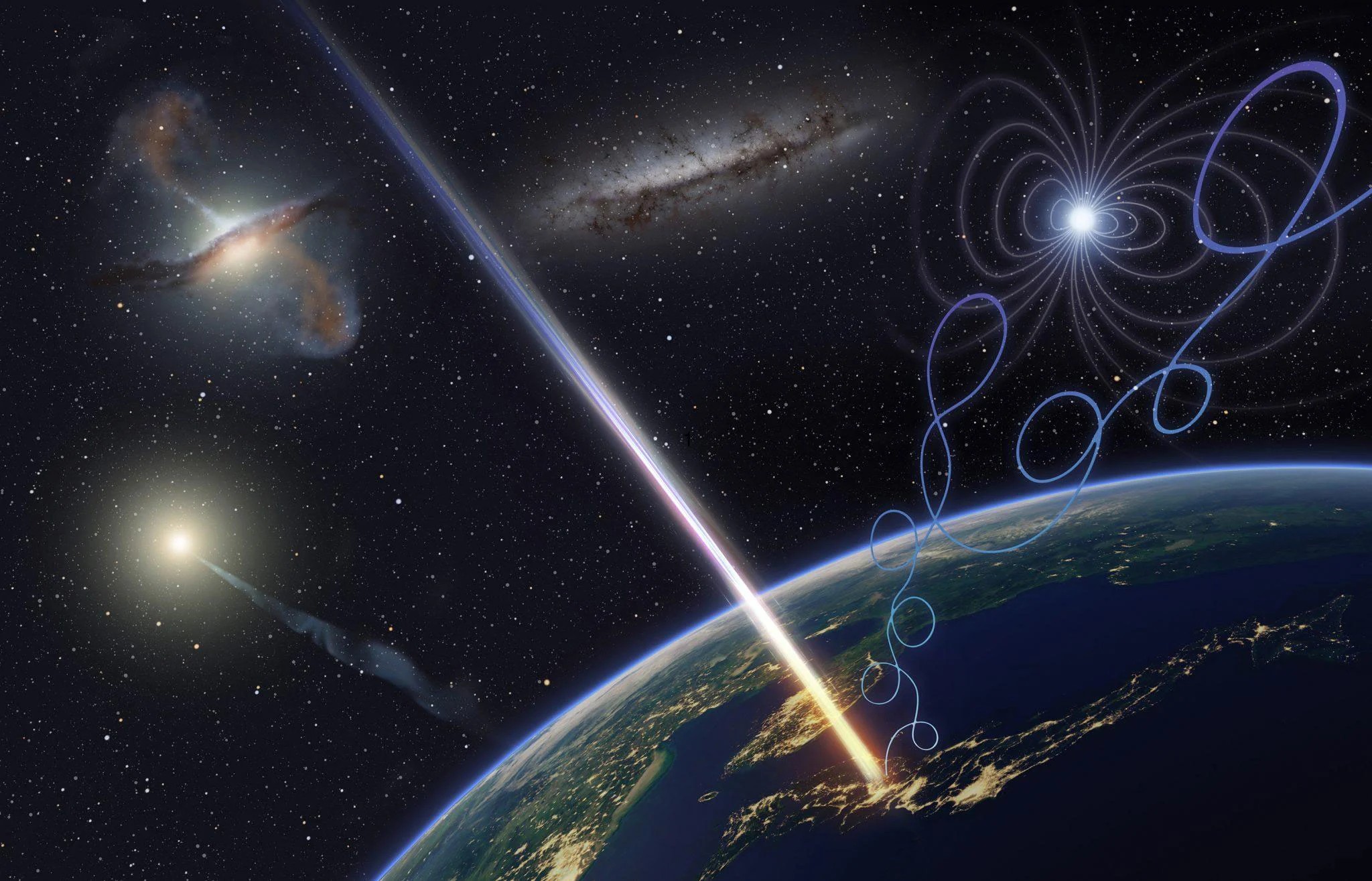
Some particles are weird. The Amaterasu particle hits Earth in Utah in 2021 with enough juice to rival a baseball thrown at professional speeds. It comes from nowhere.
Well. Not nowhere exactly. A giant cosmic void. An empty patch of sky where nothing interesting should be happening. Yet here comes this monster. Named after a sun goddess. Because why not?
We have been chasing these ghosts for six decades.
Iron Doesn’t Cut It
Standard theory says ultrahigh-energy cosmic rays come from protons or light stuff. Protons are tough, but they bleed energy fast. They slow down over the vast distances of intergalactic space like a sprinter running into headwind. If you see one on Earth, it probably didn’t come from far away. Or it started way, way faster than we think possible.
The Amaterasu event breaks the mold. Its energy rivals the famous Oh-My-God particle from 1991. Two hundred forty exa-electron volts. That is not a number your brain handles easily. It is roughly ten million times stronger than the Large Hadron Collider.
So what is it?
Researchers from Penn State think maybe it’s not a proton at all. Maybe it’s heavy. Much heavier than iron.
“Ultrahigh-energy cosmic rays lose energy more slowly if they are ultraheavy nuclei,” says Kohta Murase, leading the team.
That sounds counterintuitive. Heavy things should be harder to accelerate. But they also ride the cosmic voids differently. They hold onto their energy longer. They can survive the trip. A heavy bullet retains velocity better than a feather.
The Simulation Gap
To check this, they ran simulations. Computers crunching through intergalactic travel times and energy decay. The math points to nuclei with masses way up the periodic table. Stuff we rarely find flying around.
If this is true, the search for origins changes completely. We look for places that can sling heavy matter, not just lightweight ions.
Where do you get that?
Neutron star mergers. Binary stars dying together in a flash. Or massive stars collapsing into black holes with extreme magnetism. These are violent. Explosive. Perfect accelerators.
But wait. The Amaterasu direction shows a void. No star. No merger. Just… dark space.
That’s the kicker. Either the source is hidden behind something else. Or the magnetic fields in space bent the particle’s path so severely that the needle in the map is pointing at the wrong spot entirely.
Future Gazing
This doesn’t solve everything. It’s not a neat box with a bow. It just says: check the heavy stuff. Future telescopes like AugerPrime in Argentina will hunt for this composition. They’ll look for differences in the northern versus southern sky spectra.
If the sky is full of heavy nuclei, our understanding of high-energy physics gets a rewrite. We thought we knew the limit of human-made accelerators. Nature laughs. It packs kinetic energy of a tennis ball into a speck smaller than your eyelash and fires it at us from billions of light-years away.
Who knew emptiness could be so loud?
The particles keep coming. The detectors wait. We keep guessing.